A damaged army tank on the streets of Omdurman, Sudan. If the war between the armed forces and rival paramilitaries continues to fragment into a toxic mix of rival groups and ethnic conflicts, it will soon be out of their control to stop, even if they wanted to. Reuters
A damaged army tank on the streets of Omdurman, Sudan. If the war between the armed forces and rival paramilitaries continues to fragment into a toxic mix of rival groups and ethnic conflicts, it will


Sudan's unwinnable civil war must end


  • English
  • Arabic

April 17, 2024

Perhaps the most salient point at Monday’s international aid conference for Sudan was made by French President Emmanuel Macron, who said it was the world’s duty “not to forget what is happening” there. Sadly however, the brutal conflict raging for the past 12 months in Africa’s third-largest country has been out of sight and out of mind for far too many.

The Paris event ended with global aid pledges worth $2.1 billion. Although the gravity of the famine, displacement and poverty gripping Sudan make this commitment an important one, the fact remains that the war is not only continuing unchecked but risks fragmenting into an uncontrollable and unstoppable conflagration that will make aid efforts - let alone rebuilding - more difficult than they should be.

  • Rapid Support Forces commander Gen Mohamed Dagalo, then deputy head of Sudan's sovereign council, gives a media briefing in Khartoum in February last year. Reuters
    Rapid Support Forces commander Gen Mohamed Dagalo, then deputy head of Sudan's sovereign council, gives a media briefing in Khartoum in February last year. Reuters
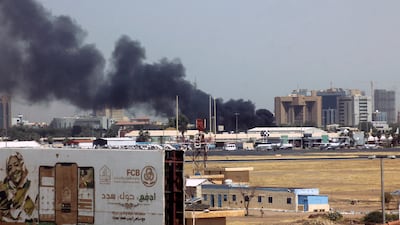
  • Smoke rises after blasts in Khartoum amid clashes between the Sudanese Army and the Rapid Support Forces paramilitary on April 15 last year. AFP
    Smoke rises after blasts in Khartoum amid clashes between the Sudanese Army and the Rapid Support Forces paramilitary on April 15 last year. AFP
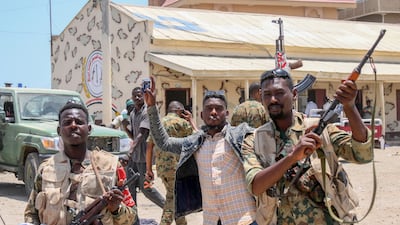
  • Sudanese Army soldiers at the Rapid Support Forces base in Port Sudan on April 16 last year. AFP
    Sudanese Army soldiers at the Rapid Support Forces base in Port Sudan on April 16 last year. AFP
  • Black smoke covers the sky over Khartoum as clashes continued on April 19. AFP
    Black smoke covers the sky over Khartoum as clashes continued on April 19. AFP
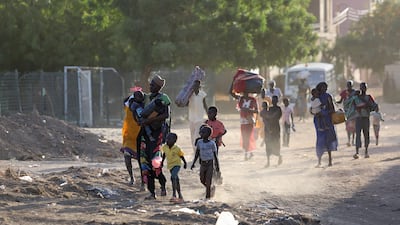
  • Displaced Khartoum residents flee the city after a 24-hour truce collapsed on April 19. AFP
    Displaced Khartoum residents flee the city after a 24-hour truce collapsed on April 19. AFP
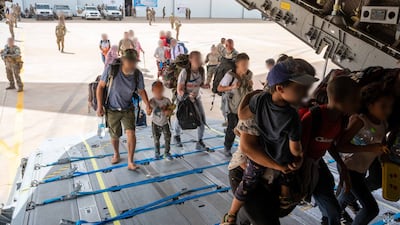
  • Foreign citizens board a plane at a French military air base in Khartoum to leave Sudan on April 23. AFP
    Foreign citizens board a plane at a French military air base in Khartoum to leave Sudan on April 23. AFP
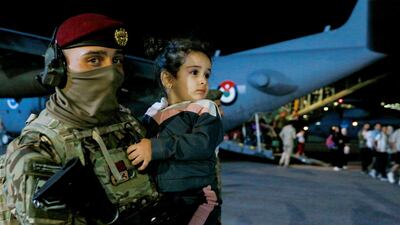
  • A soldier carries a child as people evacuated from Sudan disembark from a plain at a military airport in Amman on April 24. AFP
    A soldier carries a child as people evacuated from Sudan disembark from a plain at a military airport in Amman on April 24. AFP
  • Evacuees from Sudan sit in a military plane as they wait to be processed by Kenyan troops in Nairobi on April 24. Reuters
    Evacuees from Sudan sit in a military plane as they wait to be processed by Kenyan troops in Nairobi on April 24. Reuters
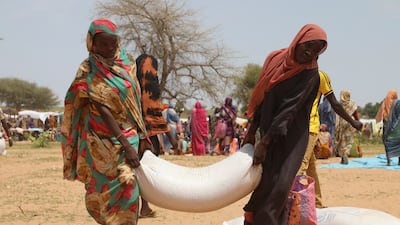
  • Sudanese refugees gather to receive humanitarian aid in Koufroun, Chad, on April 30. AFP
    Sudanese refugees gather to receive humanitarian aid in Koufroun, Chad, on April 30. AFP
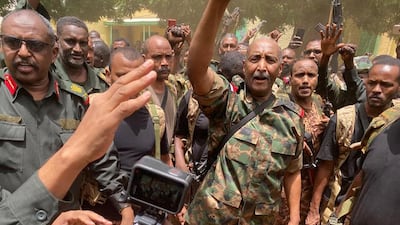
  • Sudanese Army chief Gen Abdel Fattah Al Burhan visits troop positions in Khartoum on May 30. AFP
    Sudanese Army chief Gen Abdel Fattah Al Burhan visits troop positions in Khartoum on May 30. AFP
  • Sudanese refugees at the Zabout camp in Goz Beida, Chad, on July 1. AP
    Sudanese refugees at the Zabout camp in Goz Beida, Chad, on July 1. AP
  • Smoke rises from a fire at a lumber warehouse in southern Khartoum on June 7. AFP
    Smoke rises from a fire at a lumber warehouse in southern Khartoum on June 7. AFP
  • People prepare to leave Khartoum during a ceasefire on June 19. AP
    People prepare to leave Khartoum during a ceasefire on June 19. AP
  • People sit on top of a lorry carrying furniture on the road between Khartoum and Wad Madani, Al Gezirah state, on July 18. AFP
    People sit on top of a lorry carrying furniture on the road between Khartoum and Wad Madani, Al Gezirah state, on July 18. AFP
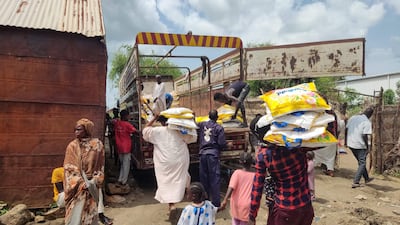
  • Men load goods from Ethiopia on to a lorry in the border town of Gallabat on August 2. AFP
    Men load goods from Ethiopia on to a lorry in the border town of Gallabat on August 2. AFP
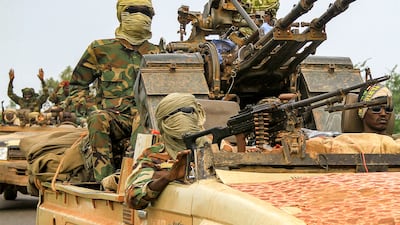
  • Sudanese Army troops ride in a military convoy accompanying the governor of Darfur State in the eastern city of Gedaref on August 30. AFP
    Sudanese Army troops ride in a military convoy accompanying the governor of Darfur State in the eastern city of Gedaref on August 30. AFP
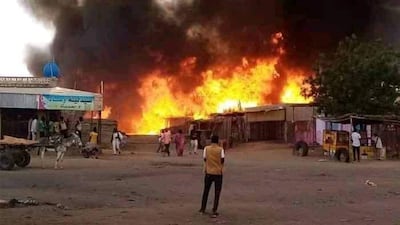
  • A fire rages at a livestock market after RSF bombardment in Al Fasher, the capital of North Darfur state, on September 1. AFP
    A fire rages at a livestock market after RSF bombardment in Al Fasher, the capital of North Darfur state, on September 1. AFP
  • People cook on a campfire at a school that has been turned into a shelter for displaced Sudanese in the northern border town of Wadi Halfa, near Egypt, on September 11. AFP
    People cook on a campfire at a school that has been turned into a shelter for displaced Sudanese in the northern border town of Wadi Halfa, near Egypt, on September 11. AFP
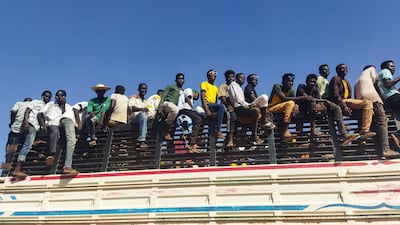
  • Displaced Sudanese ride on top of a lorry in Wad Madani on December 16. AFP
    Displaced Sudanese ride on top of a lorry in Wad Madani on December 16. AFP
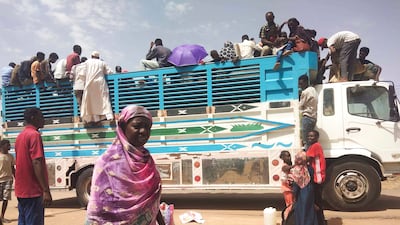
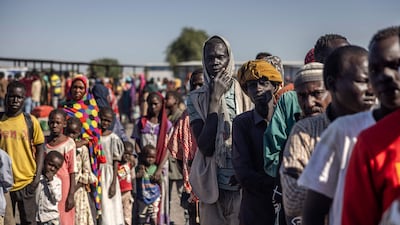
  • Sudanese refugees queue to board a lorry to go to a transit centre after crossing the border into South Sudan on February 14. AFP
    Sudanese refugees queue to board a lorry to go to a transit centre after crossing the border into South Sudan on February 14. AFP
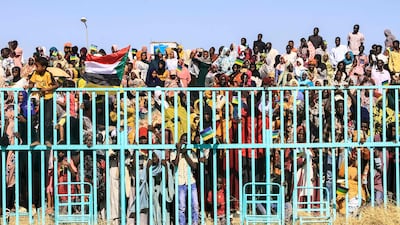
  • People watch as fighters from the army-aligned Sudan Liberation Movement attend a graduation ceremony in the south-eastern Gedaref state on March 28. AFP
    People watch as fighters from the army-aligned Sudan Liberation Movement attend a graduation ceremony in the south-eastern Gedaref state on March 28. AFP
  • Fighters from the SLM attend a graduation ceremony in Gedaref state on March 28. AFP
    Fighters from the SLM attend a graduation ceremony in Gedaref state on March 28. AFP

The unravelling of Sudan’s war into a series of localised conflicts fought by different factions with varying allegiances is truly a nightmare scenario. The International Crisis Group this month suggested that the civil war’s two main protagonists - army chief Gen Abdel Fattah Al Burhan and Rapid Support Forces’ leader Gen Mohamed Dagalo - “may find it increasingly difficult to maintain control of affiliated militias”. This “potential fragmentation” of the civil war, Crisis Group warns, “is also ominous because of how it would endanger efforts to resolve the conflict through high-level negotiation between the two leaders”. Elsewhere, the fighting is “already rapidly degenerating into inter-ethnic wars, particularly between the Darfuri Arabs and Sudan’s riverine peoples, as well as Arabs and non-Arabs in Darfur”.

Sudan is also awash with illegal firearms - about five million according to a 2022 government estimate. With many of these in the hands of various armed groups loyal to local leaders instead of an organised chain of command, many will agree with UNHCR High Commissioner Filippo Grandi’s assessment given to a French broadcaster on Monday that the presence of “local commanders, warlords and very complex negotiations on the ground” is a “a powerful obstacle to delivering aid”.

Aid efforts are also at risk because of a widespread breakdown of law and order in various parts of the country, as well as the threat to international shipping in the Red Sea posed by Yemen’s Houthi rebels. In February, the militants’ attacks forced one humanitarian NGO, the International Rescue Committee, to find longer and more expensive shipping routes to deliver live-saving aid.

The scale of the aid challenge is daunting. Already the forced displacement of nearly two million Sudanese to neighbouring countries poses a major challenge to regional stability. The internal displacement of more than six million people has put Sudanese agriculture under severe strain, exacerbating the famine that is already taking place.

Diplomatic efforts have to be better and more effective. Talks so far have been fitful and largely unproductive. Participants at the Paris summit yesterday urged the UN Secretary General's personal envoy for Sudan, Algerian diplomat Ramtane Lamamra, to push for “coherent mediation”. It is true that the presence of Mr Lamamra and other new figures, such as US envoy Tom Perriello, IGAD special envoy and South Sudanese lawyer Lawrence Korbandy, as well as an African Union team headed by Ghanian lawyer Mohamed Ibn Chambas, may will kick-start a disjointed diplomatic approach that has so far delivered little.

But they will have to redouble their efforts to make it clear to the two warring sides that the longer Sudan’s agony goes on, the harder it will be to end it. They must convince the rival leaderships that this is now an unwinnable war that - if it continues to disintegrate into a toxic mix of rival militias and ethnic conflicts - will soon be out of their control to stop, even if they wanted to. The Sudanese people cannot afford to wait any longer for all warring sides to come to their senses.


The%20Little%20Mermaid%20
%3Cp%3E%3Cstrong%3EDirector%3A%3C%2Fstrong%3E%20Rob%20Marshall%3Cbr%3E%3Cstrong%3EStars%3A%20%3C%2Fstrong%3EHalle%20Bailey%2C%20Jonah%20Hauer-King%2C%20Melissa%20McCarthy%2C%20Javier%20Bardem%3Cbr%3E%3Cstrong%3ERating%3A%20%3C%2Fstrong%3E2%2F5%3Cbr%3E%3Cbr%3E%3C%2Fp%3E%0A
The specs

Engine: 0.8-litre four cylinder

Power: 70bhp

Torque: 66Nm

Transmission: four-speed manual

Price: $1,075 new in 1967, now valued at $40,000

On sale: Models from 1966 to 1970

The specs: 2018 Renault Megane

Price, base / as tested Dh52,900 / Dh59,200

Engine 1.6L in-line four-cylinder

Transmission Continuously variable transmission

Power 115hp @ 5,500rpm

Torque 156Nm @ 4,000rpm

Fuel economy, combined 6.6L / 100km

The BIO:

He became the first Emirati to climb Mount Everest in 2011, from the south section in Nepal

He ascended Mount Everest the next year from the more treacherous north Tibetan side

By 2015, he had completed the Explorers Grand Slam

Last year, he conquered K2, the world’s second-highest mountain located on the Pakistan-Chinese border

He carries dried camel meat, dried dates and a wheat mixture for the final summit push

His new goal is to climb 14 peaks that are more than 8,000 metres above sea level

Russia's Muslim Heartlands

Dominic Rubin, Oxford

Who was Alfred Nobel?

The Nobel Prize was created by wealthy Swedish chemist and entrepreneur Alfred Nobel.

  • In his will he dictated that the bulk of his estate should be used to fund "prizes to those who, during the preceding year, have conferred the greatest benefit to humankind".
  • Nobel is best known as the inventor of dynamite, but also wrote poetry and drama and could speak Russian, French, English and German by the age of 17. The five original prize categories reflect the interests closest to his heart.
  • Nobel died in 1896 but it took until 1901, following a legal battle over his will, before the first prizes were awarded.
WHAT%20IS%20THE%20LICENSING%20PROCESS%20FOR%20VARA%3F
%3Cp%3EVara%20will%20cater%20to%20three%20categories%20of%20companies%20in%20Dubai%20(except%20the%20DIFC)%3A%3C%2Fp%3E%0A%3Cp%3E%3Cstrong%3ECategory%20A%3A%3C%2Fstrong%3E%20Minimum%20viable%20product%20(MVP)%20applicants%20that%20are%20currently%20in%20the%20process%20of%20securing%20an%20MVP%20licence%3A%20This%20is%20a%20three-stage%20process%20starting%20with%20%5B1%5D%20a%20provisional%20permit%2C%20graduating%20to%20%5B2%5D%20preparatory%20licence%20and%20concluding%20with%20%5B3%5D%20operational%20licence.%20Applicants%20that%20are%20already%20in%20the%20MVP%20process%20will%20be%20advised%20by%20Vara%20to%20either%20continue%20within%20the%20MVP%20framework%20or%20be%20transitioned%20to%20the%20full%20market%20product%20licensing%20process.%3C%2Fp%3E%0A%3Cp%3E%3Cstrong%3ECategory%20B%3A%3C%2Fstrong%3E%20Existing%20legacy%20virtual%20asset%20service%20providers%20prior%20to%20February%207%2C%202023%2C%20which%20are%20required%20to%20come%20under%20Vara%20supervision.%20All%20operating%20service%20proviers%20in%20Dubai%20(excluding%20the%20DIFC)%20fall%20under%20Vara%E2%80%99s%20supervision.%3C%2Fp%3E%0A%3Cp%3E%3Cstrong%3ECategory%20C%3A%3C%2Fstrong%3E%20New%20applicants%20seeking%20a%20Vara%20licence%20or%20existing%20applicants%20adding%20new%20activities.%20All%20applicants%20that%20do%20not%20fall%20under%20Category%20A%20or%20B%20can%20begin%20the%20application%20process%20through%20their%20current%20or%20prospective%20commercial%20licensor%20%E2%80%94%20the%20DET%20or%20Free%20Zone%20Authority%20%E2%80%94%20or%20directly%20through%20Vara%20in%20the%20instance%20that%20they%20have%20yet%20to%20determine%20the%20commercial%20operating%20zone%20in%20Dubai.%C2%A0%3C%2Fp%3E%0A
THE%C2%A0SPECS
%3Cp%3E%3Cstrong%3EEngine%3A%20%3C%2Fstrong%3E2.4-litre%20four-cylinder%0D%3Cbr%3E%3Cstrong%3EPower%3A%3C%2Fstrong%3E%20210hp%0D%3Cbr%3E%3Cstrong%3ETorque%3A%3C%2Fstrong%3E%20320Nm%0D%3Cbr%3E%3Cstrong%3EPrice%3A%3C%2Fstrong%3E%20Starting%20from%20Dh89%2C900%0D%3Cbr%3E%3Cstrong%3EOn%20sale%3A%20%3C%2Fstrong%3ENow%0D%3Cbr%3E%3C%2Fp%3E%0A
Why it pays to compare

A comparison of sending Dh20,000 from the UAE using two different routes at the same time - the first direct from a UAE bank to a bank in Germany, and the second from the same UAE bank via an online platform to Germany - found key differences in cost and speed. The transfers were both initiated on January 30.

Route 1: bank transfer

The UAE bank charged Dh152.25 for the Dh20,000 transfer. On top of that, their exchange rate margin added a difference of around Dh415, compared with the mid-market rate.

Total cost: Dh567.25 - around 2.9 per cent of the total amount

Total received: €4,670.30 

Route 2: online platform

The UAE bank’s charge for sending Dh20,000 to a UK dirham-denominated account was Dh2.10. The exchange rate margin cost was Dh60, plus a Dh12 fee.

Total cost: Dh74.10, around 0.4 per cent of the transaction

Total received: €4,756

The UAE bank transfer was far quicker – around two to three working days, while the online platform took around four to five days, but was considerably cheaper. In the online platform transfer, the funds were also exposed to currency risk during the period it took for them to arrive.

Mercer, the investment consulting arm of US services company Marsh & McLennan, expects its wealth division to at least double its assets under management (AUM) in the Middle East as wealth in the region continues to grow despite economic headwinds, a company official said.

Mercer Wealth, which globally has $160 billion in AUM, plans to boost its AUM in the region to $2-$3bn in the next 2-3 years from the present $1bn, said Yasir AbuShaban, a Dubai-based principal with Mercer Wealth.

Within the next two to three years, we are looking at reaching $2 to $3 billion as a conservative estimate and we do see an opportunity to do so,” said Mr AbuShaban.

Mercer does not directly make investments, but allocates clients’ money they have discretion to, to professional asset managers. They also provide advice to clients.

“We have buying power. We can negotiate on their (client’s) behalf with asset managers to provide them lower fees than they otherwise would have to get on their own,” he added.

Mercer Wealth’s clients include sovereign wealth funds, family offices, and insurance companies among others.

From its office in Dubai, Mercer also looks after Africa, India and Turkey, where they also see opportunity for growth.

Wealth creation in Middle East and Africa (MEA) grew 8.5 per cent to $8.1 trillion last year from $7.5tn in 2015, higher than last year’s global average of 6 per cent and the second-highest growth in a region after Asia-Pacific which grew 9.9 per cent, according to consultancy Boston Consulting Group (BCG). In the region, where wealth grew just 1.9 per cent in 2015 compared with 2014, a pickup in oil prices has helped in wealth generation.

BCG is forecasting MEA wealth will rise to $12tn by 2021, growing at an annual average of 8 per cent.

Drivers of wealth generation in the region will be split evenly between new wealth creation and growth of performance of existing assets, according to BCG.

Another general trend in the region is clients’ looking for a comprehensive approach to investing, according to Mr AbuShaban.

“Institutional investors or some of the families are seeing a slowdown in the available capital they have to invest and in that sense they are looking at optimizing the way they manage their portfolios and making sure they are not investing haphazardly and different parts of their investment are working together,” said Mr AbuShaban.

Some clients also have a higher appetite for risk, given the low interest-rate environment that does not provide enough yield for some institutional investors. These clients are keen to invest in illiquid assets, such as private equity and infrastructure.

“What we have seen is a desire for higher returns in what has been a low-return environment specifically in various fixed income or bonds,” he said.

“In this environment, we have seen a de facto increase in the risk that clients are taking in things like illiquid investments, private equity investments, infrastructure and private debt, those kind of investments were higher illiquidity results in incrementally higher returns.”

The Abu Dhabi Investment Authority, one of the largest sovereign wealth funds, said in its 2016 report that has gradually increased its exposure in direct private equity and private credit transactions, mainly in Asian markets and especially in China and India. The authority’s private equity department focused on structured equities owing to “their defensive characteristics.”

The cost of Covid testing around the world

Egypt

Dh514 for citizens; Dh865 for tourists

Information can be found through VFS Global.

Jordan

Dh212

Centres include the Speciality Hospital, which now offers drive-through testing.

Cambodia

Dh478

Travel tests are managed by the Ministry of Health and National Institute of Public Health.

Zanzibar

AED 295

Zanzibar Public Health Emergency Operations Centre, located within the Lumumba Secondary School compound.

Abu Dhabi

Dh85

Abu Dhabi’s Seha has test centres throughout the UAE.

UK

From Dh400

Heathrow Airport now offers drive through and clinic-based testing, starting from Dh400 and up to Dh500 for the PCR test.

Updated: April 17, 2024, 3:00 AM