Peacekeepers have proved their worth in a number of modern conflicts. Les Stone


The case for more female peacekeepers


  • English
  • Arabic

November 22, 2022

In 1993, only 1 per cent of all deployed uniformed personnel were women. That means that in a year that saw military action from Rwanda to Bosnia to Afghanistan, almost all of it was carried out by men. It is a similar picture today.

This minimal participation does not mean that women avoid the terrible effects of conflict; in some regards, they feel it the worst. Women in conflict zones are 50 per cent more likely to experience domestic violence. Sexual violence as a weapon of war, child marriage and people trafficking – abuses that spike in the lawlessness of conflict – disproportionately affect women and girls, too.

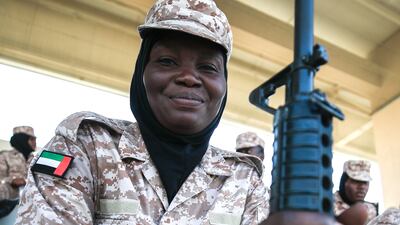
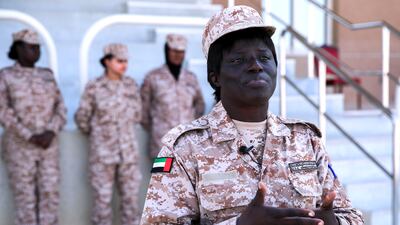
It is a reality Lt Remadji Stephanie knows all too well. Her country, Chad, is under constant threat from Boko Haram, a terrorist group that targets women and girls in particular as it seeks to deny them getting an education.

Overcoming this injustice and lack of balance will take a long time and a great deal of effort. But UN Women has been taking significant steps over the years, as it tries to understand the problem through women's eyes, and eventually make them an integral part of the solution.

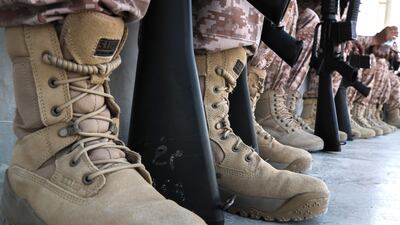
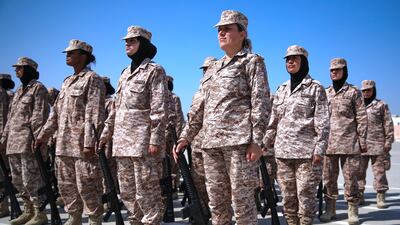
  • A team of 157 cadets are put through their paces during a UN peacekeeping training programme at the Khawla bint Al Azwar Military School in Abu Dhabi. All photos: Victor Besa / The National
    A team of 157 cadets are put through their paces during a UN peacekeeping training programme at the Khawla bint Al Azwar Military School in Abu Dhabi. All photos: Victor Besa / The National
  • The women could soon be engaged in challenging situations around the world.
    The women could soon be engaged in challenging situations around the world.
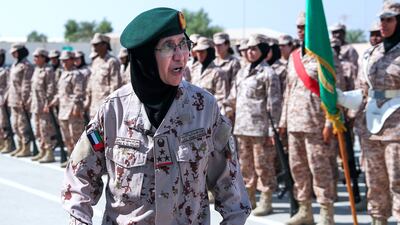
  • Brig Afra Al Falasi, commander of the military school, rallies the troops for another day of crucial training.
    Brig Afra Al Falasi, commander of the military school, rallies the troops for another day of crucial training.
  • The trainees aim to make a difference in the world.
    The trainees aim to make a difference in the world.
  • The UAE has trained more than 350 peacekeepers under a partnership between the General Women's Union, UN Women and the Ministry of Defence.
    The UAE has trained more than 350 peacekeepers under a partnership between the General Women's Union, UN Women and the Ministry of Defence.
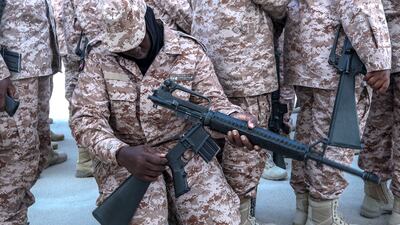
  • The cadets must complete eight weeks of military training and another two weeks focused on peacekeeping.
    The cadets must complete eight weeks of military training and another two weeks focused on peacekeeping.
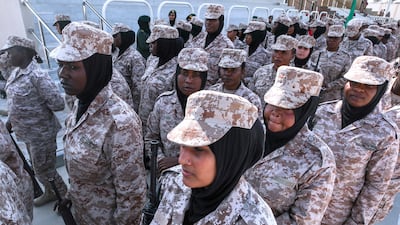
  • The trainees have come to Abu Dhabi from around the world.
    The trainees have come to Abu Dhabi from around the world.
  • The Emirates is the first country to train UN Women peacekeepers under an agreement signed in September 2018.
    The Emirates is the first country to train UN Women peacekeepers under an agreement signed in September 2018.
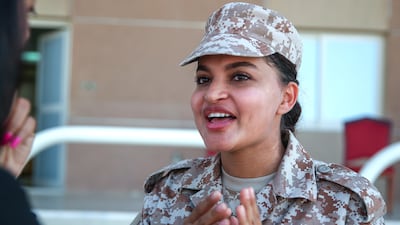
  • Doha Harbi Sharhan from Iraq is excited to be given the opportunity to serve in a military setting.
    Doha Harbi Sharhan from Iraq is excited to be given the opportunity to serve in a military setting.
  • Fatima Anne T Mendy from Gambia feels confident she can defend herself and others in any situation.
    Fatima Anne T Mendy from Gambia feels confident she can defend herself and others in any situation.
  • The UN is keen to increase the number of female peacekeepers.
    The UN is keen to increase the number of female peacekeepers.

Having more female peacekeepers is a key strategy. The term refers to UN-affiliated personnel who enter conflict zones to maintain peace and stability, under three principles, "consent of the parties, impartiality and non-use of force except in self-defence and defence of the mandate".

Gradually, more and more women have filled the organisation's ranks. In 2012, they made up 3 per cent of military and 10 per cent of police personnel in UN peacekeeping operations.

There is a strategic urgency to boost these numbers. The UN has also gathered data that shows the concrete benefits of inclusive peace-building. According to the organisation, a peace agreement in which women are involved is 20 per cent more likely to last for two years.

Now, women such as Lt Stephanie are being given the chance to participate in the wider mission of UN peacekeeping at the UAE's Khawla bint Al Azwar Military School, the region’s first women’s military college. “I am determined to go back home to help end the terrorism and violence we face at the hands of Boko Haram, not through violence but through peace,” she says.

The Emirates has so far trained 357 female cadets from all over the world. Today's class has members from Yemen, Senegal and Pakistan, to name only a few of the nationalities present.

It is also advocating for more women in peacekeeping at the highest diplomatic tables. The UAE currently has a non-permanent seat at the UN Security Council. A key goal for the country during its tenure has been implementing Security Council Resolution 1325, the first landmark Security Council resolution that specifically encompassed the role of women in maintaining peace and security.

The council is designed to be a forum for preventing international conflicts. But it, and the wider UN, is fundamentally there to maintain peace and security It is a tough mandate, but with the data in and so much willingness on the part of women to participate, getting more female peacekeepers is a strategy worth pursuing.


THE BIO:

Sabri Razouk, 74

Athlete and fitness trainer 

Married, father of six

Favourite exercise: Bench press

Must-eat weekly meal: Steak with beans, carrots, broccoli, crust and corn

Power drink: A glass of yoghurt

Role model: Any good man

F1 The Movie

Starring: Brad Pitt, Damson Idris, Kerry Condon, Javier Bardem

Director: Joseph Kosinski

Rating: 4/5

Ten tax points to be aware of in 2026

1. Domestic VAT refund amendments: request your refund within five years

If a business does not apply for the refund on time, they lose their credit.

2. E-invoicing in the UAE

Businesses should continue preparing for the implementation of e-invoicing in the UAE, with 2026 a preparation and transition period ahead of phased mandatory adoption. 

3. More tax audits

Tax authorities are increasingly using data already available across multiple filings to identify audit risks. 

4. More beneficial VAT and excise tax penalty regime

Tax disputes are expected to become more frequent and more structured, with clearer administrative objection and appeal processes. The UAE has adopted a new penalty regime for VAT and excise disputes, which now mirrors the penalty regime for corporate tax.

5. Greater emphasis on statutory audit

There is a greater need for the accuracy of financial statements. The International Financial Reporting Standards standards need to be strictly adhered to and, as a result, the quality of the audits will need to increase.

6. Further transfer pricing enforcement

Transfer pricing enforcement, which refers to the practice of establishing prices for internal transactions between related entities, is expected to broaden in scope. The UAE will shortly open the possibility to negotiate advance pricing agreements, or essentially rulings for transfer pricing purposes. 

7. Limited time periods for audits

Recent amendments also introduce a default five-year limitation period for tax audits and assessments, subject to specific statutory exceptions. While the standard audit and assessment period is five years, this may be extended to up to 15 years in cases involving fraud or tax evasion. 

8. Pillar 2 implementation 

Many multinational groups will begin to feel the practical effect of the Domestic Minimum Top-Up Tax (DMTT), the UAE's implementation of the OECD’s global minimum tax under Pillar 2. While the rules apply for financial years starting on or after January 1, 2025, it is 2026 that marks the transition to an operational phase.

9. Reduced compliance obligations for imported goods and services

Businesses that apply the reverse-charge mechanism for VAT purposes in the UAE may benefit from reduced compliance obligations. 

10. Substance and CbC reporting focus

Tax authorities are expected to continue strengthening the enforcement of economic substance and Country-by-Country (CbC) reporting frameworks. In the UAE, these regimes are increasingly being used as risk-assessment tools, providing tax authorities with a comprehensive view of multinational groups’ global footprints and enabling them to assess whether profits are aligned with real economic activity. 

Contributed by Thomas Vanhee and Hend Rashwan, Aurifer

Updated: November 22, 2022, 4:29 AM