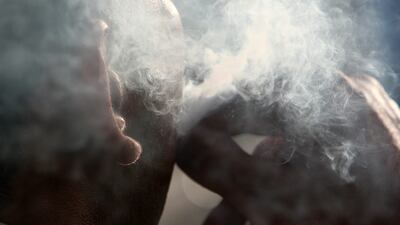
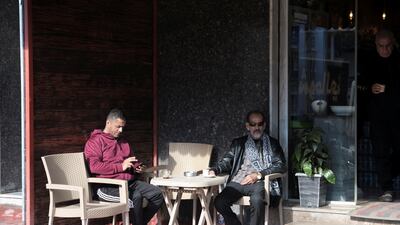
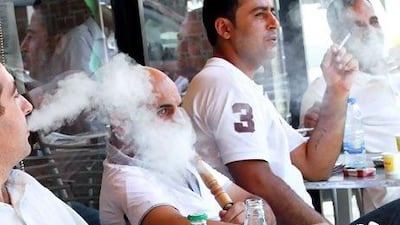
Since 2009, the number of smokers has increased in a 10-year period in four Middle Eastern nations. Pawan Singh / The National


Is the Middle East stubbing out its smoking habit?


  • English
  • Arabic

May 31, 2022

In 1949, two British researchers, Richard Doll and Bradford Hill, found that of 649 lung cancer patients in London hospitals, 647 were smokers. Their work was arguably the most important moment in the earliest days of a public health campaign that has been going on since: reducing smoking. It has not been an easy one. While convincing the medical community of the dangers was first priority, doing something about it was more complex. It required engaging with and, at points, confronting some of the biggest conglomerates as well as the deeper social acceptance of a habit that had been practised so widely for so long.

Early strategies were very similar to today's. In 1962, smoking rates fell for the first time in a decade. Doctors' recommendations included heavy taxes, along with age and advertising restrictions.

In the Middle East, implementing such policies is imperative. The latest data from the World Tobacco Atlas shows that since 2009, the number of smokers increased in a 10-year period in four of the region's nations. This is worrying. The Middle East is already heavily burdened by heart disease and strokes – smoking is a major risk factor in both. Lebanon, whose healthcare system is at breaking point, has the highest number of smokers of any Middle Eastern country.

There were some positive stories from the region. In the UAE, the tobacco trade fell from Dh410 million in 2017 to Dh62.4m in 2019. This is widely credited to the UAE imposing in 2017 a 100 per cent excise tax on cigarettes. It vindicates advocates of economic strategies to tackle smoking. They include the WHO, who in its Framework Convention on Tobacco Control recommends that at least three-quarters of the price of popular tobacco brands be taxes.

This approach is also working in Saudi Arabia where a 2017 policy mandates that 68 per cent of the price of 20-cigarette pack be taxes. Further ones on imported tobacco have seen an almost 30 per cent decline in foreign cigarettes coming into the country. Overall, 37 per cent fewer people were smoking in 2022 compared to 2014.

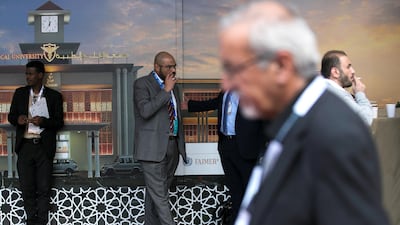
  • UAE has one of the lowest smoking rates in the Middle East and North Africa region, according to the seventh the Tobacco Atlas — a global analysis of smoking. Pawan Singh / The National
    UAE has one of the lowest smoking rates in the Middle East and North Africa region, according to the seventh the Tobacco Atlas — a global analysis of smoking. Pawan Singh / The National
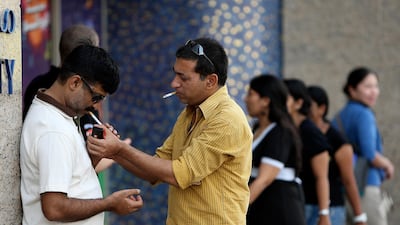
  • Smoking rates in the UAE, as a percentage of the population, are thought to be less than the worldwide average, at around 14 per cent for men and 2 per cent for women. Reem Mohammed / The National
    Smoking rates in the UAE, as a percentage of the population, are thought to be less than the worldwide average, at around 14 per cent for men and 2 per cent for women. Reem Mohammed / The National
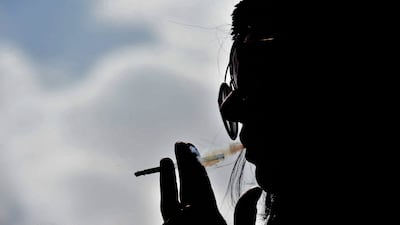
  • The Tobacco Atlas reports that only Yemen has a lower smoking figure than the UAE in the region. Pawan Singh / The National
    The Tobacco Atlas reports that only Yemen has a lower smoking figure than the UAE in the region. Pawan Singh / The National
  • In Saudi Arabia, the country with the third-lowest figure, 485 cigarettes are smoked per person annually. AFP
    In Saudi Arabia, the country with the third-lowest figure, 485 cigarettes are smoked per person annually. AFP
  • In Libya, 1,764 cigarettes are smoked per person per year. Reuters
    In Libya, 1,764 cigarettes are smoked per person per year. Reuters
  • In Kuwait, 1,849 cigarettes are smoked per person per year. Ryan Carter / The National
    In Kuwait, 1,849 cigarettes are smoked per person per year. Ryan Carter / The National
  • Lebanon has the highest smoking rate in the region with 1,955 cigarettes smoked per person. AFP
    Lebanon has the highest smoking rate in the region with 1,955 cigarettes smoked per person. AFP

In a sign of how complex the public health problem remains, there are still grounds for concern, even in countries where trends otherwise seem positive. Globally, in almost half of the 135 surveyed countries, smoking in people between 13 and 15 had increased, a sign that, alongside taxation, consumer awareness from a young age of the dangers is key.

Ongoing progress is not guaranteed, and new unknowns are emerging. The National spoke to Dr Davinder Pal Singh, a cardiologist at NMC Royal Hospital in Dubai, who drew particular attention to the issue of vaping, which he said had "increased rapidly in the past few years". A false sense of security might be driving the trend, even though the devices still contain tobacco. Dr Singh was clear: "It’s going to affect the heart ... It contains nicotine in some form. People should definitely avoid vaping. It’s the same as cigarettes.”

The picture from the latest tranche of data is mixed, then. While there is more evidence that regulation and legislation work, there is clearly not enough across the board, particularly when it comes to researching dangers of newer forms of tobacco consumption. For the Middle East, countries that are getting complacent should learn from the many neighbours taking effective steps with clear results. The dangers of smoking are obvious, but there are proven strategies to dealing with them. Ignoring them would be a betrayal of populations whose health is already too often precarious.


Mercer, the investment consulting arm of US services company Marsh & McLennan, expects its wealth division to at least double its assets under management (AUM) in the Middle East as wealth in the region continues to grow despite economic headwinds, a company official said.

Mercer Wealth, which globally has $160 billion in AUM, plans to boost its AUM in the region to $2-$3bn in the next 2-3 years from the present $1bn, said Yasir AbuShaban, a Dubai-based principal with Mercer Wealth.

Within the next two to three years, we are looking at reaching $2 to $3 billion as a conservative estimate and we do see an opportunity to do so,” said Mr AbuShaban.

Mercer does not directly make investments, but allocates clients’ money they have discretion to, to professional asset managers. They also provide advice to clients.

“We have buying power. We can negotiate on their (client’s) behalf with asset managers to provide them lower fees than they otherwise would have to get on their own,” he added.

Mercer Wealth’s clients include sovereign wealth funds, family offices, and insurance companies among others.

From its office in Dubai, Mercer also looks after Africa, India and Turkey, where they also see opportunity for growth.

Wealth creation in Middle East and Africa (MEA) grew 8.5 per cent to $8.1 trillion last year from $7.5tn in 2015, higher than last year’s global average of 6 per cent and the second-highest growth in a region after Asia-Pacific which grew 9.9 per cent, according to consultancy Boston Consulting Group (BCG). In the region, where wealth grew just 1.9 per cent in 2015 compared with 2014, a pickup in oil prices has helped in wealth generation.

BCG is forecasting MEA wealth will rise to $12tn by 2021, growing at an annual average of 8 per cent.

Drivers of wealth generation in the region will be split evenly between new wealth creation and growth of performance of existing assets, according to BCG.

Another general trend in the region is clients’ looking for a comprehensive approach to investing, according to Mr AbuShaban.

“Institutional investors or some of the families are seeing a slowdown in the available capital they have to invest and in that sense they are looking at optimizing the way they manage their portfolios and making sure they are not investing haphazardly and different parts of their investment are working together,” said Mr AbuShaban.

Some clients also have a higher appetite for risk, given the low interest-rate environment that does not provide enough yield for some institutional investors. These clients are keen to invest in illiquid assets, such as private equity and infrastructure.

“What we have seen is a desire for higher returns in what has been a low-return environment specifically in various fixed income or bonds,” he said.

“In this environment, we have seen a de facto increase in the risk that clients are taking in things like illiquid investments, private equity investments, infrastructure and private debt, those kind of investments were higher illiquidity results in incrementally higher returns.”

The Abu Dhabi Investment Authority, one of the largest sovereign wealth funds, said in its 2016 report that has gradually increased its exposure in direct private equity and private credit transactions, mainly in Asian markets and especially in China and India. The authority’s private equity department focused on structured equities owing to “their defensive characteristics.”

Living in...

This article is part of a guide on where to live in the UAE. Our reporters will profile some of the country’s most desirable districts, provide an estimate of rental prices and introduce you to some of the residents who call each area home. 

World Cricket League Division 2

In Windhoek, Namibia - Top two teams qualify for the World Cup Qualifier in Zimbabwe, which starts on March 4.

UAE fixtures

Thursday, February 8 v Kenya; Friday, February v Canada; Sunday, February 11 v Nepal; Monday, February 12 v Oman; Wednesday, February 14 v Namibia; Thursday, February 15 final

The Dictionary of Animal Languages
Heidi Sopinka
​​​​​​​Scribe

Tips to keep your car cool
  • Place a sun reflector in your windshield when not driving
  • Park in shaded or covered areas
  • Add tint to windows
  • Wrap your car to change the exterior colour
  • Pick light interiors - choose colours such as beige and cream for seats and dashboard furniture
  • Avoid leather interiors as these absorb more heat
MATCH INFO

Uefa Champions League semi-final, first leg
Bayern Munich v Real Madrid

When: April 25, 10.45pm kick-off (UAE)
Where: Allianz Arena, Munich
Live: BeIN Sports HD
Second leg: May 1, Santiago Bernabeu, Madrid

How tumultuous protests grew
  • A fuel tax protest by French drivers appealed to wider anti-government sentiment
  • Unlike previous French demonstrations there was no trade union or organised movement involved 
  • Demonstrators responded to online petitions and flooded squares to block traffic
  • At its height there were almost 300,000 on the streets in support
  • Named after the high visibility jackets that drivers must keep in cars 
  • Clashes soon turned violent as thousands fought with police at cordons
  • An estimated two dozen people lost eyes and many others were admitted to hospital 

Tales of Yusuf Tadros

Adel Esmat (translated by Mandy McClure)

Hoopoe

Naga
%3Cp%3E%3Cstrong%3EDirector%3A%C2%A0%3C%2Fstrong%3EMeshal%20Al%20Jaser%3C%2Fp%3E%0A%3Cp%3E%3Cstrong%3EStarring%3A%C2%A0%3C%2Fstrong%3EAdwa%20Bader%2C%20Yazeed%20Almajyul%2C%20Khalid%20Bin%20Shaddad%3C%2Fp%3E%0A%3Cp%3E%3Cstrong%3ERating%3A%20%3C%2Fstrong%3E4%2F5%3C%2Fp%3E%0A
From Zero

Artist: Linkin Park

Label: Warner Records

Number of tracks: 11

Rating: 4/5

Our family matters legal consultant

Name: Dr Hassan Mohsen Elhais

Position: legal consultant with Al Rowaad Advocates and Legal Consultants.

The burning issue

The internal combustion engine is facing a watershed moment – major manufacturer Volvo is to stop producing petroleum-powered vehicles by 2021 and countries in Europe, including the UK, have vowed to ban their sale before 2040. The National takes a look at the story of one of the most successful technologies of the last 100 years and how it has impacted life in the UAE.

Read part three: the age of the electric vehicle begins

Read part two: how climate change drove the race for an alternative 

Read part one: how cars came to the UAE

Russia's Muslim Heartlands

Dominic Rubin, Oxford

Key facilities
  • Olympic-size swimming pool with a split bulkhead for multi-use configurations, including water polo and 50m/25m training lanes
  • Premier League-standard football pitch
  • 400m Olympic running track
  • NBA-spec basketball court with auditorium
  • 600-seat auditorium
  • Spaces for historical and cultural exploration
  • An elevated football field that doubles as a helipad
  • Specialist robotics and science laboratories
  • AR and VR-enabled learning centres
  • Disruption Lab and Research Centre for developing entrepreneurial skills
The%20specs
%3Cp%3E%3Cstrong%3EEngine%3A%20%3C%2Fstrong%3E2.9-litre%20twin-turbo%20V6%0D%3Cbr%3E%3Cstrong%3ETransmission%3A%20%3C%2Fstrong%3E8-speed%20auto%0D%3Cbr%3E%3Cstrong%3EPower%3A%20%3C%2Fstrong%3E536hp%20(including%20138hp%20e-motor)%0D%3Cbr%3E%3Cstrong%3ETorque%3A%20%3C%2Fstrong%3E750Nm%20(including%20400Nm%20e-motor)%0D%3Cbr%3E%3Cstrong%3EPrice%3A%20%3C%2Fstrong%3EFrom%20Dh1%2C380%2C000%0D%3Cbr%3E%3Cstrong%3EOn%20sale%3A%20%3C%2Fstrong%3Enow%3C%2Fp%3E%0A

Veil (Object Lessons)
Rafia Zakaria
​​​​​​​Bloomsbury Academic

COMPANY PROFILE
Name: Kumulus Water
 
Started: 2021
 
Founders: Iheb Triki and Mohamed Ali Abid
 
Based: Tunisia 
 
Sector: Water technology 
 
Number of staff: 22 
 
Investment raised: $4 million 

Director: Paul Weitz
Stars: Kevin Hart
3/5 stars

A general guide to how active you are:

Less than 5,000 steps - sedentary

5,000 - 9,999 steps - lightly active

10,000  - 12,500 steps - active

12,500 - highly active

Jetour T1 specs

Engine: 2-litre turbocharged

Power: 254hp

Torque: 390Nm

Price: From Dh126,000

Available: Now

Updated: May 31, 2022, 3:00 AM