Insight and opinion from The National’s editorial leadership
September 15, 2021
Morocco's recent election has delivered much-needed change. "You deserve better" was the campaign slogan of the victorious National Rally of Independents (RNI), led by fuel tycoon Aziz Akhannouch, the new Prime Minister. The now-ousted Justice and Development Party (PJD) had been heading a ruling coalition for 10 years, with an underwhelming record. Last year, the country's economy shrank by 7.1 per cent, while poverty rose to 11.7 per cent. Covid-19 bears some of the blame, but many issues preceded the pandemic and voters punished the PJD at the polls.
Now, the next question is how Mr Akhannouch will deliver. His policy agenda is based on implementing a "new model of development", unveiled by King Mohammed VI, which aims to reduce the country's wealth gap and double per-capita output by 2035. The agenda includes measurable targets for, among other aims, ensuring more than 90 per cent of children learn elementary skills in primary school, as well as bringing the informal unemployment rate below 20 per cent, all by 2035. The PJD, on the other hand, preferred to base its legitimacy on populism and Islamist ideology. As many voters understand, the long-term health of society demands a competence-based approach to governance.
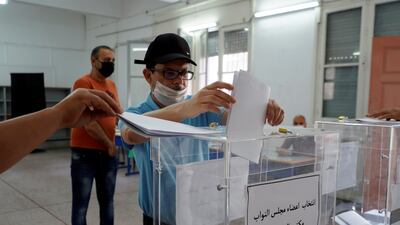
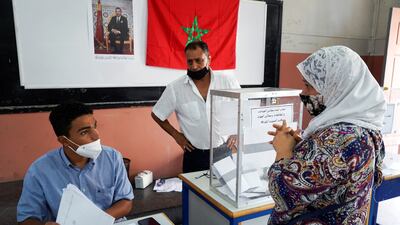
Saad-Eddine El Othmani, Morocco's Prime Minister and president of the Islamist Justice and Development Party (PJD) casts his ballot on September 8. AFP
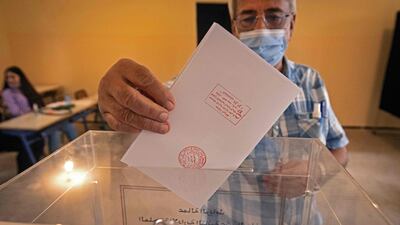
A man casts his vote at a polling station in Casablanca, Morocco. Reuters
The PJD has dominated Morocco's politics for a decade. Reuters
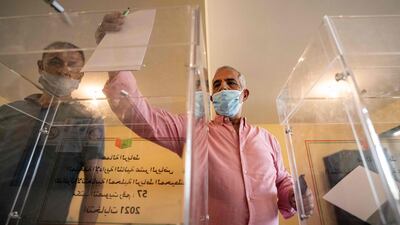
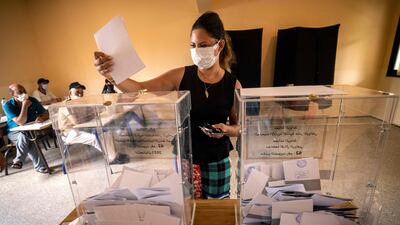
A voter casts a ballot in the capital Rabat. AFP
Polls are banned in Morocco. AFP
Wednesday's elections came as the country grapples with the economic impact of Covid-19 . AFP
Voter turnout in Moroccan elections is usually below 50 per cent. AFP
Official figures show that about three million young people between 18 and 22 registered to vote for the first time this year. Reuters
Morocco adopted a new constitution in 2011 in response to the February 20 Movement, the local version of the Arab uprisings. Reuters
The step brought the country closer to a system of constitutional monarchy. EPA
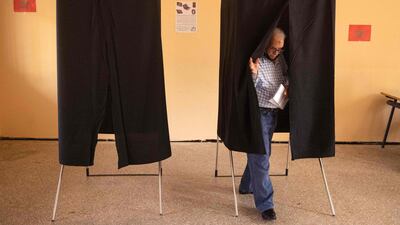
A woman prepares to cast her ballot during Morocco's parliamentary and local elections in the capital Rabat. AFP
Similar sentiments are felt in nearby Tunisia, where President Kais Saied is attempting to push for change by amending his country’s political system. Mr Saied is himself a constitutional lawyer as well as a politician, and is confident he can make overdue improvements without losing the democratic tenets of the constitution. His proposed reforms would be more just and have "more defined responsibilities", according to one of his advisers, Walid Hajjem.
One of the great virtues of Tunisia’s political culture is its pluralism, including its labour unions, some of whom view Mr Saied’s motives with suspicion. In a country suffering from a teetering economy and shaky politics, he must prove to them as quickly as possible that his path forward would boost participation in an increasingly dejected society.
Even with competent leadership, the scale of the challenges ahead is great. Protests over low Covid-19 vaccination rates in Tunisia were severe enough to oust former prime minister Hichem Mechichi in July. They were aggravated further by the country's economic crisis. Youth unemployment is dangerously high, and national debt is more than 80 per cent. It will also need to manage its relations with the US, a crucial aid donor, where some in Congress are pushing for a cut in response to Mr Saied's actions.
Similar issues are emerging in Morocco, where Covid-19 has hurt a tourism-dependent society with high poverty rates. In 2020, the country experienced its first recession since 1995. Mr Akhannouch faces another challenge: getting Moroccans engaged in politics again. The Moroccan Institute for Policy Analysis reports that of the 1,400 people surveyed in an annual trust index, 70 per cent did not trust Parliament.
Both countries are capable of addressing the challenges, even if total solutions are not possible in the short-term. Morocco's problem with disenfranchised voters has now shown that it can be improved if candidates are convincing enough. This time around, voter turnout was up seven per cent, albeit still low at 50 per cent. On the issue of vaccination in Tunisia, rates are finally picking up and daily new cases have dropped significantly since July. As the world opens up after Covid-19, Morocco and Tunisia can be confident that their vital tourism sectors will experience growth.
Restrained political realism will be important for both countries in the coming months. It might be a bitter pill to swallow, but at least it is an honest one. As Morocco and Tunisia have shown, words need to be backed up by action. If both leaders bring change in a constructive manner, competence and practicality will deliver much-needed results.

Mercer, the investment consulting arm of US services company Marsh & McLennan, expects its wealth division to at least double its assets under management (AUM) in the Middle East as wealth in the region continues to grow despite economic headwinds, a company official said.
Mercer Wealth, which globally has $160 billion in AUM, plans to boost its AUM in the region to $2-$3bn in the next 2-3 years from the present $1bn, said Yasir AbuShaban, a Dubai-based principal with Mercer Wealth.
“Within the next two to three years, we are looking at reaching $2 to $3 billion as a conservative estimate and we do see an opportunity to do so,” said Mr AbuShaban.
Mercer does not directly make investments, but allocates clients’ money they have discretion to, to professional asset managers. They also provide advice to clients.
“We have buying power. We can negotiate on their (client’s) behalf with asset managers to provide them lower fees than they otherwise would have to get on their own,” he added.
Mercer Wealth’s clients include sovereign wealth funds, family offices, and insurance companies among others.
From its office in Dubai, Mercer also looks after Africa, India and Turkey, where they also see opportunity for growth.
Wealth creation in Middle East and Africa (MEA) grew 8.5 per cent to $8.1 trillion last year from $7.5tn in 2015, higher than last year’s global average of 6 per cent and the second-highest growth in a region after Asia-Pacific which grew 9.9 per cent, according to consultancy Boston Consulting Group (BCG). In the region, where wealth grew just 1.9 per cent in 2015 compared with 2014, a pickup in oil prices has helped in wealth generation.
BCG is forecasting MEA wealth will rise to $12tn by 2021, growing at an annual average of 8 per cent.
Drivers of wealth generation in the region will be split evenly between new wealth creation and growth of performance of existing assets, according to BCG.
Another general trend in the region is clients’ looking for a comprehensive approach to investing, according to Mr AbuShaban.
“Institutional investors or some of the families are seeing a slowdown in the available capital they have to invest and in that sense they are looking at optimizing the way they manage their portfolios and making sure they are not investing haphazardly and different parts of their investment are working together,” said Mr AbuShaban.
Some clients also have a higher appetite for risk, given the low interest-rate environment that does not provide enough yield for some institutional investors. These clients are keen to invest in illiquid assets, such as private equity and infrastructure.
“What we have seen is a desire for higher returns in what has been a low-return environment specifically in various fixed income or bonds,” he said.
“In this environment, we have seen a de facto increase in the risk that clients are taking in things like illiquid investments, private equity investments, infrastructure and private debt, those kind of investments were higher illiquidity results in incrementally higher returns.”
The Abu Dhabi Investment Authority, one of the largest sovereign wealth funds, said in its 2016 report that has gradually increased its exposure in direct private equity and private credit transactions, mainly in Asian markets and especially in China and India. The authority’s private equity department focused on structured equities owing to “their defensive characteristics.”
Limited-edition art prints of The Sofa Series: Sultani can be acquired from Reem El Mutwalli at www.reemelmutwalli.com
Managing the separation process
Choose your nursery carefully in the first place
Relax – and hopefully your child will follow suit
Inform the staff in advance of your child’s likes and dislikes.
If you need some extra time to talk to the teachers, make an appointment a few days in advance, rather than attempting to chat on your child’s first day
The longer you stay, the more upset your child will become. As difficult as it is, walk away. Say a proper goodbye and reassure your child that you will be back
Be patient. Your child might love it one day and hate it the next
Stick at it. Don’t give up after the first day or week. It takes time for children to settle into a new routine.And, finally, don’t feel guilty.
6.30pm: Handicap (PA) Dh80,000 1,600m | Winner: AF Makerah, Antonio Fresu, Ernst Oertel
7pm: Wathba Stallions Cup Handicap (PA) Dh70,000 | Winner: AF Motaghatres, Antonio Fresu, Ernst Oertel
7.30pm: Handicap (TB) Dh90,000 1,600m | Winner: Tafakhor, Ronan Whelan, Ali Rashid Al Raihe
Terror attacks in Paris, November 13, 2015
- At 9.16pm, three suicide attackers killed one person outside the Atade de France during a foootball match between France and Germany - At 9.25pm, three attackers opened fire on restaurants and cafes over 20 minutes, killing 39 people - Shortly after 9.40pm, three other attackers launched a three-hour raid on the Bataclan, in which 1,500 people had gathered to watch a rock concert. In total, 90 people were killed - Salah Abdeslam, the only survivor of the terrorists, did not directly participate in the attacks, thought to be due to a technical glitch in his suicide vest - He fled to Belgium and was involved in attacks on Brussels in March 2016. He is serving a life sentence in France
New schools in Dubai
TEACHERS' PAY - WHAT YOU NEED TO KNOW
Pay varies significantly depending on the school, its rating and the curriculum. Here's a rough guide as of January 2021:
- top end schools tend to pay Dh16,000-17,000 a month - plus a monthly housing allowance of up to Dh6,000. These tend to be British curriculum schools rated 'outstanding' or 'very good', followed by American schools
- average salary across curriculums and skill levels is about Dh10,000, recruiters say
- it is becoming more common for schools to provide accommodation, sometimes in an apartment block with other teachers, rather than hand teachers a cash housing allowance
- some strong performing schools have cut back on salaries since the pandemic began, sometimes offering Dh16,000 including the housing allowance, which reflects the slump in rental costs, and sheer demand for jobs
- maths and science teachers are most in demand and some schools will pay up to Dh3,000 more than other teachers in recognition of their technical skills
- at the other end of the market, teachers in some Indian schools, where fees are lower and competition among applicants is intense, can be paid as low as Dh3,000 per month
- in Indian schools, it has also become common for teachers to share residential accommodation, living in a block with colleagues
Copa del Rey
Semi-final, first leg
Barcelona 1 (Malcom 57')
Real Madrid (Vazquez 6')
Second leg, February 27
Our family matters legal consultant
Name: Hassan Mohsen Elhais
Position: legal consultant with Al Rowaad Advocates and Legal Consultants.
Sunday, February 3, 2019 - Rome to Abu Dhabi
1pm: departure by plane from Rome / Fiumicino to Abu Dhabi
10pm: arrival at Abu Dhabi Presidential Airport
Monday, February 4
12pm: welcome ceremony at the main entrance of the Presidential Palace
12.20pm: visit Abu Dhabi Crown Prince at Presidential Palace
5pm: private meeting with Muslim Council of Elders at Sheikh Zayed Grand Mosque
6.10pm: Inter-religious in the Founder's Memorial
Tuesday, February 5 - Abu Dhabi to Rome
9.15am: private visit to undisclosed cathedral
10.30am: public mass at Zayed Sports City – with a homily by Pope Francis
12.40pm: farewell at Abu Dhabi Presidential Airport
1pm: departure by plane to Rome
5pm: arrival at the Rome / Ciampino International Airport
MOUNTAINHEAD REVIEW
Starring: Ramy Youssef, Steve Carell, Jason Schwartzman
Director: Jesse Armstrong
Rating: 3.5/5
Brief scores:
Manchester City 2
Gundogan 27', De Bruyne 85'
Crystal Palace 3
Schlupp 33', Townsend 35', Milivojevic 51' (pen)
Man of the Match: Andros Townsend (Crystal Palace)