


On September 11, 2001, the international terrorist group Al Qaeda pulled off arguably the most consequential terror attack in history, killing almost 3,000 people.
Aside from the mass casualties, the operation was also aimed at driving a permanent wedge between the US and the Islamic world. It did not manage to do so. But 20 years on, it is worth assessing how the war on terror nonetheless changed relationships between the various sides involved.
For Muslims in America, the trauma of the attack was uniquely compounded by a sudden, misinformed suspicion of their communities. “On September 10, I went to sleep a white guy. On September 11, I woke up an Arab,” recalls Dean Obeidallah, an Arab-American comedian from New Jersey.
The crashing wave of emotion and desire for revenge put every US democratic standard and institution to the test. Many were changed. The establishment of a detention facility for suspected terrorists at Guantanamo Bay visibly bent legal standards. Hidden from public view, the government authorised "enhanced interrogation techniques", using bizarre legal definitions to authorise practices that have been considered torture.
-
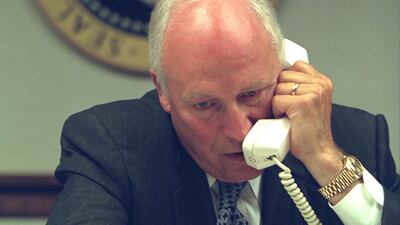
US Vice President Dick Cheney in the President's Emergency Operations Centre at the White House on September 11, 2001, the day of the terrorist attacks. US National Archives -

Secretary of State Colin Powell, right, and National Security Adviser Condoleezza Rice in the President's Emergency Operations Centre on September 11, 2001. US National Archives -
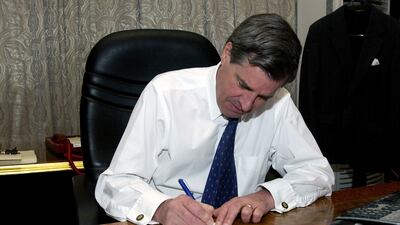
US Ambassador to Iraq Paul Bremer signs the Iraqi Sovereignty document transferring full governmental authority to the Iraqi Interim Government, in Baghdad, on June 28, 2004. Mr Bremer was tapped by the Bush administration to become the top US civilian in Iraq following the invasion. US Air Force -

CIA Director George Tenet listens to President George W Bush's address after the 9/11 terrorist attacks. US National Archives -
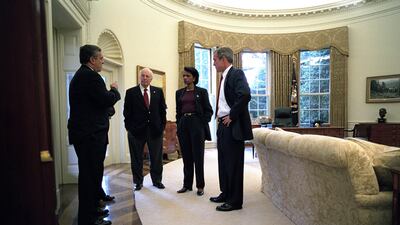
President Bush meets Mr Tenet, Vice President Cheney and Ms Rice on October 7, 2001 at the White House, the day the US invaded Afghanistan as a response to the 9/11 attacks. George W Bush Presidential Library -
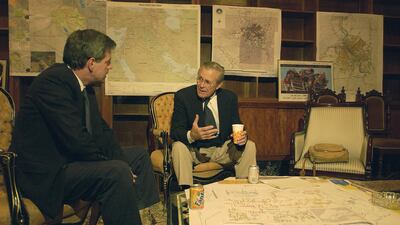
Presidential Envoy Paul Bremer, left, briefs Donald H. Rumsfeld, US Secretary of Defence, in Iraq, in 2003. Department of Defence -
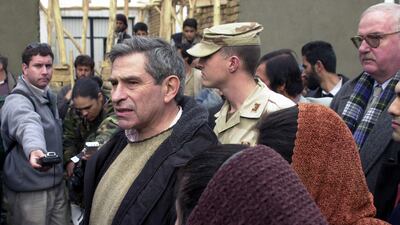
US Deputy Secretary of Defence Paul Wolfowitz addresses the media after touring the Rabia Balkhi Hospital in Kabul, Afghanistan, on January 15, 2003. US Army -
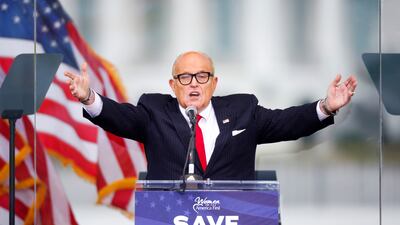
Rudy Giuliani, seen here speaking at a rally, was Mayor of New York when the 9/11 attacks took place. Reuters -

Former Special Agent John O’Neill retired from the FBI in August 2001 to lead security at the World Trade Centre. Although he escaped from his office in the North Tower after it was struck by terrorist hijackers on 9/11, he died helping others escape when the tower collapsed. Photo: FBI -
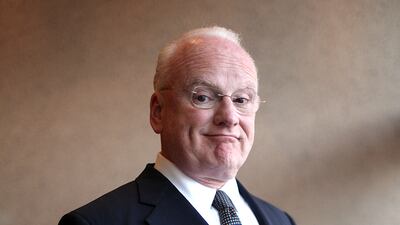
Richard Clarke worked with both the Clinton and Bush administrations to combat Al Qaeda and the Taliban. Speaking before the 9/11 Commission in 2004, Mr Clarke told the families of the victims that their government failed them. The National -
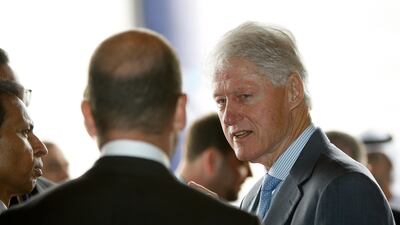
Former President Bill Clinton appeared on Australian TV 10 hours before the 9/11 attacks and said that he was obsessed with Osama bin Laden and that he almost killed him. Jeffrey E Biteng / The National


Anger also hampered the country's ability to stick to clear, strategic goals abroad. September 11 spurred a disjointed approach to the conflict in Afghanistan, which justifiably sought to capture Osama bin Laden, only for the wider mission to be confused by the invasion of Iraq. This made what was known as the war on terror a convoluted endeavour with overly grand ambitions in both Afghanistan and Iraq. President Joe Biden now criticises this as an era of "nation building".
The US military proved very effective at defeating enemies, but far less so at engaging with new governments to keep change on track and create stability for people in the region. With a sudden spike in the public's interest about Washington's policy in the Middle East, decisions were too often based off what administrations believed would win over domestic opinion.
Mr Biden's rapid withdrawal from Afghanistan is an example. One of the only cross-party issues left in the US, the decision to leave the country still polls well, although there is widespread feeling that it was carried out poorly. It might be popular, but there is no evidence it will make American's safer, the government's main responsibility.
It was scheduled to be over in time for tomorrow's anniversary. A better policy would have been centred on America's moral responsibility towards Afghans, not a symbolic date. Between the beginning of 2020, when former US president Trump signed a deal with the Taliban, and July 2021, almost 4,700 Afghan civilians were killed, more than 9/11's death toll. Some of the Americans killed in the attack on Kabul Airport last month were born after the September 11 attacks.
After two difficult decades, a more resigned America does not mean the end of engagement in the region. Its relations with the many Arab states that remain committed to helping the global effort to combat terrorism run far too deep to be shaken anytime soon.
And in a decade, emotions might be less raw and more reflective; many Americans will be too young to remember 9/11 by then. But maybe not. The horror of the day is still hard to ignore; twenty years on, 40 per cent of the remains of victims of the attack remain unidentified.
However the world deals with the trauma of 9/11 going forward, the lesson it taught America will not change: the emotions that motivate us can, if not moderated, also cloud our judgement. After the Twin Towers fell, clear-headedness was near-impossible, and that is why it was needed more than ever.

