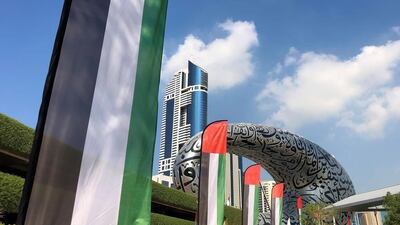
UAE flags outside the Museum of the Future in Dubai as the country celebrates its 49th National Day. Chris Whiteoak / The National

The UAE has every reason to be optimistic as the country nears its 50th year mark


  • English
  • Arabic

As we enter the year-long celebrations of the 50th anniversary of the formation of the UAE in December 1971, I have been pondering over my memories of those years, from 1975 onwards and my thoughts on the future.

One of the most remarkable features of the Emirates is how it has not just survived, but thrived. There have been ups and downs, of course. No country can escape those, especially one which, like the UAE, is so intimately bound to the global economic cycle because of its important oil and gas industry. So we have seen slumps, as well as booms. But for the most part, the country has steered a consistent path, even as its population has grown from around 250,000 at the time the federation was created to more than nine million today.

While the economy is now recovering from the Covid-19 pandemic, those of us who remember previous setbacks, such as the collapse of oil prices in the 1980s, have confidence in the UAE's ability to move forward once more.

Sheikh Zayed, Founding Father of the UAE, being briefed by Dr Farouk El-Baz, right, who was a part of America's Apollo programme. Dubai Media Office

The extraordinary extent of the acceptance of mutual coexistence amongst the UAE’s multinational population is also, in my view, something well worth remembering. This country has always welcomed people of other cultures and other faiths, of course, as anyone with a knowledge of local history can explain. This is not, though, a static process. During my years here, I have seen people arrive, become a part of the fabric of life in the Emirates and play their part in the development of community and country.

All that has taken place against a background of rapid and peaceful social and economic change that has meant that the UAE today, in terms of its urban centres, at least, is almost unrecognisable when compared to 1971. The amazement of former residents who return after a decade or two away is almost palpable.

The contrast with many of the other countries within the broader Middle East region is sufficiently sharp as to need no description.

Looking back, I give thanks that, at its birth, the UAE was endowed not just with financial resources, but with political leadership – not least that of the late Sheikh Zayed, the Founding Father – that had the wisdom to chart the course that we have followed.

What, though, can that tell us about the half-century that lies ahead?

The pace of technological progress is such that it is, I think, nearly impossible to imagine how society will look 50 years from now. How will the increasing adoption of artificial intelligence change lives, both at work and elsewhere? If advances in health care mean that the lives of most become longer, how will we adapt not just to that, but to the presumably inevitable population growth that will follow? How will the nature of travel and other communications change? What will be the key aspects of our economy, and of the economies of our present and future partners? How will our governmental system evolve to ensure the continuation of an effective two-way process of dialogue and interchange between the state and the people? How will we tackle the environmental challenges posed by climate change and the need to devise sustainable ways of exploiting natural resources before it is too late? How can we preserve the key elements of our heritage?

A 50th year celebration message of the forming of the UAE on a Dubai Metro station off Sheikh Zayed Road. The UAE's past and its future are inextricably linked. Antonie Robertson / The National
The ability to innovate and to adapt is fundamental to the UAE's successes and to overcoming challenges

For these, and for many other questions, I have no answers – merely further questions.

If, however, we look back half a century, either by recalling our own memories or by learning from those of others, a not dissimilar set of questions emerges.

Over the past 50 years, the UAE has dealt with those through a process that has involved not just careful planning but also a willingness to recognise that all plans may be liable to change as circumstances change. The ability to innovate and to adapt in pursuit of long-term goals has been fundamental both to the successes that the UAE has achieved and to the overcoming or circumventing of unexpected challenges. That ability is still evident today, as is the ability to dream.

There can be no guarantees that we will reach the targets that we now set ourselves, or, indeed, that those targets will still exist.

The same was true, of course, of the targets set back in 1971. Some have fallen by the wayside as priorities change. Others have been overtaken by changing events. What has remained, however, has been a sense of optimism, a belief that the underlying goal of creating a better society not only remains relevant but is achievable, even if the routes towards it may evolve.

Looking back, that optimism has been evident throughout our history. That is something truly worth celebrating in our anniversary year and a noble goal to set our sights on in the years ahead.

Peter Hellyer is a consultant specialising in the UAE’s history and culture

Al Jazira's foreign quartet for 2017/18

Romarinho, Brazil

Lassana Diarra, France

Sardor Rashidov, Uzbekistan

Mbark Boussoufa, Morocco

The White Lotus: Season three

Creator: Mike White

Starring: Walton Goggins, Jason Isaacs, Natasha Rothwell

Rating: 4.5/5

The major Hashd factions linked to Iran:

Badr Organisation: Seen as the most militarily capable faction in the Hashd. Iraqi Shiite exiles opposed to Saddam Hussein set up the group in Tehran in the early 1980s as the Badr Corps under the supervision of the Iran Revolutionary Guards Corps (IRGC). The militia exalts Iran’s Supreme Leader Ali Khamenei but intermittently cooperated with the US military.

Saraya Al Salam (Peace Brigade): Comprised of former members of the officially defunct Mahdi Army, a militia that was commanded by Iraqi cleric Moqtada Al Sadr and fought US and Iraqi government and other forces between 2004 and 2008. As part of a political overhaul aimed as casting Mr Al Sadr as a more nationalist and less sectarian figure, the cleric formed Saraya Al Salam in 2014. The group’s relations with Iran has been volatile.

Kataeb Hezbollah: The group, which is fighting on behalf of the Bashar Al Assad government in Syria, traces its origins to attacks on US forces in Iraq in 2004 and adopts a tough stance against Washington, calling the United States “the enemy of humanity”.

Asaeb Ahl Al Haq: An offshoot of the Mahdi Army active in Syria. Asaeb Ahl Al Haq’s leader Qais al Khazali was a student of Mr Al Moqtada’s late father Mohammed Sadeq Al Sadr, a prominent Shiite cleric who was killed during Saddam Hussein’s rule.

Harakat Hezbollah Al Nujaba: Formed in 2013 to fight alongside Mr Al Assad’s loyalists in Syria before joining the Hashd. The group is seen as among the most ideological and sectarian-driven Hashd militias in Syria and is the major recruiter of foreign fighters to Syria.

Saraya Al Khorasani:  The ICRG formed Saraya Al Khorasani in the mid-1990s and the group is seen as the most ideologically attached to Iran among Tehran’s satellites in Iraq.

(Source: The Wilson Centre, the International Centre for the Study of Radicalisation)

Mercer, the investment consulting arm of US services company Marsh & McLennan, expects its wealth division to at least double its assets under management (AUM) in the Middle East as wealth in the region continues to grow despite economic headwinds, a company official said.

Mercer Wealth, which globally has $160 billion in AUM, plans to boost its AUM in the region to $2-$3bn in the next 2-3 years from the present $1bn, said Yasir AbuShaban, a Dubai-based principal with Mercer Wealth.

Within the next two to three years, we are looking at reaching $2 to $3 billion as a conservative estimate and we do see an opportunity to do so,” said Mr AbuShaban.

Mercer does not directly make investments, but allocates clients’ money they have discretion to, to professional asset managers. They also provide advice to clients.

“We have buying power. We can negotiate on their (client’s) behalf with asset managers to provide them lower fees than they otherwise would have to get on their own,” he added.

Mercer Wealth’s clients include sovereign wealth funds, family offices, and insurance companies among others.

From its office in Dubai, Mercer also looks after Africa, India and Turkey, where they also see opportunity for growth.

Wealth creation in Middle East and Africa (MEA) grew 8.5 per cent to $8.1 trillion last year from $7.5tn in 2015, higher than last year’s global average of 6 per cent and the second-highest growth in a region after Asia-Pacific which grew 9.9 per cent, according to consultancy Boston Consulting Group (BCG). In the region, where wealth grew just 1.9 per cent in 2015 compared with 2014, a pickup in oil prices has helped in wealth generation.

BCG is forecasting MEA wealth will rise to $12tn by 2021, growing at an annual average of 8 per cent.

Drivers of wealth generation in the region will be split evenly between new wealth creation and growth of performance of existing assets, according to BCG.

Another general trend in the region is clients’ looking for a comprehensive approach to investing, according to Mr AbuShaban.

“Institutional investors or some of the families are seeing a slowdown in the available capital they have to invest and in that sense they are looking at optimizing the way they manage their portfolios and making sure they are not investing haphazardly and different parts of their investment are working together,” said Mr AbuShaban.

Some clients also have a higher appetite for risk, given the low interest-rate environment that does not provide enough yield for some institutional investors. These clients are keen to invest in illiquid assets, such as private equity and infrastructure.

“What we have seen is a desire for higher returns in what has been a low-return environment specifically in various fixed income or bonds,” he said.

“In this environment, we have seen a de facto increase in the risk that clients are taking in things like illiquid investments, private equity investments, infrastructure and private debt, those kind of investments were higher illiquidity results in incrementally higher returns.”

The Abu Dhabi Investment Authority, one of the largest sovereign wealth funds, said in its 2016 report that has gradually increased its exposure in direct private equity and private credit transactions, mainly in Asian markets and especially in China and India. The authority’s private equity department focused on structured equities owing to “their defensive characteristics.”

Benefits of first-time home buyers' scheme
  • Priority access to new homes from participating developers
  • Discounts on sales price of off-plan units
  • Flexible payment plans from developers
  • Mortgages with better interest rates, faster approval times and reduced fees
  • DLD registration fee can be paid through banks or credit cards at zero interest rates
UAE currency: the story behind the money in your pockets
F1 The Movie

Starring: Brad Pitt, Damson Idris, Kerry Condon, Javier Bardem

Director: Joseph Kosinski

Rating: 4/5

The%20Emperor%20and%20the%20Elephant
%3Cp%3E%3Cstrong%3EAuthor%3A%20%3C%2Fstrong%3ESam%20Ottewill-Soulsby%3C%2Fp%3E%0A%3Cp%3E%3Cstrong%3EPublisher%3A%20%3C%2Fstrong%3EPrinceton%20University%20Press%3C%2Fp%3E%0A%3Cp%3E%3Cstrong%3EPages%3A%20%3C%2Fstrong%3E392%3C%2Fp%3E%0A%3Cp%3E%3Cstrong%3EAvailable%3A%20%3C%2Fstrong%3EJuly%2011%3C%2Fp%3E%0A
Skoda Superb Specs

Engine: 2-litre TSI petrol

Power: 190hp

Torque: 320Nm

Price: From Dh147,000

Available: Now

The Sky Is Pink

Director: Shonali Bose

Cast: Priyanka Chopra Jonas, Farhan Akhtar, Zaira Wasim, Rohit Saraf

Three stars

Day 2, Dubai Test: At a glance

Moment of the day Pakistan’s effort in the field had hints of shambles about it. The wheels were officially off when Wahab Riaz lost his run up and aborted the delivery four times in a row. He re-measured his run, jogged in for two practice goes. Then, when he was finally ready to go, he bailed out again. It was a total cringefest.

Stat of the day – 139.5 Yasir Shah has bowled 139.5 overs in three innings so far in this Test series. Judged by his returns, the workload has not withered him. He has 14 wickets so far, and became history’s first spinner to take five-wickets in an innings in five consecutive Tests. Not bad for someone whose fitness was in question before the series.

The verdict Stranger things have happened, but it is going to take something extraordinary for Pakistan to keep their undefeated record in Test series in the UAE in tact from this position. At least Shan Masood and Sami Aslam have made a positive start to the salvage effort.

The specs: 2019 Infiniti QX50

Price, base: Dh138,000 (estimate)
Engine: 2.0L, turbocharged, in-line four-cylinder
Transmission: Continuously variable transmission
Power: 268hp @ 5,600rpm
Torque: 380Nm @ 4,400rpm
Fuel economy: 6.7L / 100km (estimate)
