• Smoke billows following air strikes on a rebel-held area in the southern city of Daraa on March 16, 2017. AFP
    Smoke billows following air strikes on a rebel-held area in the southern city of Daraa on March 16, 2017. AFP
  • Syrian army soldiers fire their weapons during a battle with rebel fighters at the Ramouseh front line, east of Aleppo, on December 5, 2016. AP Photo
    Syrian army soldiers fire their weapons during a battle with rebel fighters at the Ramouseh front line, east of Aleppo, on December 5, 2016. AP Photo
  • Russians, Syrians and others gather next to an American military convoy stuck in the village of Khirbet Ammu, east of Qamishli city, on February 12, 2020. AP Photo
    Russians, Syrians and others gather next to an American military convoy stuck in the village of Khirbet Ammu, east of Qamishli city, on February 12, 2020. AP Photo
  • A Russian soldier mans a machine gun during a patrol near the Syrian and Turkish border in north Syria on October 25, 2019. AP Photo
    A Russian soldier mans a machine gun during a patrol near the Syrian and Turkish border in north Syria on October 25, 2019. AP Photo
  • Turkish tanks and troops stationed near Syrian town of Manbij. AP
    Turkish tanks and troops stationed near Syrian town of Manbij. AP
  • Crew of Bradley fighting vehicles stand at a US military base in north-eastern Syria on November 11, 2019. AP Photo
    Crew of Bradley fighting vehicles stand at a US military base in north-eastern Syria on November 11, 2019. AP Photo
  • Anti-government protesters flash victory signs as they protest in the southern Syrian city of Daraa on March 23, 2011. AP Photo
    Anti-government protesters flash victory signs as they protest in the southern Syrian city of Daraa on March 23, 2011. AP Photo
  • Syrians climb up a mud bank as they flee across fields to reach the Syrian-Turkish border on March 10, 2014. AFP
    Syrians climb up a mud bank as they flee across fields to reach the Syrian-Turkish border on March 10, 2014. AFP
  • Syrian men gather outside the courthouse in Daraa that was torched a day earlier by angry protesters on March 21, 2011. AFP
    Syrian men gather outside the courthouse in Daraa that was torched a day earlier by angry protesters on March 21, 2011. AFP
  • Rebel fighters inside a building during clashes with pro-government forces in the Sheikh Al Said neighbourhood of Aleppo city on November 28, 2013. AFP
    Rebel fighters inside a building during clashes with pro-government forces in the Sheikh Al Said neighbourhood of Aleppo city on November 28, 2013. AFP
  • Syrians bury victims in a group funeral following air strikes in the rebel-held city of Douma on January 7, 2016. AFP
    Syrians bury victims in a group funeral following air strikes in the rebel-held city of Douma on January 7, 2016. AFP
  • A man reacts to the destruction of his home in an air strike by government forces on the northern Syrian city of Aleppo on February 22, 2014. AFP
    A man reacts to the destruction of his home in an air strike by government forces on the northern Syrian city of Aleppo on February 22, 2014. AFP
  • A woman is helped through the rubble of buildings hit by a reported Syrian government air strike in Al Sakhour district of Aleppo city on April 4, 2014. AFP
    A woman is helped through the rubble of buildings hit by a reported Syrian government air strike in Al Sakhour district of Aleppo city on April 4, 2014. AFP
  • Debris fills a street and flames rise from a building following an air strike by Syrian government forces in the Sukkari neighborhood of Aleppo on March 7, 2014. AFP
    Debris fills a street and flames rise from a building following an air strike by Syrian government forces in the Sukkari neighborhood of Aleppo on March 7, 2014. AFP
  • A man is comforted following an air strike by government forces that killed a rescue worker in Aleppo city on March 9, 2014. AFP
    A man is comforted following an air strike by government forces that killed a rescue worker in Aleppo city on March 9, 2014. AFP
  • A tank seized by rebel fighters fires at a pro-government position near the Syrian city of Hama on February 19, 2014. AFP
    A tank seized by rebel fighters fires at a pro-government position near the Syrian city of Hama on February 19, 2014. AFP
  • An injured Syrian youth cries as he is carried on a gurney following an air strike in the Maadi neighbourhood of Aleppo city on December 17, 2013. AFP
    An injured Syrian youth cries as he is carried on a gurney following an air strike in the Maadi neighbourhood of Aleppo city on December 17, 2013. AFP
  • A Syrian boy holds an oxygen mask to an infant's face following a reported gas attack in Douma on January 22, 2018, when the town near Damascus was held by rebels. AFP
    A Syrian boy holds an oxygen mask to an infant's face following a reported gas attack in Douma on January 22, 2018, when the town near Damascus was held by rebels. AFP
  • Displaced Syrians wait to enter Turkey from Idlib province across the Orontes river on February 5, 2014. AFP
    Displaced Syrians wait to enter Turkey from Idlib province across the Orontes river on February 5, 2014. AFP

The Syrian war has had a ripple effect around the world


  • English
  • Arabic

Nine years ago this week, Syrians broke a barrier of fear that had gripped their lives for decades. They took to the streets demanding dignity from a regime and a security apparatus that had imposed totalitarian control, terrorised its own citizens and sponsored terrorist groups throughout the region.

Their act of defiance was met with great cruelty and violence. Their cause was betrayed by the international community. The betrayal of their aspirations changed the international order.

The anniversary of the Syrian revolution this year is muted. The coronavirus outbreak has stunned the whole world, grounding the global economy to a standstill, leaving ordinary people scrambling to find enough food and household supplies to last them through possible quarantines. Fear is gripping all of humanity as we all grapple with deep changes to the way we live, work and be.

In addition, there are few left fighting for the cause of freedom from tyranny, besides powerless, ordinary civilians and activists. The intervention of so many regional and global powers, the myriad internecine conflicts, the rise of extremist groups such as ISIS, the sheer destruction wrought by the regime of Bashar Al Assad in response to calls for reform – all of that disfigured the face of the uprising, whose spirit nevertheless endured under the suffocating violence.

But understanding how we got to here is nevertheless worthwhile. It goes to the heart of figuring out the kind of world we want to build together. The ongoing pandemic has illustrated how nothing in our world happens in isolation, how a butterfly’s wing flap can echo around the world and become a hurricane. It is the same with Syria, where nine years of cruelty destroyed long-cherished norms and laws that were meant to enshrine our decency towards one another.

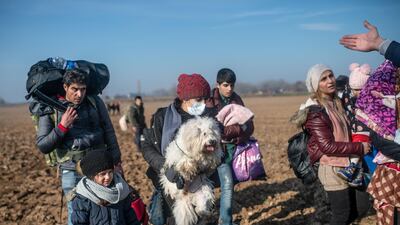
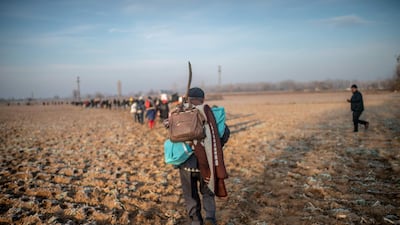
  • Migrants walk towards the Greek border in Pazarkule, in the Edirne district. Thousands of migrants stuck on the Turkey-Greece border clashed with Greek police. AFP
    Migrants walk towards the Greek border in Pazarkule, in the Edirne district. Thousands of migrants stuck on the Turkey-Greece border clashed with Greek police. AFP
  • Children sit on a beach near Skala Sykamineas on the Greek Lesbos island after crossing the Aegean sea between Turkey and Greece. AFP
    Children sit on a beach near Skala Sykamineas on the Greek Lesbos island after crossing the Aegean sea between Turkey and Greece. AFP
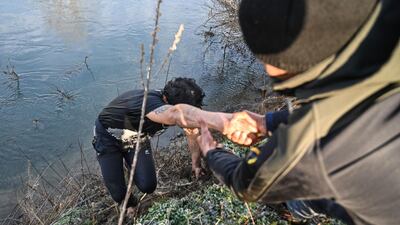
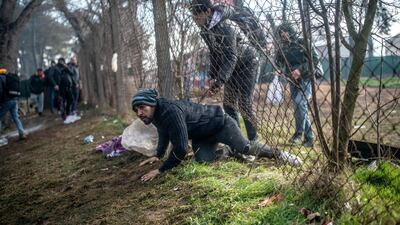
  • Migrants help each other after an attempt to enter Greece from a location near Edirne, Turkey, by crossing the Maritsa river. AFP
    Migrants help each other after an attempt to enter Greece from a location near Edirne, Turkey, by crossing the Maritsa river. AFP
  • Migrants walk towards the Greek border in Pazarkule, in the Edirne district. AFP
    Migrants walk towards the Greek border in Pazarkule, in the Edirne district. AFP
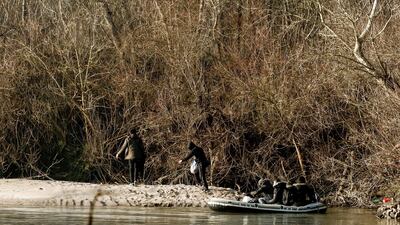
  • Migrants on a dinghy cross the Evros river to reach Greece, pictured from the Turkish border city of Edirne, Turkey. Reuters
    Migrants on a dinghy cross the Evros river to reach Greece, pictured from the Turkish border city of Edirne, Turkey. Reuters
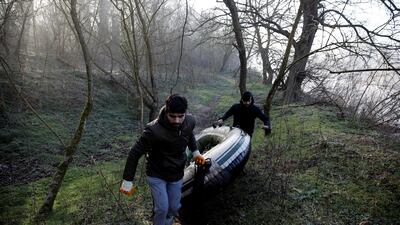
  • Migrants carry a dinghy to cross the Evros river to reach Greece, pictured near the Turkish border city of Edirne, Turkey. Reuters
    Migrants carry a dinghy to cross the Evros river to reach Greece, pictured near the Turkish border city of Edirne, Turkey. Reuters
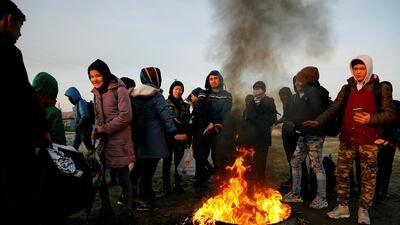
  • Migrants gather around a fire as they wait to cross the Evros river to reach Greece, near Doyran Village, near the Turkish border city of Edirne, Turkey. Reuters
    Migrants gather around a fire as they wait to cross the Evros river to reach Greece, near Doyran Village, near the Turkish border city of Edirne, Turkey. Reuters
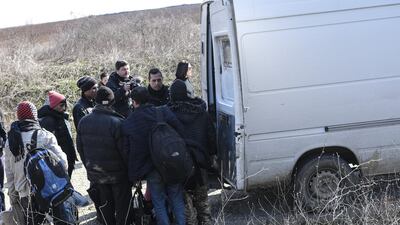
  • A group of migrants are detained after being caught by police on the side of the highway near the Greek-Turkish border. Getty Images
    A group of migrants are detained after being caught by police on the side of the highway near the Greek-Turkish border. Getty Images
  • Migrants on a dinghy cross the Evros river and reach Greece, pictured from the Turkish border city of Edirne, Turkey. Reuters
    Migrants on a dinghy cross the Evros river and reach Greece, pictured from the Turkish border city of Edirne, Turkey. Reuters
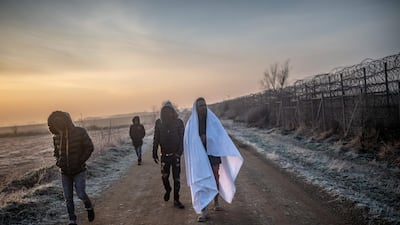
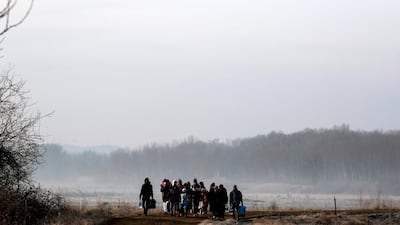
  • Migrants walk along the Evros river to reach Greece, near the Turkish border city of Edirne, Turkey. Reuters
    Migrants walk along the Evros river to reach Greece, near the Turkish border city of Edirne, Turkey. Reuters
  • Migrants sit waiting near the buffer zone at Turkey-Greece border, at Pazarkule, in Edirne district. AFP
    Migrants sit waiting near the buffer zone at Turkey-Greece border, at Pazarkule, in Edirne district. AFP
  • A migrant passes to the buffer zone during clashes with Greek police at the Turkey-Greece border, at Pazarkule, in Edirne distric. Thousands of migrants stuck on the Turkey-Greece border clashed with Greek police. AFP
    A migrant passes to the buffer zone during clashes with Greek police at the Turkey-Greece border, at Pazarkule, in Edirne distric. Thousands of migrants stuck on the Turkey-Greece border clashed with Greek police. AFP
  • A migrant walk towards the Greek border in Pazarkule, in the Edirne district. AFP
    A migrant walk towards the Greek border in Pazarkule, in the Edirne district. AFP
Ordinary Syrians' act of defiance was met with great cruelty and violence. Their cause was betrayed by the international community. The betrayal of their aspirations changed the international order

Here is what happened, in as brief a recounting as possible. In 2011, emboldened by the Arab uprisings, Syrians turned out en masse to protest the Assad regime's abuses and injustices. They were met with relentless violence. Protesters eventually picked up arms to defend themselves, but the atrocities continued. Civilians were besieged and starved to death. Hospitals were bombed. Activists were arrested and tortured. Chemical weapons were used to kill hundreds of civilians. Barrels filled with shrapnel and TNT were dropped on civilian homes.

As it became clear that the regime’s crimes would not be punished, the armed rebellion gained steam, and radicals and extremist groups gained prominence and power. Some of these fighters metastasised into a primal, savage gang known as ISIS, which became an obsession for the international community, which sought to destroy the group but not to address the cruelty that created the conditions for their rise.

As outside powers intervened – particularly Russia, Iran and Turkey – the conflict became a battle of wills to assert dominance in a new regional and international order, atop the countless corpses of Syrian civilians who simply wanted to live with dignity.

Nobody knows how many of them died. The UN stopped counting when they were around 400,000 six years ago, and the figure is probably close to a million by now. Half of the country had to flee their homes, either displaced to towns and villages farther away from the frontline or seeking refuge farther afield, over the border in Turkey, Lebanon and Jordan, or beyond, on European shores.

Their arrival in Europe spurred long-dormant far right, anti-immigrant parties who transformed the politics of the continent, auguring Britain's Brexit vote and the rise of the ultimate populist in America, Donald Trump, who slowly but surely began dismantling the apparatus of the liberal global order and abandoned alliances that underpinned international peace and security.

German government officials have warned that far-right extremism was the biggest terror threat facing the country. EPA

All the while, the carnage continued in Syria. More chemical attacks went unpunished – there were 222 in total since the start of the uprising, according to the Syrian Network for Human Rights, most of which used chlorine. More than 14,000 people have died by torture. At least 130,000 are still forcibly disappeared in the regime’s prison networks, their fate unknown.

Now, the country is a failed state. The Assad regime has clawed back much of it from rebels, who are largely sequestered in Idlib, a north-western province bordering Turkey. Three million live there, most of them women and children, and a million were displaced in recent fighting. They have nowhere to go, and nobody to fight for them. In regime-controlled areas, people are going hungry, unable to afford basic necessities. Without political reform, justice, reconstruction and a lifting of sanctions, the future of the country remains uncertain, its society a fractured mosaic.

Over nine years, Syrians’ aspirations have been crushed by a dictator unwilling to let go of what he considers a family fiefdom, and an international community that has steadfastly refused to do what was right. The slaughter of so many, and destruction at such a scale, eroded international law and the human spirit.

Perhaps, after the pandemic, we will rebuild a world where what happened in Syria will not be allowed to go on for nine years.

Kareem Shaheen is a former Middle East correspondent based in Canada