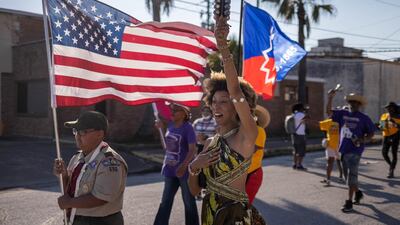
Federal holidays in the US are few and far between. It has been almost 40 years since a new one, Martin Luther King Jr Day (MLK Day), was adopted in 1983. So when US President Joe Biden signed the Juneteenth National Independence Day Act last week, it was, as he might have said: “a big… deal”.
Juneteenth is not widely known outside the US, and only recently gaining widespread recognition outside the Black community. Last year, when former president Donald Trump was considering holding a rally in Tulsa, the site of a heinous massacre of African-Americans, on Juneteenth he reportedly declared: "no one's ever heard of it”.
In fact, Juneteenth has long served as a de facto African-American Independence Day, commemorating the long-delayed enforcement in June 1865 in Texas of the Emancipation Proclamation issued by Abraham Lincoln that ended slavery in the rebellious states during the Civil War.
It effectively stands in for the comprehensive national abolition of slavery, which technically occurred with the ratification of the 13th Amendment to the Constitution in December 1865.
The point is not the date, but that the whole country should officially celebrate the abolition of slavery as a second national Independence Day, along with the traditional Independence Day on the fourth of July.
Some on the conservative far right complained that this will somehow undermine the unifying effect of the July 4 celebrations. Indeed, all limited opposition in Congress came from right-wing Republicans.
Yet the passage was swift enough, just two days before its first implementation, to take many Americans by surprise, as some were delighted by a sudden day off and others had to scramble to figure out what to do with their school-age children.
Systematic discrimination continues to define much of American life
This is certainly another milestone for the integration of the African-American experience into the national narrative.
Some dismiss the new holiday as purely symbolic. Critics say so many Republicans were happy to vote for a representational gesture as a cover for the attack against voting access, and consistent opposition to other measures that would materially improve rights and conditions for minority communities.
Over time, clearly, national symbolism and stories have a profound effect. That is why they matter so much. So, a new federal holiday cannot seriously be dismissed as irrelevant.
The question is what shapes the broader national narrative into which it will fit. A profound struggle is engaged over how to define racism and how to understand its role in US history.
This year the Republicans embraced as a major theme a passionate assault on "Critical Race Theory," which, strictly speaking, is a legal studies methodology that examines the impact and legacy of white supremacy in laws and regulations, and that critiques traditional liberal approaches.
CRT is now employed as a catchall by Republicans to condemn virtually all educational programmes to seriously examine the legacy and ongoing functioning of racism.
It is easy to understand why the white far-right seized on this heretofore obscure academic terminology. “Critical” sounds like criticism. “Race” itself sounds accusatory to many white Americans. And “Theory” sounds like some academic gibberish.
Whenever there is any consideration of structural or systemic racism, the far-right now identifies the evil hand of CRT. And they rush to claim it condemns the US as inherently racist, irredeemable or evil.
That is a platform for anti-anti-racism, the rejection of any notion that racism remains a deep-seated, systemic problem that must be urgently addressed.
Republican state legislatures around the country are busy banning the teaching of CRT in schools, a basically nonexistent phenomenon.
A new Florida political-correctness law prohibits teaching “that racism is embedded in American society and its legal systems in order to uphold the supremacy of white persons.” Apparently, any such observation is considered ridiculous or very dangerous.
Schools now “may not define American history as something other than the creation of a new nation based largely on universal principles stated in the Declaration of Independence.”
That cannot be honestly asserted because the founding document of the new nation, the Constitution, included several passages acknowledging the legitimacy of chattel slavery, including defining slaves as three-fifths of a person for political representation.
As American society sails into the dangerous waters of a long-overdue racial reckoning, it badly lacks a shared definition of what racism is, both in theory and in practice.
On the right, racism is almost always conceptualised as an expression of a person's overt, personal biases or at most long-resolved and repudiated errors of the past.
By decontextualising the problem, this sets up the now-familiar claim that anti-racists are "the real racists," because they are accused of casting collective blame against white people or suggesting Black Americans simply cannot thrive.
Some leading scholars and practitioners of antiracism on the left have reinforced these attacks by crafting a reductive binary whereby every entity, process or individual is either actively and programmatically anti-racist, as they define it, or is instead, ipso facto, racist. There is no middle ground. There is antiracism, of its own variety, and everything else is essentially racism.
That destructive discourse, especially when fully unpacked, begins to feel exceedingly accusatory to many well-meaning white Americans.
Many are required by their employers to attend anti-bias training seminars. These seminars can sometimes do more harm than good by making reasonable people feel ideologically browbeaten or accused merely on the basis of their white identity.
Anything that hints of an ideological struggle session is more likely to promote than combat racial bias and resentment.
Yet obviously centuries of slavery and decades of segregation and systematic discrimination continue to define much of American life.
Some “errors of the past” are very much realities of the present.
The impact of segregation was not magically evaporated by MLK Day. The haunting legacy of slavery won’t be exorcised by Juneteenth.
Simply passing laws to prohibit forms of discrimination that had been legally mandated and culturally enforced for hundreds of years cannot suddenly eradicate all of their functions and consequences.
They remain pervasive and resonate throughout American society to this day, particularly regarding essential social services like education and healthcare, not to mention policing.
Yet as suggested by the passionate battle over historical narratives – given their indisputable power to shape perceptions over many generations – if Republicans approved the Juneteenth holiday as a cover for opposition to voting rights and other crucial tools to combat ongoing racism, they probably only exchanged short-term victory for long-term defeat.
Hussein Ibish is a senior resident scholar at the Arab Gulf States Institute and a US affairs columnist for The National

Results
5pm: Warsan Lake – Maiden (PA) Dh80,000 (Turf) 2,200m; Winner: Dhaw Al Reef, Sam Hitchcott (jockey), Abdallah Al Hammadi (trainer)
5.30pm: Al Quadra Lake – Maiden (PA) Dh80,000 (T) 1,600m; Winner: Mrouwah Al Gharbia, Sando Paiva, Abubakar Daud
6pm: Hatta Lake – Handicap (PA) Dh80,000 (T) 1,600m; Winner: AF Yatroq, George Buckell, Ernst Oertel
6.30pm: Wathba Stallions Cup – Handicap (PA) Dh70,000 (T) 1,600m; Winner: Ashton Tourettes, Adries de Vries, Ibrahim Aseel
7pm: Abu Dhabi Championship – Listed (PA) Dh180,000 (T) 1,600m; Winner: Bahar Muscat, Antonio Fresu, Ibrahim Al Hadhrami
7.30pm: Zakher Lake – Rated Conditions (TB) Dh80,000 (T) 1,400m; Winner: Alfareeq, Dane O’Neill, Musabah Al Muhairi.
Ten tax points to be aware of in 2026
1. Domestic VAT refund amendments: request your refund within five years
If a business does not apply for the refund on time, they lose their credit.
2. E-invoicing in the UAE
Businesses should continue preparing for the implementation of e-invoicing in the UAE, with 2026 a preparation and transition period ahead of phased mandatory adoption.
3. More tax audits
Tax authorities are increasingly using data already available across multiple filings to identify audit risks.
4. More beneficial VAT and excise tax penalty regime
Tax disputes are expected to become more frequent and more structured, with clearer administrative objection and appeal processes. The UAE has adopted a new penalty regime for VAT and excise disputes, which now mirrors the penalty regime for corporate tax.
5. Greater emphasis on statutory audit
There is a greater need for the accuracy of financial statements. The International Financial Reporting Standards standards need to be strictly adhered to and, as a result, the quality of the audits will need to increase.
6. Further transfer pricing enforcement
Transfer pricing enforcement, which refers to the practice of establishing prices for internal transactions between related entities, is expected to broaden in scope. The UAE will shortly open the possibility to negotiate advance pricing agreements, or essentially rulings for transfer pricing purposes.
7. Limited time periods for audits
Recent amendments also introduce a default five-year limitation period for tax audits and assessments, subject to specific statutory exceptions. While the standard audit and assessment period is five years, this may be extended to up to 15 years in cases involving fraud or tax evasion.
8. Pillar 2 implementation
Many multinational groups will begin to feel the practical effect of the Domestic Minimum Top-Up Tax (DMTT), the UAE's implementation of the OECD’s global minimum tax under Pillar 2. While the rules apply for financial years starting on or after January 1, 2025, it is 2026 that marks the transition to an operational phase.
9. Reduced compliance obligations for imported goods and services
Businesses that apply the reverse-charge mechanism for VAT purposes in the UAE may benefit from reduced compliance obligations.
10. Substance and CbC reporting focus
Tax authorities are expected to continue strengthening the enforcement of economic substance and Country-by-Country (CbC) reporting frameworks. In the UAE, these regimes are increasingly being used as risk-assessment tools, providing tax authorities with a comprehensive view of multinational groups’ global footprints and enabling them to assess whether profits are aligned with real economic activity.
Contributed by Thomas Vanhee and Hend Rashwan, Aurifer
WHEN TO GO:
September to November or March to May; this is when visitors are most likely to see what they’ve come for.
WHERE TO STAY:
Meghauli Serai, A Taj Safari - Chitwan National Park resort (tajhotels.com) is a one-hour drive from Bharatpur Airport with stays costing from Dh1,396 per night, including taxes and breakfast. Return airport transfers cost from Dh661.
HOW TO GET THERE:
Etihad Airways regularly flies from Abu Dhabi to Kathmandu from around Dh1,500 per person return, including taxes. Buddha Air (buddhaair.com) and Yeti Airlines (yetiairlines.com) fly from Kathmandu to Bharatpur several times a day from about Dh660 return and the flight takes just 20 minutes. Driving is possible but the roads are hilly which means it will take you five or six hours to travel 148 kilometres.
ALRAWABI%20SCHOOL%20FOR%20GIRLS
%3Cp%3ECreator%3A%20Tima%20Shomali%3C%2Fp%3E%0A%3Cp%3EStarring%3A%C2%A0Tara%20Abboud%2C%C2%A0Kira%20Yaghnam%2C%20Tara%20Atalla%3C%2Fp%3E%0A%3Cp%3ERating%3A%204%2F5%3C%2Fp%3E%0A
Gully Boy
Director: Zoya Akhtar
Producer: Excel Entertainment & Tiger Baby
Cast: Ranveer Singh, Alia Bhatt, Kalki Koechlin, Siddhant Chaturvedi
Rating: 4/5 stars
The biog
Name: Abeer Al Bah
Born: 1972
Husband: Emirati lawyer Salem Bin Sahoo, since 1992
Children: Soud, born 1993, lawyer; Obaid, born 1994, deceased; four other boys and one girl, three months old
Education: BA in Elementary Education, worked for five years in a Dubai school
How has net migration to UK changed?
The figure was broadly flat immediately before the Covid-19 pandemic, standing at 216,000 in the year to June 2018 and 224,000 in the year to June 2019.
It then dropped to an estimated 111,000 in the year to June 2020 when restrictions introduced during the pandemic limited travel and movement.
The total rose to 254,000 in the year to June 2021, followed by steep jumps to 634,000 in the year to June 2022 and 906,000 in the year to June 2023.
The latest available figure of 728,000 for the 12 months to June 2024 suggests levels are starting to decrease.
Dengue%20fever%20symptoms
%3Cul%3E%0A%3Cli%3EHigh%20fever%3C%2Fli%3E%0A%3Cli%3EIntense%20pain%20behind%20your%20eyes%3C%2Fli%3E%0A%3Cli%3ESevere%20headache%3C%2Fli%3E%0A%3Cli%3EMuscle%20and%20joint%20pains%3C%2Fli%3E%0A%3Cli%3ENausea%3C%2Fli%3E%0A%3Cli%3EVomiting%3C%2Fli%3E%0A%3Cli%3ESwollen%20glands%3C%2Fli%3E%0A%3Cli%3ERash%3C%2Fli%3E%0A%3C%2Ful%3E%0A%3Cp%3EIf%20symptoms%20occur%2C%20they%20usually%20last%20for%20two-seven%20days%3C%2Fp%3E%0A
Museum of the Future in numbers
- 78 metres is the height of the museum
- 30,000 square metres is its total area
- 17,000 square metres is the length of the stainless steel facade
- 14 kilometres is the length of LED lights used on the facade
- 1,024 individual pieces make up the exterior
- 7 floors in all, with one for administrative offices
- 2,400 diagonally intersecting steel members frame the torus shape
- 100 species of trees and plants dot the gardens
- Dh145 is the price of a ticket
BUNDESLIGA FIXTURES
Friday (all kick-offs UAE time)
Hertha Berlin v Union Berlin (10.30pm)
Saturday
Freiburg v Werder Bremen (5.30pm)
Paderborn v Hoffenheim (5.30pm)
Wolfsburg v Borussia Dortmund (5.30pm)
Borussia Monchengladbach v Bayer Leverkusen (5.30pm)
Bayern Munich v Eintracht Frankfurt (5.30pm)
Sunday
Schalke v Augsburg (3.30pm)
Mainz v RB Leipzig (5.30pm)
Cologne v Fortuna Dusseldorf (8pm)
COMPANY%20PROFILE
%3Cp%3E%3Cstrong%3EName%3A%20%3C%2Fstrong%3EElmawkaa%3Cbr%3E%3Cstrong%3EBased%3A%3C%2Fstrong%3E%20Hub71%2C%20Abu%20Dhabi%3Cbr%3E%3Cstrong%3EFounders%3A%3C%2Fstrong%3E%20Ebrahem%20Anwar%2C%20Mahmoud%20Habib%20and%20Mohamed%20Thabet%3Cbr%3E%3Cstrong%3ESector%3A%3C%2Fstrong%3E%20PropTech%3Cbr%3E%3Cstrong%3ETotal%20funding%3A%3C%2Fstrong%3E%20%24400%2C000%3Cbr%3E%3Cstrong%3EInvestors%3A%20%3C%2Fstrong%3E500%20Startups%2C%20Flat6Labs%20and%20angel%20investors%3Cbr%3E%3Cstrong%3ENumber%20of%20employees%3A%3C%2Fstrong%3E%2012%3Cbr%3E%3C%2Fp%3E%0A
War
Director: Siddharth Anand
Cast: Hrithik Roshan, Tiger Shroff, Ashutosh Rana, Vaani Kapoor
Rating: Two out of five stars
WWE Super ShowDown results
Seth Rollins beat Baron Corbin to retain his WWE Universal title
Finn Balor defeated Andrade to stay WWE Intercontinental Championship
Shane McMahon defeated Roman Reigns
Lars Sullivan won by disqualification against Lucha House Party
Randy Orton beats Triple H
Braun Strowman beats Bobby Lashley
Kofi Kingston wins against Dolph Zigggler to retain the WWE World Heavyweight Championship
Mansoor Al Shehail won the 50-man Battle Royal
The Undertaker beat Goldberg
GIANT REVIEW
Starring: Amir El-Masry, Pierce Brosnan
Director: Athale
Rating: 4/5
More from Neighbourhood Watch:
The%20specs
%3Cp%3E%3Cstrong%3EEngine%3A%20%3C%2Fstrong%3ETwin-turbo%2C%20V8%3Cbr%3E%3Cstrong%3ETransmission%3A%20%3C%2Fstrong%3E8-speed%20automatic%20and%20manual%3Cbr%3E%3Cstrong%3EPower%3A%20%3C%2Fstrong%3E503%20bhp%3Cbr%3E%3Cstrong%3ETorque%3A%20%3C%2Fstrong%3E513Nm%3Cbr%3E%3Cstrong%3EPrice%3A%20%3C%2Fstrong%3Efrom%20Dh646%2C800%20(%24176%2C095)%3Cbr%3E%3Cstrong%3EOn%20sale%3A%20%3C%2Fstrong%3Enow%3C%2Fp%3E%0A
WTL%20SCHEDULE
%3Cp%3EDECEMBER%2019%20(6pm)%0D%3Cbr%3EKites%20v%20Eagles%0D%3Cbr%3EAliassime%20v%20Kyrgios%0D%3Cbr%3ESwiatek%20v%20Garcia%0D%3Cbr%3EEntertainment%3A%20Tiesto%3C%2Fp%3E%0A%3Cp%3EDECEMBER%2020%20(6pm)%0D%3Cbr%3EFalcons%20v%20Hawks%0D%3Cbr%3EDjokovic%20v%20Zverev%0D%3Cbr%3ESabalenka%20v%20Rybakina%0D%3Cbr%3EEntertainment%3A%20Wizkid%0D%3Cbr%3E%0D%3Cbr%3EDECEMBER%2021%20(6pm)%0D%3Cbr%3EFalcons%20v%20Eagles%0D%3Cbr%3EDjokovic%20v%20Kyrgios%0D%3Cbr%3EBadosa%20v%20Garcia%0D%3Cbr%3EEntertainment%3A%20Ne-Yo%0D%3Cbr%3E%0D%3Cbr%3EDECEMBER%2022%20(6pm)%0D%3Cbr%3EHawks%20v%20Kites%0D%3Cbr%3EThiem%20v%20Aliassime%0D%3Cbr%3EKontaveit%20v%20Swiatek%0D%3Cbr%3EEntertainment%3A%20deadmau5%0D%3Cbr%3E%0D%3Cbr%3EDECEMBER%2023%20(2pm)%0D%3Cbr%3EEagles%20v%20Hawks%0D%3Cbr%3EKyrgios%20v%20Zverev%0D%3Cbr%3EGarcia%20v%20Rybakina%0D%3Cbr%3EEntertainment%3A%20Mohammed%20Ramadan%0D%3Cbr%3E%0D%3Cbr%3EDECEMBER%2023%20(6pm)%0D%3Cbr%3EFalcons%20v%20Kites%0D%3Cbr%3EDjokovic%20v%20Aliassime%0D%3Cbr%3ESabalenka%20v%20Swiatek%0D%3Cbr%3EEntertainment%3A%20Mohammed%20Ramadan%0D%3Cbr%3E%0D%3Cbr%3EDECEMBER%2024%20(6pm)%0D%3Cbr%3EFinals%0D%3Cbr%3EEntertainment%3A%20Armin%20Van%20Buuren%0D%3Cbr%3E%0D%3C%2Fp%3E%0A
THREE
%3Cp%3EDirector%3A%20Nayla%20Al%20Khaja%3C%2Fp%3E%0A%3Cp%3EStarring%3A%20Jefferson%20Hall%2C%20Faten%20Ahmed%2C%20Noura%20Alabed%2C%20Saud%20Alzarooni%3C%2Fp%3E%0A%3Cp%3ERating%3A%203.5%2F5%3C%2Fp%3E%0A
Mercer, the investment consulting arm of US services company Marsh & McLennan, expects its wealth division to at least double its assets under management (AUM) in the Middle East as wealth in the region continues to grow despite economic headwinds, a company official said.
Mercer Wealth, which globally has $160 billion in AUM, plans to boost its AUM in the region to $2-$3bn in the next 2-3 years from the present $1bn, said Yasir AbuShaban, a Dubai-based principal with Mercer Wealth.
“Within the next two to three years, we are looking at reaching $2 to $3 billion as a conservative estimate and we do see an opportunity to do so,” said Mr AbuShaban.
Mercer does not directly make investments, but allocates clients’ money they have discretion to, to professional asset managers. They also provide advice to clients.
“We have buying power. We can negotiate on their (client’s) behalf with asset managers to provide them lower fees than they otherwise would have to get on their own,” he added.
Mercer Wealth’s clients include sovereign wealth funds, family offices, and insurance companies among others.
From its office in Dubai, Mercer also looks after Africa, India and Turkey, where they also see opportunity for growth.
Wealth creation in Middle East and Africa (MEA) grew 8.5 per cent to $8.1 trillion last year from $7.5tn in 2015, higher than last year’s global average of 6 per cent and the second-highest growth in a region after Asia-Pacific which grew 9.9 per cent, according to consultancy Boston Consulting Group (BCG). In the region, where wealth grew just 1.9 per cent in 2015 compared with 2014, a pickup in oil prices has helped in wealth generation.
BCG is forecasting MEA wealth will rise to $12tn by 2021, growing at an annual average of 8 per cent.
Drivers of wealth generation in the region will be split evenly between new wealth creation and growth of performance of existing assets, according to BCG.
Another general trend in the region is clients’ looking for a comprehensive approach to investing, according to Mr AbuShaban.
“Institutional investors or some of the families are seeing a slowdown in the available capital they have to invest and in that sense they are looking at optimizing the way they manage their portfolios and making sure they are not investing haphazardly and different parts of their investment are working together,” said Mr AbuShaban.
Some clients also have a higher appetite for risk, given the low interest-rate environment that does not provide enough yield for some institutional investors. These clients are keen to invest in illiquid assets, such as private equity and infrastructure.
“What we have seen is a desire for higher returns in what has been a low-return environment specifically in various fixed income or bonds,” he said.
“In this environment, we have seen a de facto increase in the risk that clients are taking in things like illiquid investments, private equity investments, infrastructure and private debt, those kind of investments were higher illiquidity results in incrementally higher returns.”
The Abu Dhabi Investment Authority, one of the largest sovereign wealth funds, said in its 2016 report that has gradually increased its exposure in direct private equity and private credit transactions, mainly in Asian markets and especially in China and India. The authority’s private equity department focused on structured equities owing to “their defensive characteristics.”
Islamophobia definition
A widely accepted definition was made by the All Party Parliamentary Group on British Muslims in 2019: “Islamophobia is rooted in racism and is a type of racism that targets expressions of Muslimness or perceived Muslimness.” It further defines it as “inciting hatred or violence against Muslims”.
