

As US and European diplomats were exploring ways for Iran and the US to return to the nuclear deal they signed in 2015, the Supreme Leader, Ayatollah Ali Khamenei, decided to grab more leverage. On February 7, he issued a “final and irreversible” decision for Iran not to return to the deal until Washington lifts all sanctions. He also gave his assent to the expansion of Iran’s nuclear activities.
During the recent US presidential election, Mr Khamenei placed great confidence in the promise of Democratic candidate Joe Biden and his prospective team to move quickly to rejoin the 2015 nuclear deal in the event that he won. But although Mr Biden was elected, Mr Khamenei’s ploy has changed Washington’s calculus, and botched the carefully thought-through plans of diplomats and others on both sides of the Atlantic and in Iran. Conversations and discussions are continuing, but the track ahead looks tension-ridden, slow-paced and uncertain.
Is Mr Biden able to resolve the US’s Iran dilemma, a feat pursued unsuccessfully by seven presidents before him? It is doubtful that a new nuclear deal today will change Tehran’s malign strategic trajectory. Still, Washington’s foreign policy machinery has instruments and expertise at its disposal to manoeuvre concurrently to resolve the puzzle. It takes a fresh perspective from the Biden administration.
In 2015, the deal was heralded as a win-win situation for the international community and the Iranian people. The relaxation of sanctions opened the door for the flow of more than $100 billion worth of oil revenues into the Iranian system. Were the proceeds allocated to curing the socio-economic problems of the country?
Special transfers to religious and ideological foundations, state companies, banks and for-profit organisations certainly continued, and the budget for the defence and security sectors increased. From July 2015, when the nuclear agreement was struck, to January 2017, nearly 110 deals worth at least $80bn were struck. And 90 were with companies owned or controlled by Iranian state entities, according to a Reuters report.
The regime also expanded its cyber capabilities. Between 2013 and 2017, the Islamic Republic Cyber Army stole more than 31 terabytes of documents and data from 144 US universities, 176 other universities in 21 countries and 47 domestic and foreign private sector companies. Public-sector victims include the US Department of Labour, the UN and Unicef.
Government funds have also been dispensed to terrorist groups and other malevolent actors. Tehran allowed Al Qaeda to strengthen its operational presence in Iran. In a 2016 broadcast, Hassan Nasrallah, the head of the Lebanese militant organisation Hezbollah, confirmed that his group's "budget, income, expenses, everything it eats and drinks, its weapons and rockets, come from the Islamic Republic of Iran". By 2018, Tehran was spending at least $6bn annually on maintaining Bashar Al Assad's government in Syria.
The absence of good governance is depleting Iran of its national wealth and resources. The chairman of Tehran’s Chamber of Commerce, Industries, Mines and Agriculture estimates that between 2012 and 2020, $98bn of capital was taken out of the country.
Systemic theft, corruption, mismanagement and repression are leading Iran and its economy to ruin. The rise in poverty is crippling. According to a report published last June by the Iranian parliament's research centre, 70 per cent of the country's 40 million working-class households live under the poverty line. This group historically has formed the support base of the clerical regime. They are disenfranchised, angry, unemployed and hopeless.

Around 400 labour protests occurred in 2015, followed by nearly 350 in 2017 spiking to 900 in 2018. Public dissatisfaction and mistrust are at an all-time high. Widespread discontent has spread through every walk of life in Iran, including within the armed forces. Grievances are all around, against economic hardships, mismanagement, corruption, environmental disasters, Iran's involvement in regional conflicts and human rights violations.
Forty-two years after the revolution took hold in Iran, the deep divisions within the regime’s political and security apparatus are also being exposed.
-
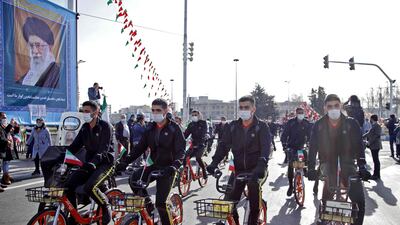
Iranians take part in a ceremony marking the 42st anniversary of the 1979 Islamic Revolution, at the Azadi Square in Tehran, on February 10, 2021. AFP -

Iranians attend a rally marking the 42nd anniversary of the 1979 Islamic Revolution, in Tehran. AP -

Iranians take part in a ceremony marking the 42st anniversary of the 1979 Islamic Revolution, at the Azadi Square in Tehran, on February 10, 2021. AFP -
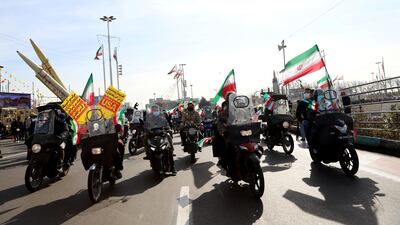
Iranians ride on motorcycles during a celebration of the 42nd anniversary of the Islamic Revolution in Tehran. WANA via REUTERS -
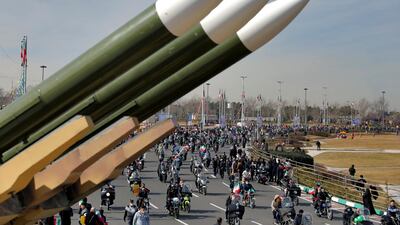
Iranians drive past missiles on their motorcycles during a rally marking the 42nd anniversary of the Islamic Revolution. AP -
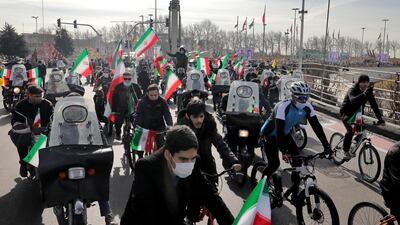
Iranians attend a rally marking the 42nd anniversary of the Islamic Revolution. AP -
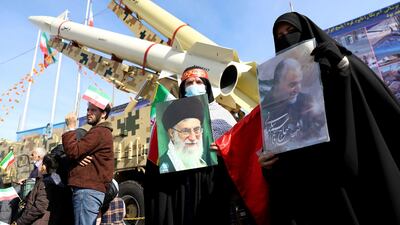
Iranian women hold pictures of the Supreme Leader Ayatollah Ali Khamenei and the late Iranian Major General Qassem Soleimani. WANA via REUTERS -
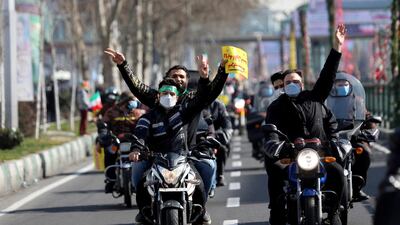
Iranians ride on motorcycles as they participate in the celebration of the 42nd anniversary of the Islamic Revolution in Tehran. WANA (West Asia News Agency) via REUTERS


Last week, the rivalry between Tehran’s intelligence ministry and the Islamic Revolutionary Guards Corps was exposed on public airwaves. Iran’s Minister of Intelligence accused IRGC intelligence agents of infiltration and negligence by failing to prevent the assassination of Mohsen Fakhrizadeh, a scientist who ran the country’s nuclear programme, including its clandestine activities.
The following day, during a rally marking the anniversary of Iran's 1979 revolution, motorcycle units from the Basij, an IRGC auxiliary paramilitary group, chanted "Death to Rouhani [the name of Iran's elected president]", added to the usual "Death to the US'' and "Death to Israel". This kind of public showdown is unprecedented and telling.
Iranians and their theocratic regime are mired in an existential struggle between two mutually exclusive outlooks. For Mr Khamenei and his fellow clerics and conservative politicians, Iran is a vehicle for a so-called Islamic revolution globally. For Iranians, it is a country in desperate need of a functioning economy and peace, both inside and outside.
Mr Biden has recommitted the US to a foreign policy centred on democracy, human rights and equality. He has placed the revitalisation of democracy at the forefront of his agenda. His plan prioritises three areas tailor-made for Iran: fighting corruption; defending against authoritarianism and advancing human rights. Iranians need maximum support in order to realise any of these things.
Doing so requires a fresh, integrated approach between various disciplines and foreign policy instruments in the US and Europe. Importantly, it also requires the participation of credible Iranian experts and stakeholders to make timely use of ways and means necessary to support Iran’s people.
They can start by exploring how the US and Europe could facilitate a free internet for Iran. In 2019, when protests erupted in 100 towns and cities in Iran over a sudden fuel price hike, the regime cut 80 million Iranians' internet access to the rest of the world for one week. Under the shadow of darkness, the regime's security forces killed over 1,000 and detained thousands more. It was the deadliest street violence since the 1979 Islamic revolution.
One month before his election, President Biden promised he would defend the right of activists, political dissidents and journalists worldwide to speak their minds freely without fear of persecution and violence. Iran is a crucial test for that vision and whether he will seize his opportunity to resolve the US’s Iran dilemma.
Nazenin Ansari is a British-Iranian journalist and editor of Kayhan London (Persian) and Kayhan Life (English)

