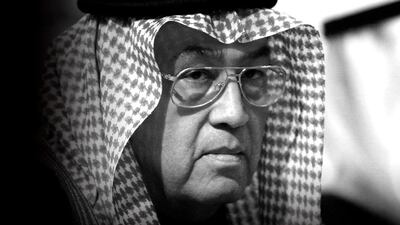
Gosaibi served the public with far more than his pen

Gosaibi served the public with far more than his pen


  • English
  • Arabic

This piece was first published in The National on August 22, 2010 and has been republished to remember Ghazi Al Gosaibi's legacy ten years after his death on August 15, 2010.

Several dozen obituaries have been written about Ghazi Al Gosaibi in the past week. The Khaleeji literary giant passed away in Riyadh at 70 years of age after decades spent in public service.

He held a number of posts: as Saudi Arabia’s Minister of Industry, he set up the petrochemical giant Saudi Basic Industries Corporation (Sabic); he was an ambassador to Britain; and finally, he was Minister of Labour from 2005 until his death.

On a personal note, I wish he had turned down the last government post and dedicated his time to his writings. But Ghazi was supremely devoted to his government duties, and that might have been his greatest conflict.

Seldom do Khaleeji writers venture beyond the artificial borders that separate the indigenous culture shared from Kuwait to Oman and see themselves as sons of the blue waters of the Gulf

Unlike the dozens of writers who penned an obituary for Ghazi, I had never met him in person. And yet, I feel as though I have known him. He is the only writer whose every publication I have read.

My favourite was one in which he filled in the blanks: Suhaim, the true story of a slave who was burnt at the stake for his mistakes as he recited poems about the tribal daughters he slept with. The tale was lost to Arab history and was only saved by Ghazi’s vast imagination.

Seldom do Khaleeji writers venture beyond the artificial borders that separate the indigenous culture shared from Kuwait to Oman and see themselves as sons of the blue waters of the Gulf. And yet, with An Apartment Called Freedom, Ghazi did just that.

Ghazi was a Saudi citizen who felt just as comfortable portraying Bahraini students as he would his compatriots. This masterfully written book revolves around four Khaleejis: Fouad, Yaqoub, Abdul Karim and Qassim studying in Cairo after the 1952 revolution.

The students party with girlfriends and dabble in religion, politics and literature. Bahrainis and other Gulf nationals received these stories as though they were written for them and about them. I can’t imagine another Khaleeji writer ascribing controversial traits to another nationality in the Gulf without being accused of political bias.

Few other writers have transcended the notion of distinct nationalities that is common among many Gulf writers today. The late Kuwaiti intellectual Ahmad Al Rubie, who spent seven months in an Omani jail for fighting on the side of Dhofari socialist revolutionaries, also saw the Gulf as a cultural whole. Like Al Rubie, Al Gosaibi was part of a generation that believed in a single Khaleeji identity.

However, Ghazi’s most controversial moment came when he wrote a poem praising a Palestinian girl who blew herself up in a Jerusalem supermarket in March 2002. It was an impossible circle to square for many Arabs, since it came so soon after September 11. Simultaneously, the memory of Muhammad al Durrah, a 12-year-old child allegedly killed by Israeli soldiers, was still fresh in many minds. That poem contained harsh criticism of the Arab world that still rings true today. Shortly after the poem was published, Ghazi voiced his support for a two-state solution for the Middle East conflict and the Saudi government backed Arab peace initiative.

Ghazi has been the latest in a string of Arab literary figures to have passed away over the past decade. Others, such as Abdul Rahman Muneef, Mohammed Choukri, Tayeb Salih and Naguib Mahfouz, weren’t compromised or conflicted by government posts.

But what concerns me the most with the passing of these literary giants is whether the new generation of Gulf and Arab writers will be as capable and brave in their writings as their predecessors.

The above writers, including Ghazi, had to struggle for the right to pen their thoughts; some were shunned, others banned, exiled – a few were jailed. Is the new generation of Arab writers willing to struggle and pay a price for their ideas?

More specifically, is the new generation of Khaleeji writers willing to look beyond state boundaries as Ghazi and Al Rubie did, and see the vast, united expanse that is the Gulf and the Arab world?

As time passes, there will be more and more people like me who have been impacted by Ghazi’s writings. What is clear from where I stand is that Ghazi may have made better choices as a fiction writer than as a politician.

His relationship with the government may have put pressure and limits on his literary career, forcing him to put his public service first. Perhaps one day, like Ghazi’s rendering of Suhaim, some young Gulf writer will fill in the blanks of this complex writer’s life-long struggle.

Sultan Sooud Al Qassemi is an Emirati lecturer and writer

Ten tax points to be aware of in 2026

1. Domestic VAT refund amendments: request your refund within five years

If a business does not apply for the refund on time, they lose their credit.

2. E-invoicing in the UAE

Businesses should continue preparing for the implementation of e-invoicing in the UAE, with 2026 a preparation and transition period ahead of phased mandatory adoption. 

3. More tax audits

Tax authorities are increasingly using data already available across multiple filings to identify audit risks. 

4. More beneficial VAT and excise tax penalty regime

Tax disputes are expected to become more frequent and more structured, with clearer administrative objection and appeal processes. The UAE has adopted a new penalty regime for VAT and excise disputes, which now mirrors the penalty regime for corporate tax.

5. Greater emphasis on statutory audit

There is a greater need for the accuracy of financial statements. The International Financial Reporting Standards standards need to be strictly adhered to and, as a result, the quality of the audits will need to increase.

6. Further transfer pricing enforcement

Transfer pricing enforcement, which refers to the practice of establishing prices for internal transactions between related entities, is expected to broaden in scope. The UAE will shortly open the possibility to negotiate advance pricing agreements, or essentially rulings for transfer pricing purposes. 

7. Limited time periods for audits

Recent amendments also introduce a default five-year limitation period for tax audits and assessments, subject to specific statutory exceptions. While the standard audit and assessment period is five years, this may be extended to up to 15 years in cases involving fraud or tax evasion. 

8. Pillar 2 implementation 

Many multinational groups will begin to feel the practical effect of the Domestic Minimum Top-Up Tax (DMTT), the UAE's implementation of the OECD’s global minimum tax under Pillar 2. While the rules apply for financial years starting on or after January 1, 2025, it is 2026 that marks the transition to an operational phase.

9. Reduced compliance obligations for imported goods and services

Businesses that apply the reverse-charge mechanism for VAT purposes in the UAE may benefit from reduced compliance obligations. 

10. Substance and CbC reporting focus

Tax authorities are expected to continue strengthening the enforcement of economic substance and Country-by-Country (CbC) reporting frameworks. In the UAE, these regimes are increasingly being used as risk-assessment tools, providing tax authorities with a comprehensive view of multinational groups’ global footprints and enabling them to assess whether profits are aligned with real economic activity. 

Contributed by Thomas Vanhee and Hend Rashwan, Aurifer

Essentials

The flights
Etihad and Emirates fly direct from the UAE to Delhi from about Dh950 return including taxes.
The hotels
Double rooms at Tijara Fort-Palace cost from 6,670 rupees (Dh377), including breakfast.
Doubles at Fort Bishangarh cost from 29,030 rupees (Dh1,641), including breakfast. Doubles at Narendra Bhawan cost from 15,360 rupees (Dh869). Doubles at Chanoud Garh cost from 19,840 rupees (Dh1,122), full board. Doubles at Fort Begu cost from 10,000 rupees (Dh565), including breakfast.
The tours 
Amar Grover travelled with Wild Frontiers. A tailor-made, nine-day itinerary via New Delhi, with one night in Tijara and two nights in each of the remaining properties, including car/driver, costs from £1,445 (Dh6,968) per person.

RACE CARD

6.30pm: Maiden (TB) Dh82,500 (Dirt) 1,200m

7.05pm: Maiden (TB) Dh82,500 (D) 1,900m

7.40pm: Handicap (TB) Dh102,500 (D) 2,000m

8.15pm: Conditions (TB) Dh120,000 (D) 1,600m

8.50pm: Handicap (TB) Dh95,000 (D) 1,600m

9.25pm: Handicap (TB) Dh87,500 (D) 1,400m

Who's who in Yemen conflict

Houthis: Iran-backed rebels who occupy Sanaa and run unrecognised government

Yemeni government: Exiled government in Aden led by eight-member Presidential Leadership Council

Southern Transitional Council: Faction in Yemeni government that seeks autonomy for the south

Habrish 'rebels': Tribal-backed forces feuding with STC over control of oil in government territory

APPLE IPAD MINI (A17 PRO)

Display: 21cm Liquid Retina Display, 2266 x 1488, 326ppi, 500 nits

Chip: Apple A17 Pro, 6-core CPU, 5-core GPU, 16-core Neural Engine

Storage: 128/256/512GB

Main camera: 12MP wide, f/1.8, digital zoom up to 5x, Smart HDR 4

Front camera: 12MP ultra-wide, f/2.4, Smart HDR 4, full-HD @ 25/30/60fps

Biometrics: Touch ID, Face ID

Colours: Blue, purple, space grey, starlight

In the box: iPad mini, USB-C cable, 20W USB-C power adapter

Price: From Dh2,099

What is the FNC?

The Federal National Council is one of five federal authorities established by the UAE constitution. It held its first session on December 2, 1972, a year to the day after Federation.
It has 40 members, eight of whom are women. The members represent the UAE population through each of the emirates. Abu Dhabi and Dubai have eight members each, Sharjah and Ras al Khaimah six, and Ajman, Fujairah and Umm Al Quwain have four.
They bring Emirati issues to the council for debate and put those concerns to ministers summoned for questioning. 
The FNC’s main functions include passing, amending or rejecting federal draft laws, discussing international treaties and agreements, and offering recommendations on general subjects raised during sessions.
Federal draft laws must first pass through the FNC for recommendations when members can amend the laws to suit the needs of citizens. The draft laws are then forwarded to the Cabinet for consideration and approval. 
Since 2006, half of the members have been elected by UAE citizens to serve four-year terms and the other half are appointed by the Ruler’s Courts of the seven emirates.
In the 2015 elections, 78 of the 252 candidates were women. Women also represented 48 per cent of all voters and 67 per cent of the voters were under the age of 40.
 

TRAP

Starring: Josh Hartnett, Saleka Shyamalan, Ariel Donaghue

Director: M Night Shyamalan

Rating: 3/5
