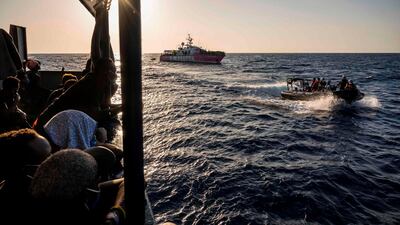
The images have been seen around the world: migrants trying to cross the high seas from Libyan shores in a desperate bid to reach Europe. Many don’t make it, their bodies washing ashore unnamed and the lives and families they left behind at home a mystery.
The coverage of the migrant story in Libya often focuses on the treacherous journey they take. What it lacks is what is left behind: families in Libya, Ethiopia, Eritrea, Sudan, Somalia and elsewhere who hugged and kissed their loved ones goodbye only for them to vanish without a trace.
August 30 is International Day of the Disappeared: a date that is meant to remind all of us of the anguish that families of the missing suffer as they wait to know the fate of their loved ones. In Libya, where both conflict and migration break families apart, the issue is urgent.
The ICRC has more than 1,600 people registered as missing in Libya today. Behind this figure stand hundreds of families who have approached the Red Cross and Red Crescent Movement network in Libya or abroad, looking for their relatives in Libya. Many of them are children. However, given the magnitude of the migration flow within and through the country and the years of drawn-out conflict, this caseload is likely to be just the tip of the iceberg.
Missing migrants are not the only ones whose fates are unknown. Nine years of war have brought with them some ghastly and sad realities: people seen as opponents or security threats being rounded up and never returning, families fleeing in different directions to escape attacks and fighters killed on the battle field and buried in unmarked graves or left unattended.
These tragedies are not limited to Libya alone and have been seen in warzones the world over. What I have observed in my career at the ICRC is that no matter the country nor the battle, the pain families feel when someone they love goes missing is universal.
For each person reported missing, there is someone searching for them and waiting for news – a mother, a wife, a father, a child, a sibling, a childhood friend.
For them, time does not heal. Answers do.
Three years ago, Rasheed (name changed) was returning home from a wedding with his family when a group of armed men took him. His father searched everywhere for him, only to return home without his son or any answers as to what happened to him. His father approached the ICRC and lodged a tracing request, enabling us to reach out to authorities to know Rasheed’s status.
-

A Libyan coast guardsman stands on a boat during the rescue of 147 illegal immigrants attempting to reach Europe off the coastal town of Zawiyah, 45 kilometres west of the capital Tripoli, on June 27, 2017. Taha Jawashi / AFP -

A migrant craft in distress off the coast of Libya, June 5, 2019 in this picture obtained by Reuters June 6, 2019. Jose Benavente/ Pilotes Volontaires/via Reuters -

Libya has intercepted 200 migrants headed for Europe. Reuters -

A handout picture released by German migrant rescue NGO Sea-Eye and taken on April 6, 2020, reportedly shows a speed boat of Libyan authorities around a small boat in distress off the Libyan coast during a rescue operation with the NGO vessel "Alan Kurdi". Cedric Fettouche / various sources / AFP -

A rescue team approaches migrants on board of rubber dinghy at sea off the coast of Libya, August 22, in this still image taken from the video. Sea-Watch/Handout via Reuters -

Migrants rescued by Sea-Watch 4 a week ago in the international waters off Libya watch crew members of civil sea rescue ship Sea-Watch 4 on inflatable boats help migrants to get off the rescue ship funded by British street artist Banksy "Louise Michel" (background) off the coast of Malta, on August 29. Thomas Lohnes / AFP -

A boat approaches migrants from Libya aboard a dinghy in the mid Mediterranean Sea. AP -

A coast guard vessel navigates past the Ocean Viking docked at left at the Sicilian port of Messina, southern Italy on September 24, 2019. The humanitarian ship docked in Sicily, Italy, to disembark 182 men, women and children rescued in the Mediterranean Sea after fleeing Libya. Cesare Abbate/ANSA via AP -

A woman wearing a straw hat arrives at Lampedusa island aboard an Italian Coast Guard boat on August 1 along with other migrants from Tunisia and Libya. AFP -

A Libyan coastguard slits a dinghy that was used by migrants trying to reach Europe, at a naval base Ismail Zitouny / Reuters


As recently as last week, his father called hoping to know if there had been any developments on his request. Rasheed would be 28 today and for his parents and siblings, his disappearance has left a gaping hole in their lives.
The same is true for Hameed’s sister (name changed upon request), who left Libya with her husband and son by boat for Italy in 2019. Their boat capsized near Italian shores and while many were rescued, over a dozen people including his sister were not found. Hameed has kept this secret from his mother to spare her the grief that her daughter is missing.
For humanitarian workers, helping families register and search for missing relatives is emotionally challenging. A Libyan colleague told me that families often approach us with high hopes only to realise later how complicated it is to find answers about what happened to their loved ones. She, along with many of my colleagues who dedicate their days to this work, must balance showing compassion with gently managing expectations in order to prevent further heartbreak and disappointment.
On the other hand, families feel grateful that they found someone to confide in and to listen to, as they cannot share this with other family members who are going through the same pain.
The plight of the families of missing persons is immense and distressing. Attempting to address it requires understanding their needs and acknowledging the tragedy that comes with living without news about the fate of a family member and the devastating impact that it has.
For those missing who are found dead, the least we owe to them and their families is to demand that they are buried and treated with dignity, with due respect to local customs and tradition.
There is, however, hope in the darkness: last year, we were able to support in clarifying the fate and whereabouts of 41 persons reported to have gone missing in Libya by their families in the past.
Our call on the International Day of the Disappeared is that families of the missing deserve to be supported and have answers; authorities and parties to the conflict on all sides have a responsibility to do whatever they can to help them and to prevent more people from going missing in the first place.
Jean-Nicolas Marti is the head of the ICRC delegation in Libya

