


With the coronavirus outbreak continuing to wreak havoc around the world, trust has become an increasingly treasured commodity for citizens looking up to their governments for solutions. It could even be the most crucial determinant in deciding the fate of many world leaders and their administrations – particularly in the West – as they find ways to contain the pandemic and also deal with the economic earthquake it has unleashed on the global financial system.
One such leader is US President Donald Trump, who can no longer rest assured of a second term. Covid-19 has hit the US economy and the stock market hard, thereby undermining Mr Trump's chances of getting re-elected in November. For him to improve his chances of victory, he will need to transform his image from "tweeter-in-chief" to sober statesman who is up to the gravest challenge his country has faced in decades.
His daily press briefings over the past few days, in which he has surrounded himself with a team of experts, suggest he is trying to do that.
During the Milken Summit in Abu Dhabi last month, the global elite in attendance had been polled on Mr Trump’s re-election chances, and a resounding majority expressed confidence a second term was in his pocket. That confidence has now come undone, especially as he is most likely to face former vice president Joe Biden in the elections.
Indeed, the past few weeks have not been easy for the Trump administration. The virus has claimed nearly 20,000 lives in the country amid widespread concern over a lack of preparedness on the part of the government in containing the spread of Covid-19, as well as being able to test and treat prospective patients. The stock market has been through a roller-coaster ride, crashing to ever-new lows, wiping out the euphoria of a president who has long linked his success to the mood on Wall Street.
As a result of this crisis, two viewpoints have emerged.
-
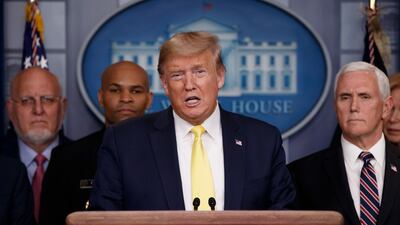
President Donald Trump speaks in the briefing room of the White House in Washington about the coronavirus outbreak, flanked by Dr Robert Redfield, Director of the Centres for Disease Control and Prevention, Surgeon-General Jerome Adams and Vice President Mike Pence, on March 9, 2020. AP Photo -

A couple sits on a beach amid the coronavirus pandemic in Santa Monica, California on March 18, 2020. EPA -

Vehicles are lined up at the US-Canada border in Derby, Vermont on March 18, 2020. Earlier in the day, US President Donald Trump and Canadian Prime Minister Justin Trudeau announced that the border would be closed to non-essential traffic. EPA -
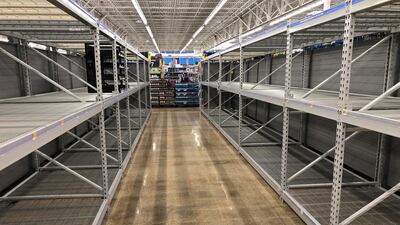
Empty shelves at a local Walmart in Sulphur Springs, Texas on March 18, 2020, as residents have attempted to stockpile goods. EPA -

An empty Times Square is seen following the outbreak of coronavirus, in New York City on March 18, 2020. Reuters -
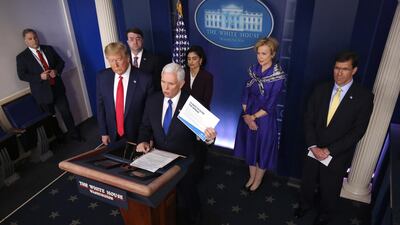
US Vice President Mike Pence delivers remarks on the coronavirus pandemic alongside the President and members of the Coronavirus Task Force at the White House, on March 18, 2020. EPA -
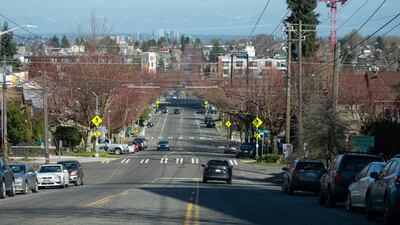
Vehicles travel along a near-empty road in Seattle, Washington on March 18, 2020. Bloomberg -
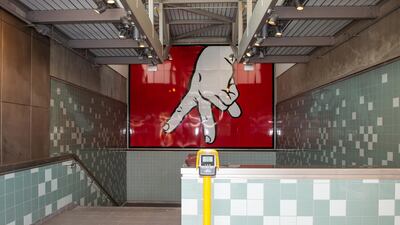
An entrance to Capitol Hill Link Station in Seattle, Washington is empty on March 18, 2020, following social distancing measures in teh wake of the coronavirus outbreak. Bloomberg -
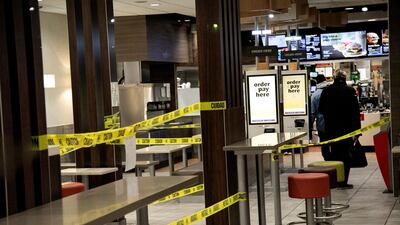
Customers at a McDonald's restaurant in Brooklyn, New York stand between cordons, as the restaurant is only preparing food for takeaway and delivery as part of its social distancing measures to slow the spread of coronavirus in the city. AP Photo


One is that Mr Trump's presidency is "toast", especially as it faces the prospects of an economic meltdown, 20 per cent unemployment and a long recession – if not depression – if the virus continues to spread and no cure or vaccine is quickly found.
There is another view that runs contrary to such a conclusion. It holds that the decisive factor will be how Mr Trump manages the crisis and what measures he takes. The administration might already be taking some unprecedented steps: it is working on a $1 trillion stimulus package to help corporations and rescue the economy from total collapse. It is also pledging to give $1000 cheques to every American, which could influence how citizens vote in November.
Another factor that could help Mr Trump's bid for a second term is the ability of America's pioneering pharmaceutical companies to find a cure for Covid-19, although few are optimistic that a vaccine can be made available for months. The prudent partnership emerging between the public and private sectors in America, and the possible transformation of Mr Trump's image, could also have an impact.
In the meantime though, the trillion-dollar question is: how long can a country like the US remain under lockdown?
Faced with many unknowns, it will be therefore necessary for governments around the world who have already made plans based on the assumption that Mr Trump will secure a second term to develop contingencies. This will be important in the event that a President Biden sets out to undo the last four years of Mr Trump’s policies, much the same way Mr Trump dismantled much of his predecessor Barack Obama’s legacy.
The Arab Gulf region will certainly be waiting and watching anxiously over the next few months. After all, Mr Trump had revived America's favourable relations with the Gulf, as well as Egypt, following the Obama-Biden team's controversial efforts to rehabilitate the Iranian regime in the global polity by signing a nuclear deal with Tehran and thereby gradually helping to plug its economy back into the global financial system.
Of course, the regime finds itself in a different situation today, with Mr Trump having pulled out of the deal in 2018 and snapped sanctions back. To make things worse for the leadership, the country has been battling the worst coronavirus outbreak in the region, with at least 20,000 cases and more than 1,000 deaths having been reported. This has forced Tehran to pursue a policy of "strategic patience" as it prioritises its survival. It has, as a result, softened its hardline approach to dealing with the international community and called on the International Monetary Fund for support.
But just like Mr Trump seems to be working hard to win the trust of the American people, it is incumbent upon the Iranian regime to do the same. It can begin by rectifying some of the mistakes it made in recent times and, perhaps, even introduce reforms to the system it put in place many years ago.
After all, desperate times call for desperate measures.
Raghida Dergham is the founder and executive chairwoman of the Beirut Institute

