


Third time lucky? That is the question being posed as to whether the third candidate proposed by Iraqi President Barham Salih to head the country’s next government can form a cabinet. So far, the answer seems to be yes. Mustafa Al Kadhimi was given full political backing by Iraq’s leading political blocs, both in public statements and in the presence of prominent party leaders during a meeting held specifically to appoint him to the job.
The two previous candidates, Mohammed Tawfiq Allawi and Adnan Al Zurfi, did not get the same endorsements. The meetings in which they received their credentials from the President were low-key affairs. In Mr Al Kadhimi’s case, there is evident external support for his appointment as Prime Minister designate, which has been publicly welcomed by countries such as the US and UAE. Moreover, the meeting to formalise the appointment was attended by the UN Secretary General’s Special Representative to Iraq, Jeanine Hennis-Plasschaert.
Mr Al Kadhimi’s name had been floated as a suitable candidate Prime Minister for several months. However, he was initially unable to garner the support needed to make it through. A number of political parties, largely Iran-backed militant groupings, publicly opposed him, in part because of his active drive against their militias. Others complained that he did not have enough experience to run a country as complex as Iraq. He also does not belong to any political party that could lobby for him. Until his appointment as head of the intelligence services, he did not hold a government position.
However, his experience as head of the Iraqi National Intelligence Service over the past four years gives him unique advantages. In that role, Mr Al Kadhimi has built important relationships not only with regional neighbours – especially in the fight against ISIS – but with a number of regional and international interlocutors. The latter will prove useful in his leadership of Iraq. Mr Al Kadhimi’s ties with a number of Arab countries, moreover, will enable Baghdad’s ties with them to improve as well.
Internally, Mr Al Kadhimi has developed relations with a whole plethora of actors. He is known to have good ties with Ayatollah Ali Sistani, the Kurds, civil society and several leaders of political parties who he knows from his time in the opposition movement against the regime of Saddam Hussein.
Yet the general opinion of Iraqis about Mr Al Kadhimi remains unknown. The public presence of the protest movement that started last October has diminished due to the coronavirus outbreak. He will need to win the movement over and have its input to ensure the validity of his tenure until the country can hold elections.
However, a number of militant groups had made their opposition to Mr Al Kadhimi known. Asaib Ahal Al Haq and Kataib Hezbollah, two of the Iranian Islamic Revolutionary Guard Corps’ proxies in Iraq, are among them. Some went so far as to accuse him of being behind the killing of Quds Force leader Qassem Suleimani and the head of the Popular Mobilisation Units, Abu Mahdi AlMuhandis. However, in the last week, those accusers have fallen silent.
-
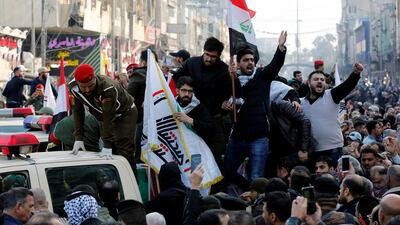
Mourners gesture as they attend the funeral of Qassem Suleimani and Abu Mahdi al-Muhandis, who were killed in an air strike at Baghdad airport, in Baghdad. Reuters -
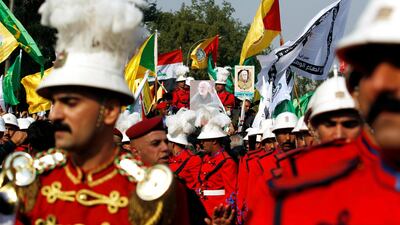
Iraqi Honor Guard perform as they attend the funeral of the Iranian Major-General Qassem Suleimani, head of the elite Quds Force and the Iraqi militia commander Abu Mahdi al-Muhandis, who were killed in an air strike at Baghdad airport, in Baghdad. Reuters -
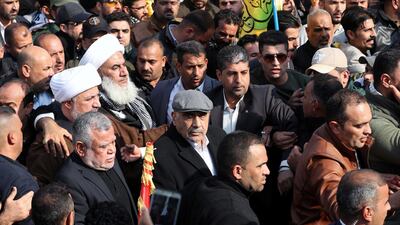
Iraqi Prime Minister Adel Abdul Mahdi attends the funeral of the Iranian Major-General Qassem Suleimani, head of the elite Quds Force of the Revolutionary Guards, and the Iraqi militia commander Abu Mahdi al-Muhandis, who were killed in an air strike at Baghdad airport, in Baghdad. Reuters -
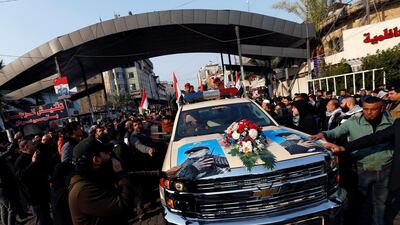
Mourners gesture as they attend the funeral of Qassem Suleimani and Abu Mahdi al-Muhandis, who were killed in an air strike at Baghdad airport, in Baghdad. Reuters -
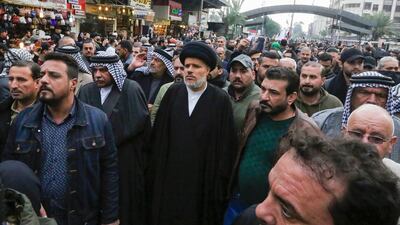
Mohammed al-Tabatabai (centre), deputy secretary general of the Asaib Ahl Al Haq faction, attends the funeral of Iraqi paramilitary chief Abu Mahdi Al Muhandis and Iranian military commander Qassem Suleimani, in Kadhimiya, a Shiite pilgrimage district of Baghdad. AFP -
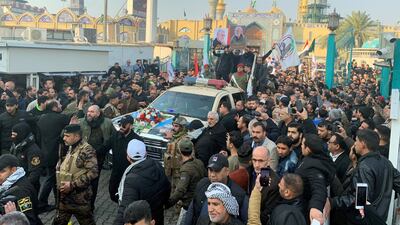
People gather at the funeral of Qassem Suleimani and the Iraqi militia commander Abu Mahdi al-Muhandis in Baghdad, Iraq. Reuters -

Iraq's Popular Mobilization Forces hold a funeral for the Iranian Major-General Qassem Suleimani, top commander of the elite Quds Force of the Revolutionary Guards, and the Iraqi militia commander Abu Mahdi al-Muhandis, who were killed in an air strike at Baghdad airport, in Baghdad. Reuters -
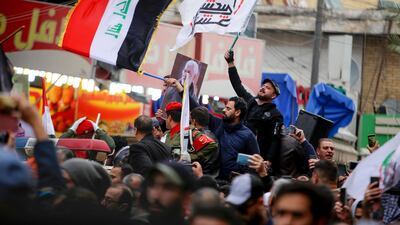
Mourners wave the national flag and the Hashed al-Shaabi flag as they carry the portrait of Iraqi paramilitary chief Abu Mahdi al-Muhandis during a funeral procession, for Muhandis and Iranian military commander Qassem Suleimani, in Kadhimiya, a Shiite pilgrimage district of Baghdad. AFP -
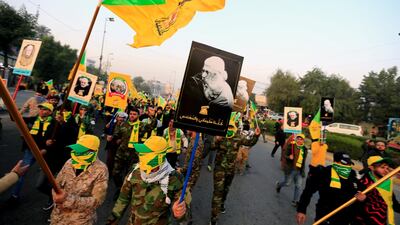
Kataib Hezbollah Iraqi militia gather ahead of the funeral of the Iraqi militia commander Abu Mahdi al-Muhandis, who was killed in an air strike at Baghdad airport, in Baghdad. Reuters -
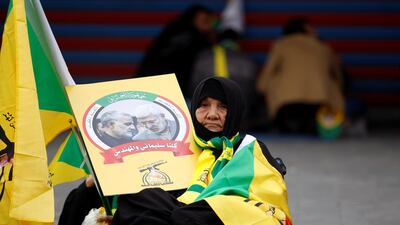
A woman holds the picture of the Iranian Major-General Qassem Suleimani ahead of the funeral in Baghdad. Reuters -
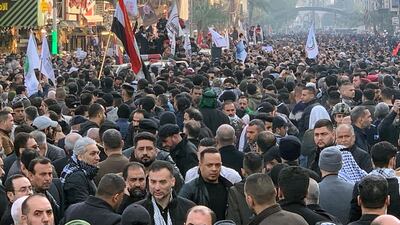
People gather at the funeral of Qassem Suleimani and the Iraqi militia commander Abu Mahdi al-Muhandis in Baghdad, Iraq. Reuters -
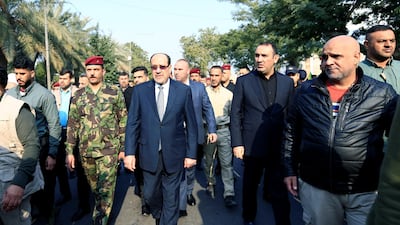
Former Prime Minister Nuri al-Maliki attends the funeral of the Iranian Major-General Qassem Soleimani, top commander of the elite Quds Force of the Revolutionary Guards, and the Iraqi militia commander Abu Mahdi al-Muhandis, who were killed in an air strike at Baghdad airport, in Baghdad. REUTERS -

Head of the Popular Mobilization forces Faleh al-Fayyad (R) attends the funeral of the Iranian Major-General Qassem Soleimani, head of the elite Quds Force of the Revolutionary Guards, and the Iraqi militia commander Abu Mahdi al-Muhandis, who were killed in an air strike at Baghdad airport, in Baghdad. REUTERS -
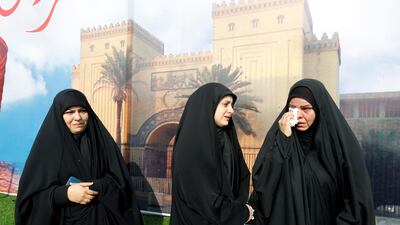
Mourners react as they attend the funeral of the Iranian Major-General Qassem Soleimani, head of the elite Quds Force of the Revolutionary Guards, and the Iraqi militia commander Abu Mahdi al-Muhandis, who were killed in an air strike at Baghdad airport, in Baghdad. REUTERS -
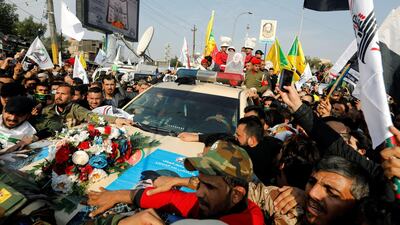
Mourners attend the funeral of the Iranian Major-General Qassem Soleimani, head of the elite Quds Force of the Revolutionary Guards, and the Iraqi militia commander Abu Mahdi al-Muhandis, who were killed in an air strike at Baghdad airport, in Baghdad. REUTERS -

Mourners surround a car carrying the coffin of Iraqi paramilitary chief Abu Mahdi al-Muhandis during a funeral procession, for him and nine others, in Baghdad's district of al-Jadriya, near the high-security Green Zone. AFP


Why the Iranian-backed political parties chose not to block Mr Al Kadhimi’s candidacy is not immediately evident. However, sources say that a number of those parties and militias want to reduce the level of tensions with the US, and Mr Al Kadhimi could be exactly the candidate to help with that. Moreover, not all Iran-backed groups are the same. The competition between various militias and groups continues, and parties like the Badr Organisation do not want to see Kataib Hezbollah become the leading group in Iraq. Rather, they are aiming to strike a deal with Mr Al Kadhimi to have a role in his next government while keeping the more militant groups at bay. The naming of Mr Al Kadhimi came as Washington announced a "Rewards for Justice" bounty of $10 million for Hezbollah commander Muhammed Kawtharani. As Kataib Hezbollah gets squeezed in Iraq, other Shia militant groups aim to consolidate their position.
-

An anti-government protester holds a placard with Arabic that reads, "We are a stubborn people," during ongoing anti-government protests, in Baghdad, Iraq, Sunday, February 23, 2020. AP Photo -
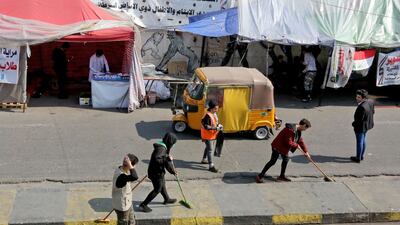
Iraqi protesters clean a street at Baghdad's Tahrir square on February 23, 2020. AFP -
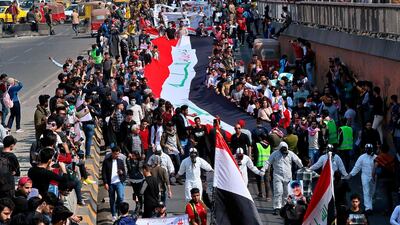
Students and other demonstrators hold national flags during ongoing anti-government protests, in Baghdad, Iraq, Sunday, Februar 23, 2020. AP Photo -

An anti-government protester holds an Iraqi flag during ongoing anti-government protests, in Baghdad, Iraq, Sunday, February 23, 2020. AP Photo -
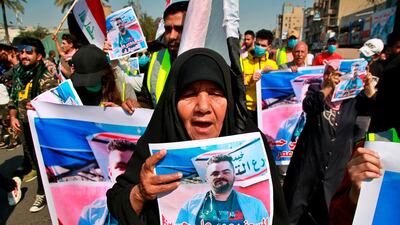
A woman holds a picture of her a missing protester son during ongoing anti-government protests, in Baghdad, Iraq, Sunday, February 23, 2020. Arabic on the poster reads, "Freedom for paramedic Omr Ali." AP Photo


On the other hand, Mr Al Kadhimi is faced with international forces, and particularly American forces, withdrawing from the country. Meanwhile, the US continues its efforts to limit Iran’s role in Iraq. Mr Al Kadhimi and the government will be faced with the challenge of recalibrating relations with Washington. The two countries are now preparing for a strategic dialogue set to start in June and all of these issues are on the table.
It is worth noting that Mr Al Zurfi had been named as Prime Minister designate on March 17, 17 years after then-US president George Bush gave his ultimatum to Saddam before launching the war that would topple that regime. And on April 9, the 17th anniversary of that regime’s fall, Mr Al Kadhimi was named the next PM designate. Both candidates are men whose political fortunes were made by the American invasion of 2003. And now Iraq-US relations are entering a new phase during a challenging period for Baghdad.
-
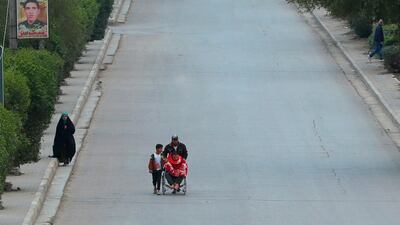
Iraqis walk in an empty street in Baghdad on March 22, 2020 amid a curfew to help fight the spread of Covid-19. AP Photo -

A nearly empty street in central Baghdad. AP Photo -
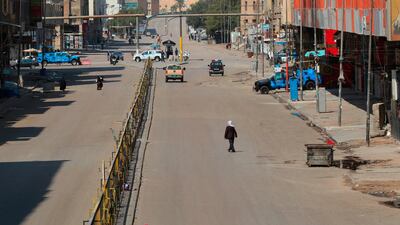
The Iraqi government extended the curfew by another six days on March 22, 2020. AP Photo -
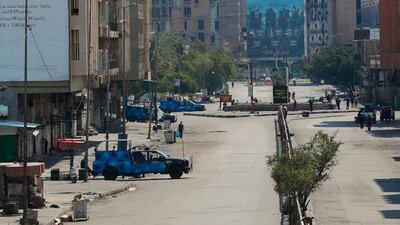
Security forces are deployed to impose the curfew in central Baghdad. AP Photo -
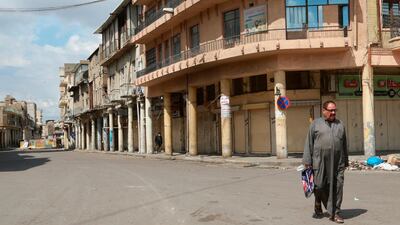
A man walks past closed shops in Baghdad on March 22, 2020. AP Photo -
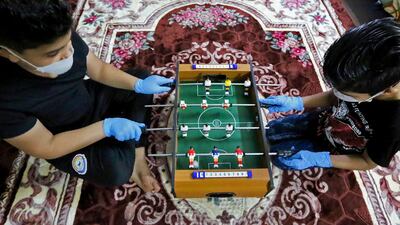
Iraqi children play indoors at their home in Baghdad. AFP -

Health workers disinfect houses in the Iraqi city of Najaf on March 22, 2020. Reuters -
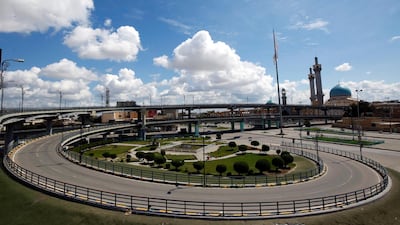
Empty streets in Najaf, Iraq. Reuters


Mr Al Kadhimi is taking the reins at a difficult time and is not to be envied. In addition to the impact of Covid-19, a massively reduced oil price means that the state's finances are in even greater trouble than they have normally been under the long-standing weight of corruption.
The reality is that as important as the naming of Iraq’s next prime minister is, there is only so much one person can do. Without institutional change and a re-establishment of the state’s monopoly over the use of force, Iraq’s woes will continue. Building those institutions will take time and resources, and Mr Al Kadhimi doesn’t have an abundance of either.
Mina Al-Oraibi is editor-in-chief of The National

