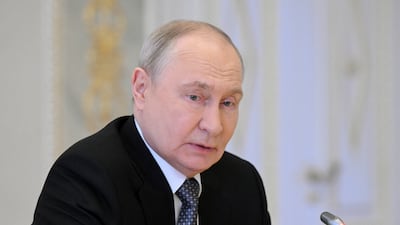

Washington has called Russian President Vladimir Putin many things since his 2022 invasion of Ukraine. Joe Biden branded him “a butcher”, a “murderous dictator” and a “pure thug”.
Four years later, the White House has a new adjective for the man wanted by the International Criminal Court: humanitarian.
President Donald Trump’s peace envoy Steve Witkoff used the descriptor yesterday as he met Mr Putin in the grand Constantine Palace in St Petersburg, after the Russian leader freed Stephen Hubbard, a 74-year-old American citizen who had been held in custody since 2022.
“You talk so much about my President, President Trump, being a humanitarian,” Mr Witkoff said. “You are a humanitarian also, sir, and I salute that, I commend you and I thank you again.”
Mr Witkoff’s comment stunned US politicians from both sides of the aisle. “No. Putin is a stone-cold killer,” Republican Senator John Cornyn wrote on X as he shared footage of the envoy's remarks.
“What an embarrassing and outrageous thing to say,” said another Republican senator, Thom Tillis.
Mr Witkoff’s praise was jarring, but it was hardly surprising given recent events. On October 9, Mr Trump announced a deal to bring Russian diesel into US and global markets as he tries to ease energy costs before the November 3 midterm elections. On October 16, he went further, waiving parts of a Russia sanctions bill he’d signed less than a month earlier.
It's a significant reversal from years of US-Russia policy, and makes a mockery of Washington's sanctions, which were designed to punish Moscow for invading its smaller neighbour.
Estimates vary, but Moscow is expected to garner an additional $300 million to $700 million in revenue from the waivers, much of which will be funnelled into Russia’s war machine against Ukraine.
Mr Trump has been dogged by accusations that he has a soft spot for Russia ever since he emerged as a presidential candidate in 2016. Hillary Clinton famously called him a “puppet” for Moscow, a claim he angrily rejected.
On Monday, he offered a fresh illustration of his appreciation for Moscow. "Russia, frankly, has been fine on Ukraine. They haven't been doing much," he said, on the same day a Russian drone strike killed six people, including two children, according to Ukrainian authorities.
Mr Trump's now open embrace of Mr Putin comes even as Russia has been accused of helping Iran to pinpoint US forces in the Middle East. But Mr Trump is prepared to give Moscow the benefit of the doubt on that. If Russia and China are helping Iran, "it’s at a very low level, but I don’t believe they are at all", he said on October 12.
Underscoring the deepening ties between the Trump White House and the Kremlin, Mr Trump has repeatedly attacked Ukrainian President Volodymyr Zelenskyy, saying it is time for him to step down and reacting furiously at his unwillingness to capitulate.
Ukraine’s struggle for survival appears to be secondary to the President’s desire for a deal to end the war, which is killing tens of thousands of Russian and Ukrainian troops each month.
“It's time to make a deal,” Mr Trump said on Tuesday. “Remember this: Though we've given a lot to Ukraine, we've gotten absolutely nothing back.”
The cost of the Ukraine war to American taxpayers is a legitimate concern. But the claim that the US has got nothing back from Kyiv reminds me of Monty Python’s “What have the Romans ever done for us?” scene in the Life of Brian. Nothing really, except aqueducts, sanitation, roads and so on.
Ukraine has inflicted enormous losses on what until recently was a major US adversary without American troops getting involved. Its battlefield experience has provided the Pentagon with an up-close view of Russian military capabilities and the realities of modern warfare, exposing weaknesses in equipment and assumptions about how a future conflict might play out.
The conflict has also given the US lessons in drone warfare, electronic jamming, missile defence and the performance of US weapons against a "near-peer" competitor.
Meanwhile, much of the money Mr Trump says went to Ukraine actually supported domestic defence manufacturers, propped up US jobs and expanded America's missile and ammunition production capacities.
Perhaps the Trump-Putin bromance will result in a peace deal that Ukraine can stomach, thereby saving countless lives. But given Mr Putin's track record, this seems more like wishful thinking by Mr Trump, who nonetheless appears eager to take Russia at its word.
None of it helps the US President or his Republican Party make a coherent closing argument to voters in the final stretch before the midterms.

