

It is always a sign of political trouble in the UK when its prime minister gathers top figures at the Chequers Court, a house west of London that the head of government uses as a weekend retreat.
Keir Starmer, the current incumbent, has done this rather a lot during his nearly two years in Downing Street. The idea is that the isolation and hot house atmosphere can define a new path forward for the government and, in the process, help the Prime Minister escape his woes.
Today is a big day in the fate of Mr Starmer’s prime ministership as plots thicken against him. There is peril in his situation because of a scandal that has erupted around his appointment of the disgraced former politician, diplomat and lobbyist Peter Mandelson as UK ambassador to Washington.
Mr Starmer is renowned as a process politician. Yet the extraordinary revelation around Mr Mandelson’s appointment is that the normal supremacy of security vetting in the appointments process was serially overridden, despite a cloud of suspicion over the latter’s association with the American convicted sex offender Jeffrey Epstein.
To forestall the dangers to himself in this, Mr Starmer dismissed the head of the foreign office after finding fault with his appointments process. Now UK Parliament is tearing apart that decision in a series of meetings and procedures that are dialling up the political pain for the Prime Minister.
On Friday, Mr Starmer convened one of his Chequers conclaves to figure out a way out of the mess. For the fifth time in his premiership, a fresh relaunch is reportedly in the works.
This will come after the local elections on May 7. The plotters from all wings of the governing Labour party may not agree on much, but they are looking for a consensus on how many losses their party can bear.
From a high point of the political cycle four years ago, as then-Conservative prime minister Boris Johnson was undergoing a similarly torturous scandal of his own, the local elections will almost certainly turn out to be poor for Labour.
The emerging rebels in the party agree that losing any more than 1,500 local councillors will be untenable for it. There is already a consensus that it will not regain its governing role in Scotland, where hopes were high just two years ago. And for the first time in more than a century, it will lose Wales as a political bastion.
Mr Starmer is dogged in the face of these disasters. Even he will know that this is now looming as a last chance for a poorly structured premiership project that has so far squandered a huge majority.
A look at previous resets shows that Mr Starmer prefers to deal in patriotic flourishes that are hard to translate into tangible achievement. He won power by promising to pursue five missions, which he has failed to accomplish.
Several versions of this tinkering have lurked in the background of his time in office. In December 2024, he announced that the government was staring at huge “black holes” in its finances and launched a plan for change. Six promises were duly laid down, and the government was said to have a new focus and intensity.
-
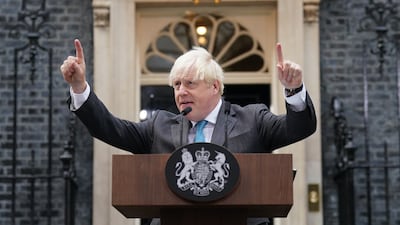
Boris Johnson makes a speech outside 10 Downing Street, London, on Tuesday, September 6, 2022, before leaving for Balmoral in Scotland for an audience with Queen Elizabeth II to formally resign as Britain's prime minister. PA -
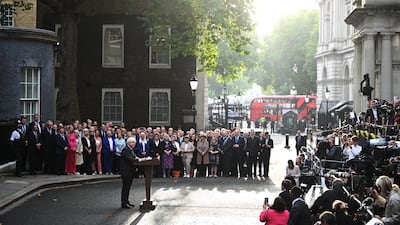
Mr Johnson paid tribute to his successor Liz Truss, saying with her at the helm of 'this compassionate Conservative government', everything would be done to get people through the cost of living crisis this winter. He added that 'this country will endure it and we will win'. Getty -
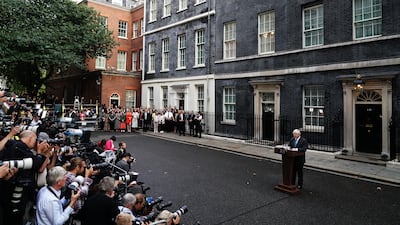
Mr Johnson highlighted his government’s record on delivering Brexit, supporting Ukraine and the Covid-19 vaccine campaign, watched by a group of loyal Conservative MPs, members of staff and his wife Carrie. PA -

While Mr Johnson urged Conservative Party members to reunite behind the new leader Ms Truss, he could not resist making a dig at those who ousted him, saying 'they changed the rules half way through, never mind that now'. Reuters -
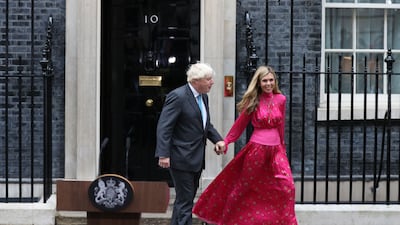
Mr Johnson and his wife Carrie after the speech. AFP -
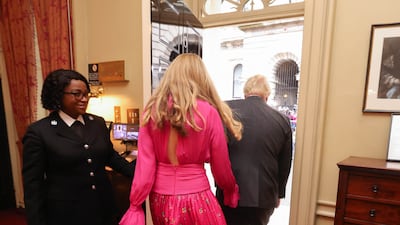
Mr Johnson and his wife Carrie depart No 10 Downing Street. Photo: No 10 Downing Street -
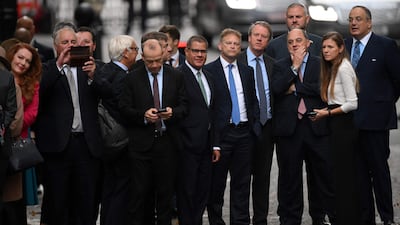
Conservative MPs gather to listen to Mr Johnson's speech. AFP -
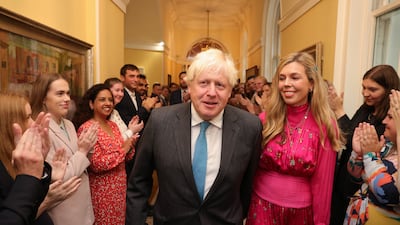
Mr Johnson joked about his post-prime ministerial future, alluding to plans for a getaway, but pledged to offer Ms Truss's government 'my most fervent support'. Photo: No 10 Downing Street -
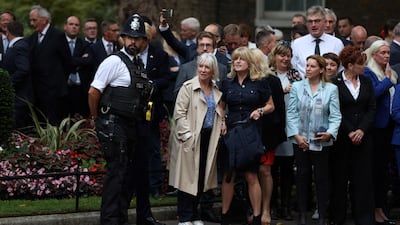
Britain's former culture secretary Nadine Dorries, centre, and Mr Johnson's sister Rachel, centre right, stand with Conservative MPs and staff as they gather to listen to the speech. AFP -
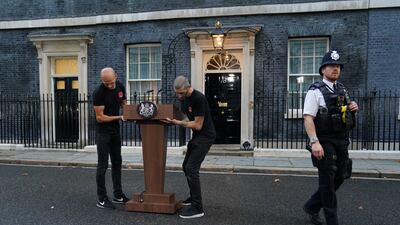
Preparations for Mr Johnson's speech take place. PA -
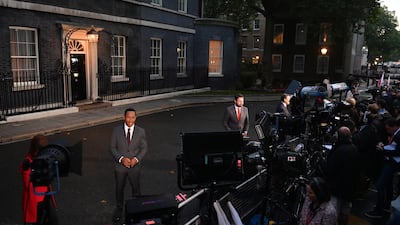
Journalists gather before Mr Johnson's speech. The queen will appoint Ms Truss, 47, as the 15th prime minister of her 70-year reign on Tuesday, after Mr Johnson formally tenders his resignation. EPA -
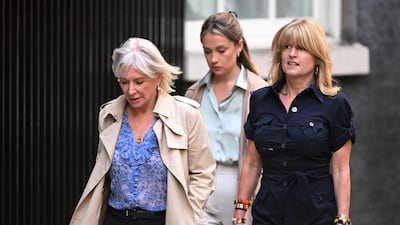
Ms Dorries, left, and Mr Johnson's sister Rachel, right, arrive at Downing Street before the prime minister's departure. Getty


Last year, he lost his then-deputy, Angela Rayner, after months of fighting over the government’s failure to ignite economic growth and cuts that targeted pensioners. His inability to get a welfare bill reform through Parliament cost the government credibility with its own MPs, and the party’s lead in the polls evaporated. The Reform UK party, radical outsiders in the British political scene, took the top spot even as Mr Starmer has doggedly pursued integration with the EU to reverse the Brexit growth trap.
To show that renewal is becoming a reality, Mr Starmer is unveiling a new parliamentary agenda in the King’s speech on May 13. It is a Westminster staple that will set out proposed bills and a new phase for the government. Inevitably, it will come against the backdrop of a rumour mill focused on potential senior resignations and the manoeuvring from would-be successors to take over.
Mr Starmer will inevitably try to play the statesman card. By then, another month of the Strait of Hormuz’s partial closure will almost certainly show an increased toll on the economy. The prospects for a resolution are out of the hands of the UK or any initiative that originates in Europe. That will not stop the Prime Minister from constantly addressing the crisis, but by being ineffectual it will not do his political position much good either.
Mr Starmer should look to two Conservative predecessors for an inkling of his fate. I’ve already said there are parallels in the decline and fall of Mr Johnson in his current troubles. There is also a potential re-run of the playbook that his fellow Croydon-ite John Major used when he was prime minister in the early 1990s. However torrid things got, Mr Major kept turning up to eventually hold on for the duration of his parliamentary term.
If you thought April was bad for Mr Starmer, May is set to be worse. Only his obstinacy can see him through.

