Rev Jesse Jackson, who passed away last week, was a larger-than-life figure who made enormous and consequential contributions to American life.
He registered millions of voters, laying the groundwork for a substantial increase in the number of black elected officials across the country. He also succeeded in pressing major corporations to increase economic opportunities for African Americans thereby significantly increasing the black middle class. As part of the younger generation of black leaders who had developed a global consciousness, his agenda moved beyond civil rights to make support for movements for social justice and liberation part of the mainstream of American politics.
Because of this, he was the first American political leader to recognise and incorporate into his movement my community of Arab Americans and our domestic and foreign policy concerns.
I first began working with Mr Jackson in the late 1970s. His staff approached me to discuss his plans for a visit to Palestine/Israel to see for himself the situation in the occupied lands. The injustices he witnessed left an indelible impression, leaving him committed to addressing the centrality of Palestinian rights to Middle East peace.
In 1979, when then-US ambassador to the UN Andrew Young was removed from his post for speaking with the Palestine Liberation Organisation’s UN representative, many black leaders, Mr Jackson included, were outraged. It wasn’t just that Mr Young had been a colleague in the civil rights movement. Mr Jackson could not accept that the US had committed itself to a “no talk” policy with the Palestinian leaders.
He resolved to visit Beirut to meet PLO chief Yasser Arafat and demonstrate that “a no talk policy is no policy at all”.
In 1983, Mr Jackson approached me at a dinner and asked me to leave what I was doing and join his campaign for president. When I replied: “I’ve been organising my community of Arab Americans for the last four years and I’m not sure I can leave what I’m doing,” he said: “You will do more for your community in the next four months than you’ve done in the last four years.” He was right.
Up until that point, Arab Americans had never been welcomed in American politics as an ethnic constituency, mainly because of our support for Palestinian human rights. Candidates had rejected our contributions and endorsements. No campaign had ever included an Arab-American committee. And no candidate had raised the issues about which our community cared deeply.
Mr Jackson changed all that and the response from Arab Americans was overwhelming. In fact, we were so moved by that 1984 campaign that we launched the Arab American Institute to focus on lessons we’d learned: increasing voter registration, encouraging candidate engagement and the importance of bringing our concerns into the electoral arena.
Because Mr Jackson had made it possible to speak about Palestine, we built coalitions around the issue during the 1988 presidential campaign. We elected a record number of delegates across the country and built coalitions with black, Latino and progressive Jewish delegates and others. We passed resolutions supporting Palestinian rights in 10 state Democratic conventions. And at the national convention in Atlanta, we’d earned enough delegates to call for a minority plank on Palestinian rights.
There had never been a discussion about Palestine at a Democratic convention. In negotiations with the presumptive winner Michael Dukakis’s campaign, they were adamant that the issue would not be raised. In fact, Madeleine Albright, representing Mr Dukakis’s team said if the “P word” was even mentioned at the convention, “all hell would break loose”. I told them not to play “chicken little” with us and insisted that the issue be discussed.
Mr Jackson asked me to present our plank from the podium of the convention, and I did. It was a heady experience to be able to address the National Convention calling for “mutual recognition, territorial compromise, and self-determination for both Israelis and Palestinians”. My speech was preceded by a floor demonstration of more than 1,000 delegates carrying signs calling for Palestinian-Israeli peace and a two-state solution and waving Palestinian flags. It was the first (and unfortunately, the last) time that that issue was raised at a party convention.
The backlash was intense. While Mr Jackson had secured a position for me on the Democratic National Committee, party leaders told me I should withdraw because my presence would make me a target for Republicans and for some Jewish Democrats, who would use an Arab American in a DNC leadership role to attack Mr Dukakis. Incoming party chair Ron Brown thought it best that I withdraw but promised to make it up to us. And he did.
-
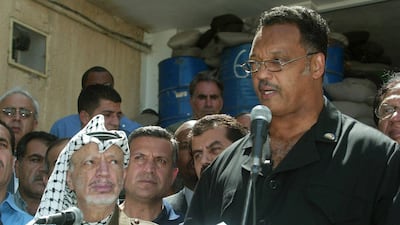
Jackson speaks to the press in Ramallah, in the occupied West Bank, as Palestinian leader Yasser Arafat, left, looks on, July 2002. AFP -
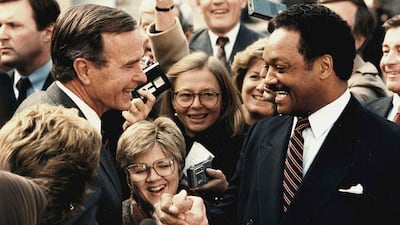
The Reverend Jesse Jackson shakes hands with president-elect George Bush after a lunch meeting at the White House in Washington, November 1988. The veteran US civil rights activist died on February 17, 2026, aged 84. AFP -
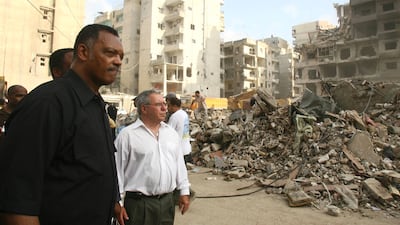
Jackson visits the southern suburbs of Beirut, a Hezbollah stronghold, where entire neighbourhoods were flattened in Israeli attacks, in August 2006. AFP -
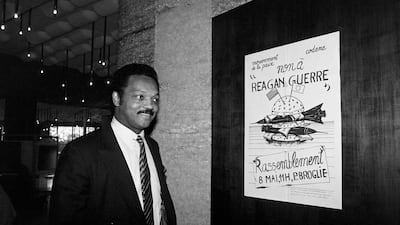
Jackson passes a poster reading ‘No to Reagan, to war’, in Strasbourg, where people were protesting against US President Ronald Reagan’s forthcoming appearance at the European Parliament, in May 1985. Jackson stood against Reagan unsuccessfully in 1984. AFP -
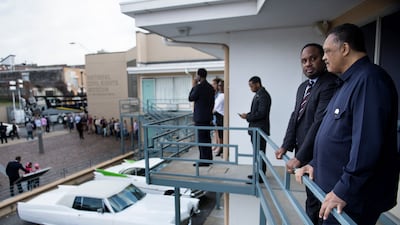
Jackson visits the balcony outside room 306 at the motel where Martin Luther King Jnr was assassinated, on the grounds of the National Civil Rights Museum in Memphis, Tennessee, April 2018. AFP -
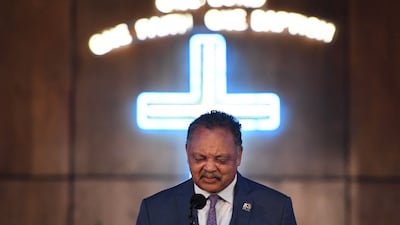
Jackson speaks celebrating the life of singer Aretha Franklin at her father's church, New Bethel Baptist, during a Sunday morning service in Detroit, Michigan, August 2018. AFP -
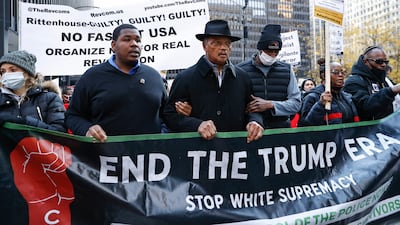
Jackson joins a march in protest over the not-guilty verdict in Kyle Rittenhouse's murder trial, in Chicago, Illinois, November 2021. AFP -
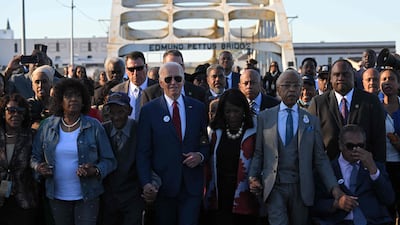
Jackson joins US President Joe Biden, Martin Luther King III and others in Selma, Alabama, to mark the 58th anniversary of Bloody Sunday, in March 2023. AFP


He became the first party chair to host Arab Americans at party headquarters, to meet with Arab-American Democrats around the country, and to address our national conventions. A few years into his term, he appointed me to fill a vacancy on the DNC where I’ve been ever since.
In 1994, in the months after Oslo Accords signing, Mr Jackson accepted an invitation to be keynote speaker at an international peace conference the Palestinians were convening in Jerusalem. Once there, the Israelis said that we could not meet in Jerusalem or hold a political meeting with Palestinians. Mr Jackson was determined to go forward. We spoke with then-Israeli prime minister Yitzak Rabin and then-foreign minister Shimon Peres urging them to allow the event to go forward.
Even though they were unrelenting, Mr Jackson convened the meeting and then announced that we’d march from the hotel to the Orient House, the Jerusalem headquarters of the Palestinians. The Israeli military surrounded the hotel and told us we could not leave. True to form, Mr Jackson announced that we’d march anyway and so we left the hotel walking through the lines of Israeli soldiers.
To be honest, I was frightened, but what happened surprised us. Because of the power of his personality and his work, Mr Jackson’s presence was formidable on the world stage. Once the Israelis soldiers saw him leading this peaceful march right up to their blockade, they parted and not only allowed him through, but many gathered around, wanting to touch or shake his hand, asking to have their pictures taken with him.
The Israeli commanders were furious and continued shouting orders to their troops to back away. The soldiers ignored them. We marched to Orient House and had our meeting.
In all the years that I worked with Mr Jackson, I witnessed not only his commitment to justice and courage in the face of challenges, but also the extent to which he recognised that his personal power could make a difference on the world stage. He freed prisoners. He opened doors to negotiations. He gave hope to the hopeless and voice to the voiceless. He also challenged the Democratic Party to be principled and consistent in its commitment to human rights and justice.
He will be missed, but his legacy lives on in the progressive movement for domestic and foreign policy change that he helped shape.