A hero died this week. A giant of politics, even though he never won national office.
The Rev Jesse Jackson may have been an American politician who stood twice for the Democratic presidential nomination, in 1984 and 1988, making history as the first black person to be a serious contender for the highest office. He may have been a civil rights leader, standing next to the Rev Martin Luther King Jr when he was assassinated in 1968, having begun his career as an activist some years earlier at the age of 18, when he led a group of friends to break the colour bar at a whites-only public library.
But his passing has not only been marked in his own country. It has resounded around the world, because Mr Jackson was more than that. At a time when trust in politicians has possibly reached a new low, he reminds us of a different class of public service – one based on courage, conviction, consistency and compassion.
Mr Jackson’s career is not just a reproach to politicians of the left: although it is that, as while many nominally Labour or Social Democratic parties in Europe and North America have trimmed and tacked, have been diverted by “third ways” and misplaced their founding principles as they got caught up in the latest progressive fads, Mr Jackson and that other great veteran of the US civil rights movement, the late Congressman John Lewis, stayed anchored in their mission for all the oppressed.
As Mr Jackson put it at the Democratic National Convention in 1984: “This is not a perfect party. We’re not a perfect people. Yet, we are called to a perfect mission. Our mission to feed the hungry, to clothe the naked, to house the homeless, to teach the illiterate, to provide jobs for the jobless and to choose the human race over the nuclear race.”
That clarity is a lesson for all politicians: that their platforms need to have a moral bedrock. It is surely no coincidence that Mr Jackson, Mr Lewis and Mr King were all ordained ministers. With that surest of moorings, they were far better placed to withstand the buffeting winds of fashionable ideologies and the sugar rush of novel theories.
Mr Jackson stood out, too, for that oratory that brought the pulpit to the people, and for a turn of phrase where just one carefully placed word could pierce the heart. Remembering the death of Dr King in 2018, he told an interviewer: “It’s a hurtful, painful thought: that a man of love is killed by hate; that a man of peace should be killed by violence; a man who cared is killed by the careless.”
He often talked of the need to reach for the “higher ground”. Certainly, his global vision was far more inclusive and capacious than the defence of “western civilisation” that US Secretary of State Marco Rubio laid out at the Munich Security Conference last week. Mr Jackson stood up for Muslims. “We are bound by Moses and Jesus, and also connected to Islam and [Prophet] Mohammed,” Mr Jackson said at the 1984 convention, referring to Judaism, Christianity and Islam as “these three great religions”, and as recently as 2015 he denounced Islamophobia as “immoral and wrong” after attending Friday prayers at a mosque in Chicago.
He was a true friend to Palestine, publicly embracing Yasser Arafat in Beirut in 1979 – which was a courageous act at a time when many in America and the West considered the Palestine Liberation Organisation leader to be a terrorist, not a freedom fighter.
-
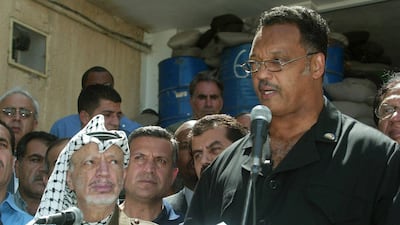
Jackson speaks to the press in Ramallah, in the occupied West Bank, as Palestinian leader Yasser Arafat, left, looks on, July 2002. AFP -
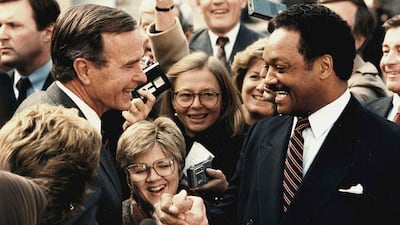
The Reverend Jesse Jackson shakes hands with president-elect George Bush after a lunch meeting at the White House in Washington, November 1988. The veteran US civil rights activist died on February 17, 2026, aged 84. AFP -

Jackson visits the southern suburbs of Beirut, a Hezbollah stronghold, where entire neighbourhoods were flattened in Israeli attacks, in August 2006. AFP -
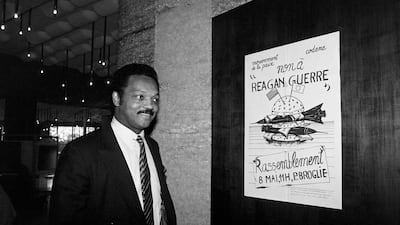
Jackson passes a poster reading ‘No to Reagan, to war’, in Strasbourg, where people were protesting against US President Ronald Reagan’s forthcoming appearance at the European Parliament, in May 1985. Jackson stood against Reagan unsuccessfully in 1984. AFP -
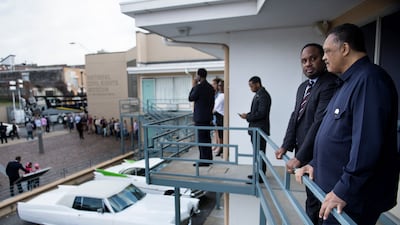
Jackson visits the balcony outside room 306 at the motel where Martin Luther King Jnr was assassinated, on the grounds of the National Civil Rights Museum in Memphis, Tennessee, April 2018. AFP -
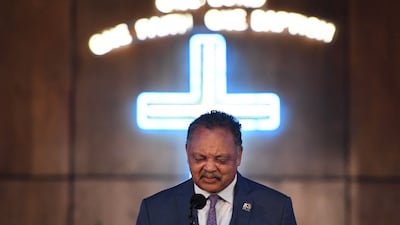
Jackson speaks celebrating the life of singer Aretha Franklin at her father's church, New Bethel Baptist, during a Sunday morning service in Detroit, Michigan, August 2018. AFP -
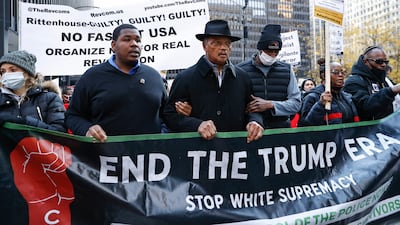
Jackson joins a march in protest over the not-guilty verdict in Kyle Rittenhouse's murder trial, in Chicago, Illinois, November 2021. AFP -
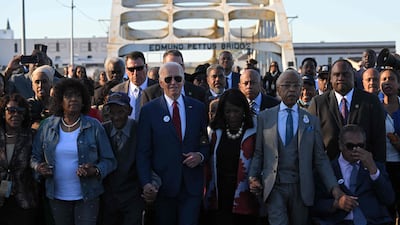
Jackson joins US President Joe Biden, Martin Luther King III and others in Selma, Alabama, to mark the 58th anniversary of Bloody Sunday, in March 2023. AFP


He was tireless in the fight against apartheid in South Africa, and was present when Nelson Mandela was released from jail after 27 years in 1990. “We are deeply indebted to the energy, principled clarity and personal risk with which he supported our struggle and campaigned for freedom and equality in other parts of the world,” South African President Cyril Ramaphosa said in a statement on Tuesday.
For Mr Jackson, who called for a “global coalition of conscience”, human dignity was universal and applicable to all, and his former deputy campaign manager, my distinguished fellow columnist James Zogby, once wrote that “When I accompanied him, I could see that he was as at home in Cairo, Kuwait, or Jerusalem as he was in the neighbourhoods of Chicago or the impoverished towns of Appalachia.”
And contrary to critics who tried to paint him as a divisive demagogue, he was above all a unifier. One example: in 1990, there were protests in New Jersey when a black teenager was shot to death by a white police officer. Addressing the boys’ schoolmates, Mr Jackson told them: “When the lights go out, don’t turn on each other. In the dark, turn to each other and not on each other, and then wait until morning comes. What is the challenge of your age? Learning to live together.”
Earlier, also in 1984, he had quoted the words of former US vice president Hubert Humphrey: “When all is said and done, we must forgive each other, and redeem each other, and move on.” Competition, he added, “should make us better, not bitter”.
Mr Jackson was addressing an American audience when he also said, “Red, yellow, brown, black and white – we are all precious in God’s sight”, but the power of his message transcended national boundaries. I can still remember being inspired and thrilled by him as a 12-year-old in Jeddah.
For Jesse Jackson stood for “common ground”, another term he frequently used, and for everyone, whatever colour or creed they were. Yes, he had flaws of course. But as his half-brother Noah Robinson once said: “What is it that motivates a person to grow? For Jesse, it’s his ego. God bless him for having that ego.”
I think we can smile – and move on from that. The vision of radical love and justice that Mr Jackson, Mr Lewis and Mr King shared was witnessed around the world through his life. It is no wonder that his passing is being mourned far from the land of his birth.