

Coastal ecosystems are nature’s quiet champions – and some of the most under-measured. Mangrove forests, salt marshes and seagrass meadows absorb storm surges, nurture fisheries and lock away more carbon for every hectare than most terrestrial forests.
Yet these blue-carbon buffers are eroding at the very moment the climate crisis makes them more valuable than ever. Turning that tide demands precision. Every decision, such as where to intervene, which species to plant, how to phase replanting, must be informed by accurate, timely and location-specific data – because every misstep compounds over decades.
Until recently, collecting that intelligence meant clipboards, tide tables and a few scattered transects. The result was inconsistent outcomes. Some projects flourished, many faltered and practitioners were left guessing why. This is where technology has reshaped the landscape.
The game-changer has been the emergence and wider availability of sensing and autonomous platforms that convert coastlines into living datasets. Today, Earth observation satellites scan entire deltas every few days, while drones and uncrewed surface vehicles trace centimetre-level elevation and hydrology. Machine-learning models synthesise these feeds into dynamic, continuously updated maps of soil salinity, sediment flow and canopy health.
When salinity surges or turbidity rises, alerts go out instantly, giving field teams time to adjust before stress becomes visible. Autonomous robotics extend that vigilance below the surface, gathering water column readings that once required costly boat time.
Emerging innovations illustrate this potential vividly. By using precision-mapping, restoration initiatives can now access detailed information on soil composition, hydrology, biodiversity and carbon sequestration capacity.
The impact is already measurable. Along Sri Lanka’s north-west coast, early plantings following the 2004 tsunami struggled. Teams lacked the soil and hydrological baselines needed to match the right species to the right site. A decade later, the same region shifted to data-led natural regeneration. Continuous satellite imagery, sensor arrays and transparent dashboards have so far restored more than 500 hectares of mangroves and set a course to reach 10,000 hectares by 2030.
-

Dubai Mangroves is set to be the world's largest coastal regeneration project. All photos: URB -
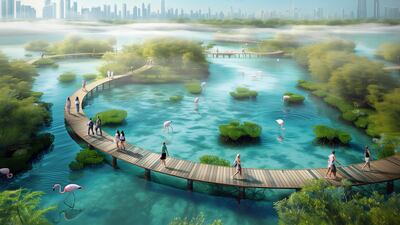
Running from Jebel Ali beach to Dubai Islands beach, the project would aim to boost Dubai's ecotourism offering -

Spanning 72km, it would transform Dubai's coastline -
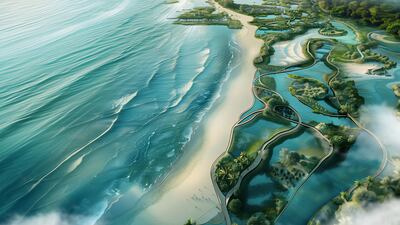
100 million mangroves would be planted -

Edutainment and conservation is at the heart of the plan -

A rendering of visitors exploring Dubai Mangroves -

An artist's impression of the glass-domed Botanical Museum -
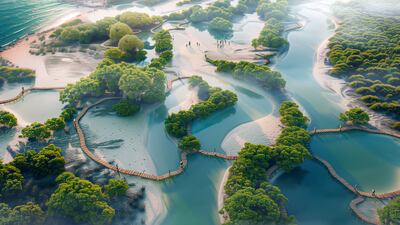
The planted mangroves could sequester 1.23 million tonnes of CO2 each year -

The project would also aim to restore Dubai's seagrass beds


Since then, the technologies underpinning this progress – from higher-resolution satellites to increasingly autonomous sensing platforms – have only accelerated. They are giving practitioners the ability to detect ecological shifts and guide interventions with an unprecedented level of precision. Such precise insights significantly enhance the accuracy and effectiveness of restoration projects, ensuring interventions are sustainable and ecologically beneficial.
Firms in this space use these technologies into decision-support platforms that government agencies, NGOs and coastal engineers can easily use. Certain AI models turn complex spatial data into clear instructions – where to seed, where to reinforce sediment, where to optimise seedling density and where to step back and let nature recover.
The goal is not to replace ecologists or community stewards but to amplify their insight and free them to focus on choices that only humans can make.
To fully take advantage of these technological advancements, reliable and effective data-driven restoration efforts must adhere to best practices. Data collection should be specific to each ecosystem, not generic or copy-and-paste – and aligned with the local geomorphology and ecological drivers. Ecological expertise must also guide this process, ensuring accuracy, relevance and alignment with ecological realities. Continuous validation is a non-negotiable, ensuring decisions evolve with the ecosystem itself.
Data is not the whole answer, but it is the foundation. Without it, restoration depends on guesswork; with it, coastlines gain a fighting chance. The opportunity ahead is far larger than fixing past failures. With advances in AI, sensing and autonomy, we now have the ability to understand coastal ecosystems at a resolution that simply wasn’t possible before.
What comes next is a collective choice. Governments, researchers, technologists and coastal communities must invest in shared data infrastructure that accelerates action, unlocks blue-carbon value and guides smarter interventions. With better data and co-ordinated action, our coasts don’t just survive, they thrive.

