
On January 10, I travelled to Tehran, where I had been invited – before the current protests began – to give some talks on Afghanistan, where I live and am a university lecturer. Upon arriving at the airport, I was glad to see that phone networks were working despite the internet being shut down. The money changers were refusing most currencies because of the uncertainty of the rates. I exchanged a few dollars and took the cab to my hotel in the centre of the city.
The city was calm as we drove through it. The cab driver was an ardent supporter of the state and told me how “Zionist-inspired” youngsters had set fire to a mosque in Iran. He pointed out to me the large mausoleum of Ruhollah Khomeini, the Islamic Republic’s founding supreme leader, at the entrance of Tehran. He warned me against staying in the centre of the city, fearing that the protests would eventually reach there. I had arrived as one of the major protests looked to be dying down. I only heard of small gatherings around the city after my arrival on the first day but nothing major after that.
These protests seemed to have occurred in a third realm, beyond the ones portrayed by local state media channels and international media such as the BBC, which was available via satellite in my hotel room. Local media continued to play clips of government enforcers being lynched, whilst international media portrayed the protests as ongoing, with human rights groups reporting deaths of protesters at the hands of the regime in the thousands.

I cannot speak for the whole country, but it was difficult to imagine just looking at Tehran itself that thousands of lives were being lost. The government appeared to be functioning as per usual. Some shops were shuttered for the first three days and the ones that were open barely had customers. But the roads were buzzing with traffic. Only at night could you see scores of government enforcers armed with rifles and shotguns that I was told had paintballs and rubber bullets.
The state organised a large gathering of its own supporters on Thursday at the city’s famous Revolution Square. The government, of course, had a vested interest in protecting demonstrators who came out in support of it, but it would seem wrong to me to claim that thousands were paid or coerced into marching onto the streets against the protests. I saw what looked like genuine enthusiasm.
The government had stationed a fire truck it claimed was burnt in the protests at the Revolution Square as a reminder of what was done to public property. It seemed as if the protesters were being reminded that their actions had made life more difficult rather than easier. The square also became the stage for a large demonstration in favor of the regime days after the protest.
-

Anti-government demonstrators and supporters of exiled Iranian crown prince Reza Pahlavi outside the Houses of Parliament in London. EPA -

Iranians during a protest in Tehran on January 9. AFP -
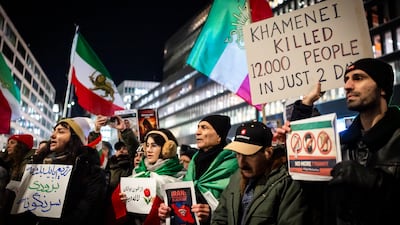
Protesters attend a rally in Zurich on January 13 in support of the nationwide mass demonstrations in Iran. EPA -

A screengrab shows body bags lying outside Kahrizak Forensic Medical Centre in Tehran, after deadly protests across Iran. Reuters -

Activists attend a rally in support of the protesters, in Los Angeles, California. AFP -

Protesters burn a picture of Iran's supreme leader Ayatollah Ali Khamenei outside Downing Street, in London. AFP -

Demonstrators gather in Paris to support the Iranian people amid the anti-government protests in Iran. AFP -
Smoke rises from a mosque as protesters gather amid evolving anti-government unrest in Tehran, Iran, on Friday. Reuters -
Protesters gather amid evolving anti-government unrest in Tehran, Tehran Province, Iran, on Friday. Reuters -
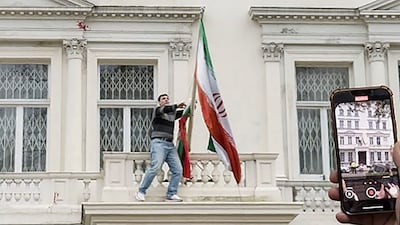
A protester pulls down the Iranian flag from the balcony of Iran's embassy in central London on Saturday. AFP -
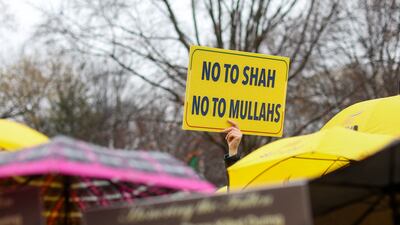
A person holds a placard, as demonstrators and activists rally in support of nationwide protests in Iran, outside the White House in Washington. Reuters -
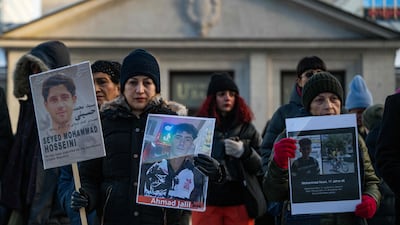
Protesters display placards featuring portraits of Iranians executed by the Iranian regime, during a rally in Berlin on Saturday. AFP -
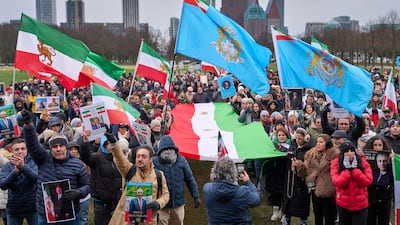
People protest in solidarity with demonstrations in Iran at Malieveld Square, Netherlands on Saturday. AFP


Some younger people told me that they were initially inclined to protest against the cost of living, but after seeing that their demands were being equated, by all sides, with a demand for the restoration of a monarchy backed by the US and Israel, they became disillusioned with the movement.
One night, after attempting to see the waterfront in the north of Tehran, which was closed, I drove into a square that had a crowd of around 50 Iranians marching. I immediately attempted to reverse out of it, fearing the worst, but the crowd waved at me to pass through. Only as I drove past them did I see the Islamic Republic flags they were carrying.
The protests that Iran witnessed this month were some of the largest organic outpourings of people into the streets of Iran in its recent history. Those protesting had suffered for decades. I felt like the sanctions had lasted so long that most of the young had forgotten who imposed them and simply blamed their government. US President Donald Trump’s constant rallying calls also put a target on the backs of those who are protesting for basic improvements. The association with the US and the violence committed in certain parts of Iran have hijacked the actual cause of the movement and, I think, could hasten its demise.
The internet blackout might have helped the regime stop the protesters and instigators from organising, but it also created a void that was filled in by outsiders. Since there was not much to see on the streets after the major protest in Tehran, I only had satellite TV to monitor the situation. There was only one instance in which an expert was invited on a chat show from within Iran but he, too, could barely be heard over his connection. By attempting to contain the protests, the regime had muted its own defenders and allowed the concoction of a pseudo-environment in the capital that was much darker than the reality I could see in the week I spent there.
There was a small silver lining to the protests; the state was quick to acknowledge the difficult lives the people were leading and promised to make changes to what were implied to be bad economic policies. However, there is limited change that can occur while the sanctions are in place. Iran’s regime seems to be between a rock and a hard place. It would either have to let go of the security goals it claims to be pursuing for deterrence in an attempt to rid its people of the sanctions imposed or succumb to foreign pressures and risk becoming an easier target for a US and Israel that have harboured ill intentions towards it for decades.

