

This week, after years of preliminary legal arguments, the case concerning Myanmar’s alleged brutal treatment of the Rohingya people opened at the International Court of Justice in The Hague.
There, in the weeks to come, expert witnesses and survivors will recount, in terrible detail, how a Muslim minority in Rakhine state was ethnically cleansed from its homes and subjected to horrific cruelty – rape, mass killings and systematic persecution – by a state. Myanmar stands accused of violating the 1948 UN Convention on the Prevention and Punishment of the Crime of Genocide.
For many, this case means nothing.
Myanmar is far from the Middle East, Europe and the Americas. The Rohingya’s suffering has often barely made the news. If you were not a human rights expert reading reports in the summer of 2017, you may not know that these crimes began when the Myanmar military launched a massive “clearance operation”, triggering an exodus of more than 700,000 people to Bangladesh in just a few months.
Amnesty International documented widespread murder and crimes against humanity, including the burning of villages through mass arson. Human Rights Watch reported mass rape by members of Myanmar’s security forces.
Does this sound familiar? It should. Similar crimes have reportedly unfolded many times in Sudan, Gaza, Ukraine, Yemen, the Democratic Republic of the Congo and Ethiopia. The list of war crimes and crimes against humanity is long. What makes this ICJ case resonate is that if it succeeds in proving Myanmar’s government targeted the Rohingya people, it will help shape – and potentially strengthen – South Africa’s current genocide case against Israel.
What happens inside the Peace Palace in The Hague may determine how genocide is argued and contested far beyond the borders of Myanmar. Governments, legal experts and human rights activists are watching closely.
The case is being brought by The Gambia, an African state far away from Myanmar. It was not directly harmed by Myanmar’s actions. But it has pursued the issue nonetheless, and a win would also be a victory for the Global South, showing that international justice is not reserved for wealthy western nations. Smaller states, too, can invoke binding legal frameworks and demand accountability.

At a moment when the rule of law is openly derided – with the US’s actions in Venezuela a prime example – The Gambia is showing tremendous moral clarity.
“These oral hearings come at a time in which the fundamental principles of international law, as enshrined in the UN Charter, are under stress and threat globally,” Gambian Attorney General Dawda Jallow said.
For those of us working in accountability, this is a pivotal moment in international law.
“This case represents the realisation of one key aspect of the Genocide Convention that has long been underutilised: states holding other states accountable for their criminal behaviour,” says Christopher "Kip" Hale, my colleague and chief of staff of The Reckoning Project and an American lawyer who worked for the prosecution at the Cambodia tribunal addressing genocide against the Vietnamese and Cham Muslim peoples; as well as other cases.
And this will affect future state criminality. The Gambia’s insistence that states have responsibilities – and that all states have a duty to protect has helped spur South Africa’s decision to take Israel before the same court.
“Yes, the norms are changing,” Mr Hale says. “It is important to highlight that this is about state responsibility, not the responsibility of individuals. Accountability for both is key to securing durable and real justice.”
The Genocide Convention was adopted in the grim years after the Second World War. It was meant to ensure that the words “never again” meant something. For decades, however, it remained a largely dormant moral instrument rather than an active legal tool. Consider the 1990s and the genocides in Srebrenica and Rwanda.
The cases of Israel and Myanmar differ widely, yet South Africa’s application proceeds before the same court. While the crimes are different, the cases are linked by a single question: how the ICJ will interpret and apply the Genocide Convention. In this sense, this is a moment of activation. In this sense, The Gambia is acting on behalf of the entire international community, doing work that the world’s justice systems have too often failed to do.
-
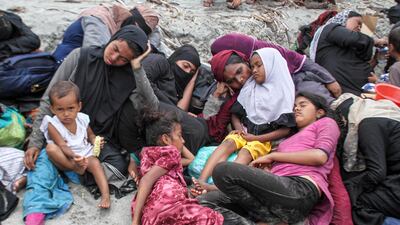
Rohingya women and children rest on the sand after making the sea crossing from Bangladesh to Aceh province, Indonesia. Reuters -
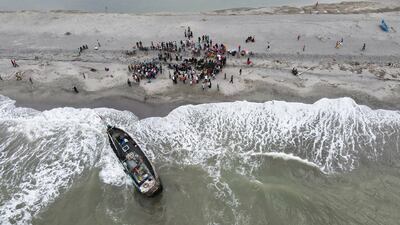
A boat carrying Rohingya stranded on Lampanah beach, Aceh province. The UN says the official recorded drowning toll of 350 in 2022 was the 'tip of the iceberg', with many more feared dead. Reuters -
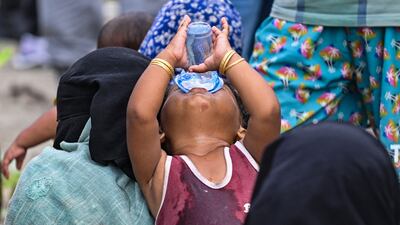
A child drinks after arriving by boat in Indonesia. Many Rohingya are fleeing refugee camps in Cox's Bazaar, Bangladesh, where kidnapping, rape and violence have become common. AFP -
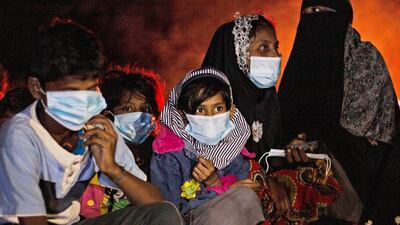
Families sit by a fire on a beach on Idaman Island in East Aceh, Indonesia. Despite the risks of crossing the Andaman Sea, the prospect of life in Malaysia and Indonesia attracts thousands. AP -

People smugglers charge about $5,000 for a seat on a vessel from Bangladesh to Indonesia, Thailand or Malaysia. Conditions on board are often grim. AFP -
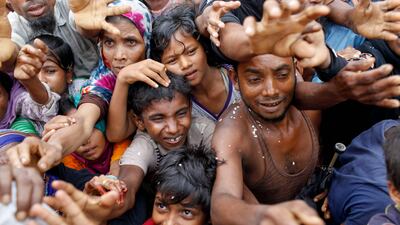
Rohingya refugees from Myanmar wait for aid at the Kutupalong refugee camp, the largest in the world, in Bangladesh. AFP -
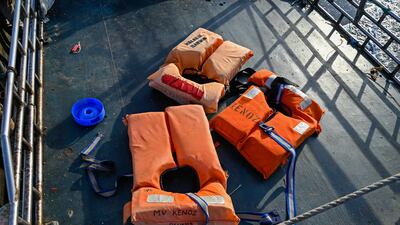
Lifejackets lie in a boat used to ferry Rohingya refugees across the water. AFP -
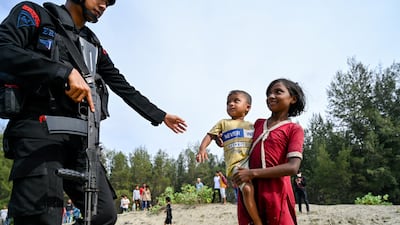
Indonesian police assist Rohingya refugee children at a beach in Aceh province. AFP -
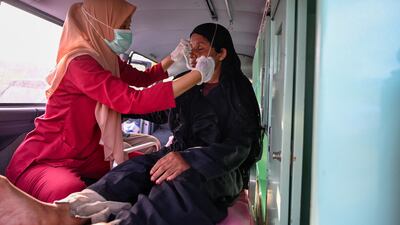
A health worker helps a Rohingya refugee after she arrived by boat on the coast of Aceh. AFP


Unlike the International Criminal Court, also in The Hague, the ICJ does not send individuals to prison. If The Gambia wins, the ICJ cannot jail the generals who led the slaughter, nor can it overthrow the junta.
What it can do is find that Myanmar violated the Genocide Convention.
The court could require Myanmar to change discriminatory laws and practices that still affect the Rohingya, to protect the remaining population, to allow humanitarian access and to preserve evidence of crimes. Myanmar could be ordered to submit regular compliance reports and allow international monitoring. The court may even determine that Myanmar owes reparations.
Impunity, once taken for granted, will come at a higher cost.
None of this will happen quickly. Justice moves slowly. But it matters – for diplomatic relations, for arms sales, for trade and investment. An ICJ ruling can strengthen the legal basis for sanctions and make it harder for other states to justify doing business with the junta. Isolation follows.
Most importantly, it sends a powerful message. It can strengthen future arrest warrants and prosecutions of Myanmar officials. One day, they may face prison.
“The arc of the moral universe is long,” Martin Luther King Jr said in 1967, “but it bends towards justice.”
Genocide is not an internal matter. The Gambia case shows that states have responsibilities. The ICJ is no longer merely a court of last resort: what is happening in the Hague this week matters. The case of The Gambia against Myanmar is a vital precedent – one that will shape genocide allegations for years to come.

