

From the Iranian and Venezuelan shadow fleets against which the administration of US President Donald Trump is waging an economic and logistical war, to Russia’s Oreshnik missiles deployed in Belarus, the contours of a dual strategic confrontation are now emerging.
The US war on vessels transporting Iranian and Venezuelan oil and commodities has demonstrated how control over economic arteries can become an effective tool of pressure on the international system as a whole.
The Europeans’ internal debate over Russia’s frozen assets and their possible use to finance Ukraine – set against Moscow’s reinforcement of its military capabilities in the continent’s vicinity, including the Oreshnik missiles – has shortened warning times and raised the cost of any escalation. Money, fleets and missiles have become parallel instruments of warfare. Today’s confrontation is no longer between one weapon and another, or one sanction and another, but rather a multi-layered strategic conflict.
Russia’s assets in Europe amount to tens of billions of dollars, held in banks in France, Germany, Britain and Belgium. Using these funds directly to support Kyiv would be a strategic political decision capable of altering the balance of the Kremlin’s war in Ukraine. However, Europe has been divided over this option, and the US hasn’t supported it.
The EU’s internal debate ended with an agreement to provide a €90 billion ($105.4 billion) loan to Ukraine to cover its expected budget shortfall, after the bloc’s leaders failed to reach a settlement on what to do with Moscow’s assets. The loan will be backed by the bloc’s joint budget and will provide funding for Kyiv over a two-year period.
Nonetheless, Europe finds itself at a crossroads. Does it settle its position on financing Ukraine’s war, or does it remain hostage to negotiations between Washington and Moscow over ending the conflict?
Despite repeated attempts to unify ranks behind a common strategy to confront Russia, the Europeans continue to face enormous internal challenges. Dependence on Russian gas hasn’t been eliminated, and public pressure on governments over rising prices limits their ability to adopt stringent measures.
-
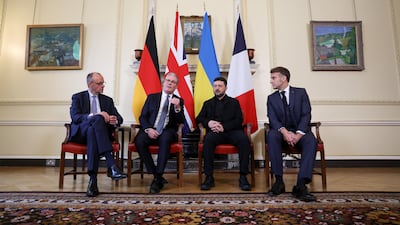
From left: Friedrich Merz, Keir Starmer, Volodymyr Zelenskyy and Emmanuel Macron at 10 Downing Street. Getty Images -
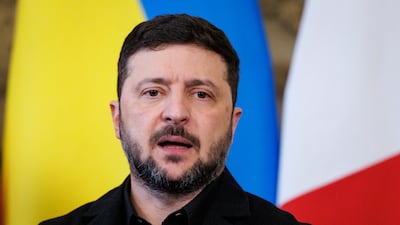
Mr Zelenskyy speaks during the talks, which are aimed at ending Russia’s war in Ukraine. EPA -
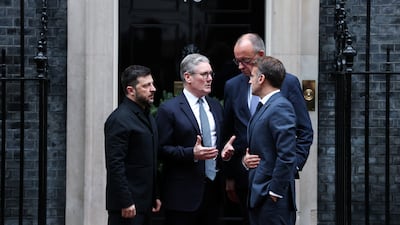
Mr Starmer with the leaders outside 10 Downing Street. Reuters -
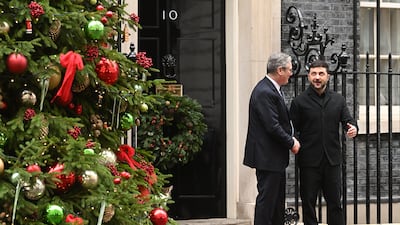
Mr Starmer welcomes Mr Zelenskyy. Getty Images -
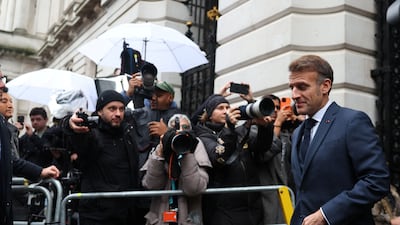
Mr Macron arrives at Downing Street. AFP -
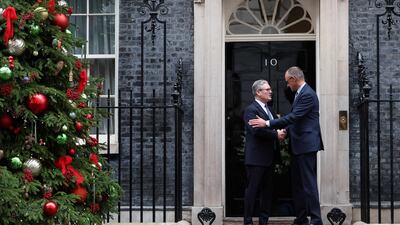
Mr Starmer greets Mr Merz on his arrival at Number 10. AFP


These internal divisions make any sanctions or economic measures against Moscow less effective and leave room for Russia to exploit the continent’s vulnerabilities, particularly in Eastern Europe and the Baltic region. Moscow, however, is directly concerned with another region of the world – specifically the US’s determination to curb its influence in Venezuela and the implications of American control over the global oil markets.
For now, Washington is waging a “shadow war” against Tehran and Caracas. Its naval forces operate discreetly to monitor Iranian and Venezuelan vessels and obstruct their movements, while strict financial restrictions are imposed on linked assets.
The objective is not merely to disrupt sources of funding, but to also send a clear message to regional and global actors alike: any attempt to bypass US sanctions or expand political and financial influence will be met with a swift response.
The intersection between these two tracks – Europe and Russia on the one hand, and America’s shadow war on the other – lies in the control over the global financial and energy system. However, despite the freezing of its assets in the West, Moscow has succeeded in strengthening its economic ties with China, India and other emerging markets.
At the level of European politics, the parallel and indirect war is having unexpected repercussions. European countries that rely on Russian energy, or trade with Central Asia, find themselves facing a complex equation: much as they support sanctions against Moscow, they are also dealing with the consequences of US actions against Iran and Venezuela on financial and energy markets.
This reality increases Europe’s fragility, makes unifying positions more difficult and grants Russia an opportunity to exploit divisions for strategic gain.
The military dimension is no less significant. Russia’s deployment of advanced missiles in Belarus reflects Moscow’s readiness to confront any European escalation. At the same time, the US conducts precise naval operations near Venezuela’s coast and prepares for the possibility of direct military operations inside that country.
In essence, today’s international confrontation isn’t confined to land or traditional borders; it extends across the seas, the financial sphere and cyberspace.
Economically, pressure through frozen assets remains a central instrument in this global game. Russia uses its gas supply to Europe in part as a political pressure tool, while the US prevents Iran and Venezuela from transforming their assets into financial power that could be invested in regional expansion or military development.
Such use of financial instruments illustrates how modern economic warfare has evolved beyond sanctions alone into a global contest over influence and resources.
Europe needs to reframe its energy and security policies; Russia is investing in alternative markets and exploiting western divisions; and the US is exerting pressure on its adversaries across multiple arenas to reduce their capacity for manoeuvre.
What we’re left with is a confrontation between Russia and Europe that, to a certain extent, is linked to America’s parallel war against Iran and Venezuela. This is placing the world on the threshold of a new phase of complex strategic balances.

