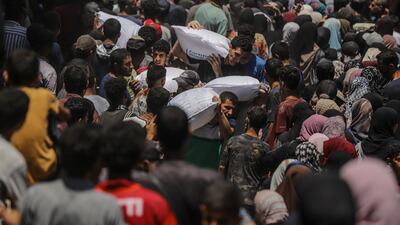
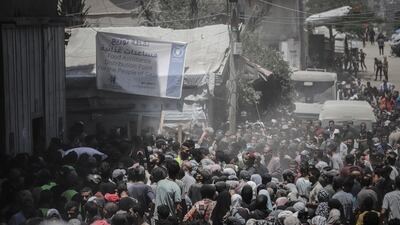
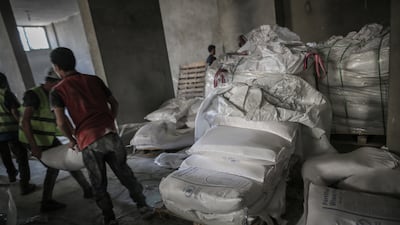
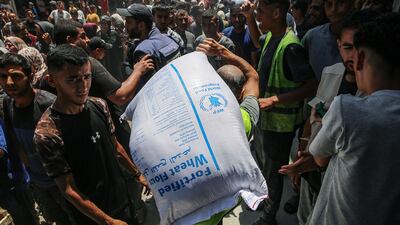
Internally displaced Palestinians in Rafah. Surveys of Palestinian attitudes point to some disturbing signs of despair about the future. EPA


Stop telling Palestinians what they should be doing


  • English
  • Arabic

July 08, 2025

From early, piecemeal reports, the White House meeting between Israeli Prime Minister Benjamin Netanyahu and US President Donald Trump didn’t live up to expectations. From what we can gather from public comments, it featured some excessive displays of flattery. Mr Netanyahu announced that he was nominating Mr Trump for a Nobel Peace Prize and when asked about a two-state solution, after Mr Trump deferred to the “great man” from Israel to answer the question. Both say they want a ceasefire in Gaza, but what they want and what average Palestinians need are quite far apart.

There’s nothing new in this sad state of affairs. As the situation in Gaza, the West Bank and East Jerusalem worsens, the response of most nations to the Palestinians’ plight has been feckless. Instead of definitively condemning the killing and the occupation, the best they can muster are hollow and sometimes banal pronouncements urging the parties to negotiate (as if there were something about which to negotiate) or professions of their support for a two-state solution (as if that were even possible under the current circumstances).

This hasn’t stopped some from proposing “peace plans”, calling for international peacekeepers, a “reformed Palestinian Authority” and a disarming of Hamas. But these proposals also ignore two important realities: Israel’s rejection of every element of every plan put forward to date, and the fact that the Israeli occupation is so entrenched and has so distorted the realities on the ground in the West Bank, Gaza and East Jerusalem that the way forward to Palestinian independence has become far more complicated than it was at the time of the Oslo Accords.

To better understand where we are and what must be done, my polling company has been contracted by the Tony Blair Institute to conduct annual surveys in the occupied lands in order to assess Palestinian attitudes towards their current situation and their hopes for the future. What comes through quite clearly in these surveys is that the Palestinians in all three areas are in deep distress. As a result of the unique burdensome conditions Israel has imposed on them, there are distinct differences in the opinions of respondents in each area – towards their governance, the threats they face and their hopes for the future. These cannot be ignored.

For two decades, Gaza was severed from the rest of the Palestinian population and economically strangled by Israel, with Hamas being both punished and then rewarded by the Israeli government which sought to foster a division in Palestinian ranks. This was accomplished, enabling Hamas to grow in strength.

Israel’s war on Gaza has had devastating consequences for Palestinians. Our findings were able to quantify the magnitude of their losses. Almost two thirds report having been forced to evacuate their families four or more times in the first 18 months. Most have lost family members. Seventy per cent say that their homes have been totally destroyed, with majorities reporting extreme scarcity of food, water, medical services and adequate shelter.

The three-decades-long enforced closure of East Jerusalem has severed the city’s Palestinians from their compatriots in the rest of the occupied territories. Before the closure, Palestinians from the West Bank came to Jerusalem for employment and services. After it, Palestinians in East Jerusalem lost their customers, clients and income, and were forced to become incorporated into the Israeli economy. Since the October 7 attacks, our polls show majorities reporting heightened levels of economic and political distress.

There is also increased economic insecurity in the West Bank. Because Israeli policies drastically slowed independent economic development, the two largest sources of employment for Palestinians in the West Bank became the public sector – the Palestinian Authority (PA) – and jobs as day labourers in Israel or Israeli settlements. After the war, Israel suspended work permits and restricted the transfer of Palestinian tax revenues to the PA, forcing the PA to reduce salaries. As a result, there has been a tripling of unemployment in the West Bank and an increased impoverishment of the population.

The Israeli occupation is so entrenched and has so distorted the realities on the ground that the way forward to Palestinian independence has become far more complicated than it was at the time of the Oslo Accords

What has also grown are the severity of threats experienced by Palestinians in the West Bank and East Jerusalem, emanating from settler violence, home demolitions, land seizures, forced expulsions and raids from Israeli security forces. As a result, Palestinians report feeling increasingly threatened and insecure.

Our findings also demonstrate a Palestinian crisis of confidence in their own leadership. Palestinians in Gaza want little to do with Hamas, while those in the West Bank have diminished regard for the role of the PA. Gazans increasingly blame both Hamas and Israel for the war, and three quarters of West Bank Palestinians are dissatisfied with the PA’s overall performance in response to the conflict. The PA, which once conveyed the promise of a Palestinian future, has increasingly come to be seen as humiliated by Israel, or even as an agent of the occupation.

These factors combined define the crisis confronting Palestinians today. They know what they want – independence, security, an improved economy and improved services – but don’t see a clear path forward.

Flowing from this, our poll findings point to some disturbing signs of despair. When asked for their preferred strategies moving forward, the plurality of respondents in the West Bank and Gaza say they just want the situation to revert to pre-October 7 but with better paying jobs, and improved services and quality of life. And despite the finding that a majority of Gazans and a plurality of West Bank Palestinians still favour a two-state solution based on the 1967 borders, almost two-thirds of respondents in all three areas say that, given current political conditions and facts on the ground, they believe the situation is now close to a one-state reality in which Israel controls Palestinians throughout Israel, the West Bank and Gaza.

The bottom line from our three years of polling is that the unique circumstances that Israel has imposed on Palestinians have created greater complexity in finding a path forward. Current efforts of the international community focus on what Palestinians must do. But the real threat to peace and stability is the Israeli government which has rejected any and all proposals that call for an end to their assault on Gaza, withdrawal of their forces, a role for the PA in Gaza and any suggestion that Palestinian independence or sovereignty be on the agenda.

It is this intransigence that must be addressed. Instead of placing the burden of reform solely on the Palestinians, the US, Western Europe and the Arab states should take concrete measures to force Israel to end its occupation, impose an international trusteeship with a peacekeeping force in the occupied territories and make a long-term commitment to assisting Palestinians in establishing representative governance in an independent sovereign state – all of which majorities or pluralities of Palestinians support.


Pros%20and%20cons%20of%20BNPL
%3Cp%3E%3Cstrong%3EPros%3C%2Fstrong%3E%0D%3C%2Fp%3E%0A%3Cul%3E%0A%3Cli%3EEasy%20to%20use%20and%20require%20less%20rigorous%20credit%20checks%20than%20traditional%20credit%20options%0D%3C%2Fli%3E%0A%3Cli%3EOffers%20the%20ability%20to%20spread%20the%20cost%20of%20purchases%20over%20time%2C%20often%20interest-free%0D%3C%2Fli%3E%0A%3Cli%3EConvenient%20and%20can%20be%20integrated%20directly%20into%20the%20checkout%20process%2C%20useful%20for%20online%20shopping%0D%3C%2Fli%3E%0A%3Cli%3EHelps%20facilitate%20cash%20flow%20planning%20when%20used%20wisely%0D%3C%2Fli%3E%0A%3C%2Ful%3E%0A%3Cp%3E%3Cstrong%3ECons%3C%2Fstrong%3E%3C%2Fp%3E%0A%3Cul%3E%0A%3Cli%3EThe%20ease%20of%20making%20purchases%20can%20lead%20to%20overspending%20and%20accumulation%20of%20debt%0D%3C%2Fli%3E%0A%3Cli%3EMissing%20payments%20can%20result%20in%20hefty%20fees%20and%2C%20in%20some%20cases%2C%20high%20interest%20rates%20after%20an%20initial%20interest-free%20period%0D%3C%2Fli%3E%0A%3Cli%3EFailure%20to%20make%20payments%20can%20impact%20credit%20score%20negatively%0D%3C%2Fli%3E%0A%3Cli%3ERefunds%20can%20be%20complicated%20and%20delayed%0D%3C%2Fli%3E%0A%3C%2Ful%3E%0A%3Cp%3E%3Cem%3ECourtesy%3A%20Carol%20Glynn%3C%2Fem%3E%3C%2Fp%3E%0A
Who's who in Yemen conflict

Houthis: Iran-backed rebels who occupy Sanaa and run unrecognised government

Yemeni government: Exiled government in Aden led by eight-member Presidential Leadership Council

Southern Transitional Council: Faction in Yemeni government that seeks autonomy for the south

Habrish 'rebels': Tribal-backed forces feuding with STC over control of oil in government territory

Real Madrid 1
Ronaldo (87')

Athletic Bilbao 1
Williams (14')

UAE currency: the story behind the money in your pockets

Profile of MoneyFellows

Founder: Ahmed Wadi

Launched: 2016

Employees: 76

Financing stage: Series A ($4 million)

Investors: Partech, Sawari Ventures, 500 Startups, Dubai Angel Investors, Phoenician Fund

Our legal columnist

Name: Yousef Al Bahar

Advocate at Al Bahar & Associate Advocates and Legal Consultants, established in 1994

Education: Mr Al Bahar was born in 1979 and graduated in 2008 from the Judicial Institute. He took after his father, who was one of the first Emirati lawyers

MATCH INFO

Champions League quarter-final, first leg

Ajax v Juventus, Wednesday, 11pm (UAE)

Match on BeIN Sports

Company Profile

Name: Thndr
Started: 2019
Co-founders: Ahmad Hammouda and Seif Amr
Sector: FinTech
Headquarters: Egypt
UAE base: Hub71, Abu Dhabi
Current number of staff: More than 150
Funds raised: $22 million

Getting%20there%20and%20where%20to%20stay
%3Cp%3EFly%20with%20Etihad%20Airways%20from%20Abu%20Dhabi%20to%20New%20York%E2%80%99s%20JFK.%20There's%2011%20flights%20a%20week%20and%20economy%20fares%20start%20at%20around%20Dh5%2C000.%3Cbr%3EStay%20at%20The%20Mark%20Hotel%20on%20the%20city%E2%80%99s%20Upper%20East%20Side.%20Overnight%20stays%20start%20from%20%241395%20per%20night.%3Cbr%3EVisit%20NYC%20Go%2C%20the%20official%20destination%20resource%20for%20New%20York%20City%20for%20all%20the%20latest%20events%2C%20activites%20and%20openings.%3Cbr%3E%3C%2Fp%3E%0A
CHINESE GRAND PRIX STARTING GRID

1st row 
Sebastian Vettel (Ferrari)
Kimi Raikkonen (Ferrari)

2nd row 
Valtteri Bottas (Mercedes-GP)
Lewis Hamilton (Mercedes-GP)

3rd row 
Max Verstappen (Red Bull Racing)
Daniel Ricciardo (Red Bull Racing)

4th row 
Nico Hulkenberg (Renault)
Sergio Perez (Force India)

5th row 
Carlos Sainz Jr (Renault)
Romain Grosjean (Haas)

6th row 
Kevin Magnussen (Haas)
Esteban Ocon (Force India)

7th row 
Fernando Alonso (McLaren)
Stoffel Vandoorne (McLaren)

8th row 
Brendon Hartley (Toro Rosso)
Sergey Sirotkin (Williams)

9th row 
Pierre Gasly (Toro Rosso)
Lance Stroll (Williams)

10th row 
Charles Leclerc (Sauber)
arcus Ericsson (Sauber)

What is a robo-adviser?

Robo-advisers use an online sign-up process to gauge an investor’s risk tolerance by feeding information such as their age, income, saving goals and investment history into an algorithm, which then assigns them an investment portfolio, ranging from more conservative to higher risk ones.

These portfolios are made up of exchange traded funds (ETFs) with exposure to indices such as US and global equities, fixed-income products like bonds, though exposure to real estate, commodity ETFs or gold is also possible.

Investing in ETFs allows robo-advisers to offer fees far lower than traditional investments, such as actively managed mutual funds bought through a bank or broker. Investors can buy ETFs directly via a brokerage, but with robo-advisers they benefit from investment portfolios matched to their risk tolerance as well as being user friendly.

Many robo-advisers charge what are called wrap fees, meaning there are no additional fees such as subscription or withdrawal fees, success fees or fees for rebalancing.

Mercer, the investment consulting arm of US services company Marsh & McLennan, expects its wealth division to at least double its assets under management (AUM) in the Middle East as wealth in the region continues to grow despite economic headwinds, a company official said.

Mercer Wealth, which globally has $160 billion in AUM, plans to boost its AUM in the region to $2-$3bn in the next 2-3 years from the present $1bn, said Yasir AbuShaban, a Dubai-based principal with Mercer Wealth.

Within the next two to three years, we are looking at reaching $2 to $3 billion as a conservative estimate and we do see an opportunity to do so,” said Mr AbuShaban.

Mercer does not directly make investments, but allocates clients’ money they have discretion to, to professional asset managers. They also provide advice to clients.

“We have buying power. We can negotiate on their (client’s) behalf with asset managers to provide them lower fees than they otherwise would have to get on their own,” he added.

Mercer Wealth’s clients include sovereign wealth funds, family offices, and insurance companies among others.

From its office in Dubai, Mercer also looks after Africa, India and Turkey, where they also see opportunity for growth.

Wealth creation in Middle East and Africa (MEA) grew 8.5 per cent to $8.1 trillion last year from $7.5tn in 2015, higher than last year’s global average of 6 per cent and the second-highest growth in a region after Asia-Pacific which grew 9.9 per cent, according to consultancy Boston Consulting Group (BCG). In the region, where wealth grew just 1.9 per cent in 2015 compared with 2014, a pickup in oil prices has helped in wealth generation.

BCG is forecasting MEA wealth will rise to $12tn by 2021, growing at an annual average of 8 per cent.

Drivers of wealth generation in the region will be split evenly between new wealth creation and growth of performance of existing assets, according to BCG.

Another general trend in the region is clients’ looking for a comprehensive approach to investing, according to Mr AbuShaban.

“Institutional investors or some of the families are seeing a slowdown in the available capital they have to invest and in that sense they are looking at optimizing the way they manage their portfolios and making sure they are not investing haphazardly and different parts of their investment are working together,” said Mr AbuShaban.

Some clients also have a higher appetite for risk, given the low interest-rate environment that does not provide enough yield for some institutional investors. These clients are keen to invest in illiquid assets, such as private equity and infrastructure.

“What we have seen is a desire for higher returns in what has been a low-return environment specifically in various fixed income or bonds,” he said.

“In this environment, we have seen a de facto increase in the risk that clients are taking in things like illiquid investments, private equity investments, infrastructure and private debt, those kind of investments were higher illiquidity results in incrementally higher returns.”

The Abu Dhabi Investment Authority, one of the largest sovereign wealth funds, said in its 2016 report that has gradually increased its exposure in direct private equity and private credit transactions, mainly in Asian markets and especially in China and India. The authority’s private equity department focused on structured equities owing to “their defensive characteristics.”

Cryopreservation: A timeline
  1. Keyhole surgery under general anaesthetic
  2. Ovarian tissue surgically removed
  3. Tissue processed in a high-tech facility
  4. Tissue re-implanted at a time of the patient’s choosing
  5. Full hormone production regained within 4-6 months
SPEC%20SHEET%3A%20APPLE%20IPAD%20PRO%20(12.9%22%2C%202022)
%3Cp%3E%3Cstrong%3EDisplay%3A%3C%2Fstrong%3E%2012.9-inch%20Liquid%20Retina%20XDR%2C%202%2C732%20x%202%2C048%2C%20264ppi%2C%20wide%20colour%2C%20True%20Tone%2C%20ProMotion%2C%201%2C600%20nits%20max%2C%20Apple%20Pencil%20hover%3C%2Fp%3E%0A%3Cp%3E%3Cstrong%3EChip%3A%3C%2Fstrong%3E%20Apple%20M2%2C%208-core%20CPU%2C%2010-core%20GPU%2C%2016-core%20Neural%20Engine%3C%2Fp%3E%0A%3Cp%3E%3Cstrong%3EMemory%3A%3C%2Fstrong%3E%20Storage%20%E2%80%93%20128GB%2F256GB%2F512GB%20%2F%201TB%2F2TB%3B%20RAM%20%E2%80%93%208GB%2F16GB%3C%2Fp%3E%0A%3Cp%3E%3Cstrong%3EPlatform%3A%3C%2Fstrong%3E%20iPadOS%2016%3C%2Fp%3E%0A%3Cp%3E%3Cstrong%3EMain%20camera%3A%3C%2Fstrong%3E%20Dual%2012MP%20wide%20(f%2F1.8)%20%2B%2010MP%20ultra-wide%20(f%2F2.4)%2C%202x%20optical%2F5x%20digital%2C%20Smart%20HDR%204%3C%2Fp%3E%0A%3Cp%3E%3Cstrong%3EVideo%3A%3C%2Fstrong%3E%20ProRes%204K%20%40%2030fps%2C%204K%20%40%2024%2F25%2F30%2F60fps%2C%20full%20HD%20%40%2025%2F30%2F60fps%2C%20slo-mo%20%40%20120%2F240fps%3C%2Fp%3E%0A%3Cp%3E%3Cstrong%3EFront%20camera%3A%3C%2Fstrong%3E%20TrueDepth%2012MP%20ultra-wide%20(f%2F2.4)%2C%202x%2C%20Smart%20HDR%204%2C%20Centre%20Stage%2C%20Portrait%2C%20Animoji%2C%20Memoji%3B%20full%20HD%20%40%2025%2F30%2F60fps%3C%2Fp%3E%0A%3Cp%3E%3Cstrong%3EAudio%3A%3C%2Fstrong%3E%20Four-speaker%20stereo%3C%2Fp%3E%0A%3Cp%3E%3Cstrong%3EBiometrics%3A%3C%2Fstrong%3E%20Face%20ID%2C%20Touch%20ID%3C%2Fp%3E%0A%3Cp%3E%3Cstrong%3EI%2FO%3A%3C%2Fstrong%3E%20USB-C%2C%20smart%20connector%20(for%20folio%2Fkeyboard)%3C%2Fp%3E%0A%3Cp%3E%3Cstrong%3EBattery%3A%3C%2Fstrong%3E%20Up%20to%2010%20hours%20on%20Wi-Fi%3B%20up%20to%20nine%20hours%20on%20cellular%3C%2Fp%3E%0A%3Cp%3E%3Cstrong%3EFinish%3A%3C%2Fstrong%3E%20Silver%2C%20space%20grey%3C%2Fp%3E%0A%3Cp%3E%3Cstrong%3EIn%20the%20box%3A%3C%2Fstrong%3E%20iPad%2C%20USB-C-to-USB-C%20cable%2C%2020-watt%20power%20adapter%3C%2Fp%3E%0A%3Cp%3E%3Cstrong%3EPrice%3A%3C%2Fstrong%3E%20WiFi%20%E2%80%93%20Dh4%2C599%20(128GB)%20%2F%20Dh4%2C999%20(256GB)%20%2F%20Dh5%2C799%20(512GB)%20%2F%20Dh7%2C399%20(1TB)%20%2F%20Dh8%2C999%20(2TB)%3B%20cellular%20%E2%80%93%20Dh5%2C199%20%2F%20Dh5%2C599%20%2F%20Dh6%2C399%20%2F%20Dh7%2C999%20%2F%20Dh9%2C599%3C%2Fp%3E%0A
'The Batman'

Stars:Robert Pattinson

Director:Matt Reeves

Rating: 5/5

The specs

Engine: 3.5-litre V6

Power: 272hp at 6,400rpm

Torque: 331Nm from 5,000rpm

Transmission: 8-speed auto

Fuel consumption: 9.7L/100km

On sale: now

Price: Dh149,000


ENGLAND SQUAD

For first two Test in India Joe Root (captain), Jofra Archer, Moeen Ali, James Anderson , Dom Bess, Stuart Broad , Rory Burns, Jos Buttler, Zak Crawley, Ben Foakes, Dan Lawrence, Jack Leach, Dom Sibley, Ben Stokes, Olly Stone, Chris Woakes. Reserves James Bracey, Mason Crane, Saqib Mahmood, Matthew Parkinson, Ollie Robinson, Amar Virdi.

Living in...

This article is part of a guide on where to live in the UAE. Our reporters will profile some of the country’s most desirable districts, provide an estimate of rental prices and introduce you to some of the residents who call each area home. 

The%20specs
%3Cp%3E%3Cstrong%3EEngine%3A%20%3C%2Fstrong%3E3.5-litre%20twin-turbo%20V6%20%0D%3Cbr%3E%3Cstrong%3EPower%3A%20%3C%2Fstrong%3E456hp%20at%205%2C000rpm%0D%3Cbr%3E%3Cstrong%3ETorque%3A%20%3C%2Fstrong%3E691Nm%20at%203%2C500rpm%0D%3Cbr%3E%3Cstrong%3ETransmission%3A%20%3C%2Fstrong%3E10-speed%20auto%20%0D%3Cbr%3E%3Cstrong%3EFuel%20consumption%3A%20%3C%2Fstrong%3E14.6L%2F100km%0D%3Cbr%3E%3Cstrong%3EPrice%3A%20%3C%2Fstrong%3Efrom%20Dh349%2C545%0D%3Cbr%3E%3Cstrong%3EOn%20sale%3A%20%3C%2Fstrong%3Enow%3C%2Fp%3E%0A
Zidane's managerial achievements

La Liga: 2016/17
Spanish Super Cup: 2017
Uefa Champions League: 2015/16, 2016/17, 2017/18
Uefa Super Cup: 2016, 2017
Fifa Club World Cup: 2016, 2017

Mia Man’s tips for fermentation

- Start with a simple recipe such as yogurt or sauerkraut

- Keep your hands and kitchen tools clean. Sanitize knives, cutting boards, tongs and storage jars with boiling water before you start.

- Mold is bad: the colour pink is a sign of mold. If yogurt turns pink as it ferments, you need to discard it and start again. For kraut, if you remove the top leaves and see any sign of mold, you should discard the batch.

- Always use clean, closed, airtight lids and containers such as mason jars when fermenting yogurt and kraut. Keep the lid closed to prevent insects and contaminants from getting in.


The specs: 2018 Jaguar E-Pace First Edition

Price, base / as tested: Dh186,480 / Dh252,735

Engine: 2.0-litre four-cylinder

Power: 246hp @ 5,500rpm

Torque: 365Nm @ 1,200rpm

Transmission: Nine-speed automatic

Fuel consumption, combined: 7.7L / 100km

How to wear a kandura

Dos

  • Wear the right fabric for the right season and occasion 
  • Always ask for the dress code if you don’t know
  • Wear a white kandura, white ghutra / shemagh (headwear) and black shoes for work 
  • Wear 100 per cent cotton under the kandura as most fabrics are polyester

Don’ts 

  • Wear hamdania for work, always wear a ghutra and agal 
  • Buy a kandura only based on how it feels; ask questions about the fabric and understand what you are buying
How to protect yourself when air quality drops

Install an air filter in your home.

Close your windows and turn on the AC.

Shower or bath after being outside.

Wear a face mask.

Stay indoors when conditions are particularly poor.

If driving, turn your engine off when stationary.

Paatal Lok season two

Directors: Avinash Arun, Prosit Roy 

Stars: Jaideep Ahlawat, Ishwak Singh, Lc Sekhose, Merenla Imsong

Rating: 4.5/5

Dhadak

Director: Shashank Khaitan

Starring: Janhvi Kapoor, Ishaan Khattar, Ashutosh Rana

Stars: 3

THE DETAILS

Kaala

Dir: Pa. Ranjith

Starring: Rajinikanth, Huma Qureshi, Easwari Rao, Nana Patekar  

Rating: 1.5/5 

Updated: July 08, 2025, 2:00 PM