


Optimism about Lebanon’s ability to transition itself from a vassal state to a state with stature and the capacity to govern itself is waning. As neighbouring Syria makes strides following a civil war, Lebanon is still behaving like an extension of Hezbollah’s mini state.
This is largely because Iran hasn’t allowed Hezbollah to surrender its weapons and relinquish its position as the leader of its “Resistance Axis” against Israel, thereby refusing to facilitate US President Donald Trump’s quest for a strategic shift in Lebanon.
Mr Trump’s special envoy to the Middle East, Steve Witkoff, hasn’t raised the issue of armed proxies in his negotiations with Iran, perhaps giving its leaders the impression that Hezbollah is a mere footnote in the nuclear talks. As for Israel, its confidence in its military capability to eliminate Hezbollah’s arsenal – even if that means causing widespread destruction in Lebanon – is growing.
It’s for this reason that Lebanon’s citizens, as well as its Arab and western partners, are growing weary of Beirut’s political class.
The country’s top three leaders – President Joseph Aoun, Prime Minister Nawaf Salam and Speaker of Parliament Nabih Berri – will face severe blowback if, out of wariness of Hezbollah, they don’t force the group to place its weapons under the sole authority of the state. They will have only themselves to blame if their hesitation serves as ammunition for Israel to complete its mission of dismantling Hezbollah’s arsenal by force, which might include reoccupying southern Lebanon.
Mr Aoun genuinely believes in the oath he took to become President in January, which earned him popular applause and kindled hopes for a better future. He understands the importance of the international support he received for his presidency. His problem, however, has been to fall into the trap of starting a “dialogue” with Hezbollah and getting caught in the clutches of its stalling tactics.
By opening the door to Hezbollah’s bargaining and the various Palestinian factions’ refusal to disarm, Mr Aoun has imprisoned himself in a spiral of give-and-take, appearing weak and forfeiting much of the public’s confidence.
Mr Salam, meanwhile, seems to have retreated after making bold statements, affirming the need for Hezbollah to place all its arms under state authority, and speaking in a critical tone about Iran’s revolutionary ideology. Whether his retreat is the result of a backlash he received from Hezbollah – or his own fears about accusations that he has abandoned pro-Palestinian positions from early on in his political career – the fact is that he has remained largely silent lately.
As Mr Berri, the future of southern Lebanon rests on his shoulders. It’s time for him to challenge his own political environment and Hezbollah’s leadership, and to compel a choice between ties to Iran and loyalty to Lebanon. It’s time for him to take proactive positions that spare southern Lebanon from Israel’s aggression, and to return the decision of reconstructing the country to the Lebanese state – not leave it as a bargaining chip in Hezbollah’s hands.
The group’s secretary general, Naim Qassem, once entrusted its affairs to Mr Berri when it was needed. Today, Mr Qassem and Hezbollah’s leadership act from a deluded place of triumph, echoing Iranian supreme leader Ayatollah Ali Khamenei’s declarations of victory after its 12-day war with Israel, while completely ignoring Israel’s capacity to devastate both Hezbollah and Lebanon.
Hezbollah’s leadership is turning a blind eye to the potential non-renewal of the UN peacekeeping mission in Lebanon – known as Unifil – which could lead to direct confrontation between the Israeli army and the ill-equipped Lebanese army, paving the way for a possible renewed Israeli occupation of southern Lebanon.
Mr Berri’s responsibility today is, therefore, historic. It requires courage on his part to confront Hezbollah publicly, and to speak honestly to Lebanon’s Shiite community.
Everyone knows that reconstruction funding from western and Arab states won’t flow unless Hezbollah hands over its weapons to the state. Everyone also knows there is a real opportunity to secure Israel’s withdrawal from the five Lebanese hilltops it is currently occupying, and to reach a realistic solution on the Shebaa Farms thus ending the rationale for “resistance”. At that point, it would be possible to demarcate Lebanon’s land borders with both Israel and Syria.
-
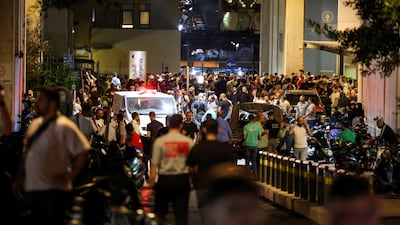
Panic at a Beirut hospital after thousands, including Hezbollah fighters and medics, were injured when the pagers they used to communicate exploded across Lebanon. Several people were killed. Reuters -
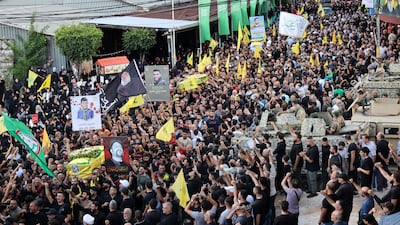
Mourners in Beirut's southern suburbs carry the coffins of people killed after hundreds of paging devices exploded, in a mass funeral on September 18, 2024. AFP -
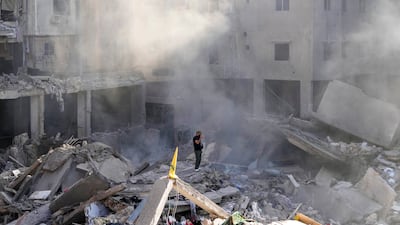
A man stands on the rubble of buildings near the site of the assassination of Hezbollah leader Hassan Nasrallah in Beirut's southern suburbs on September 29, 2024. AP -
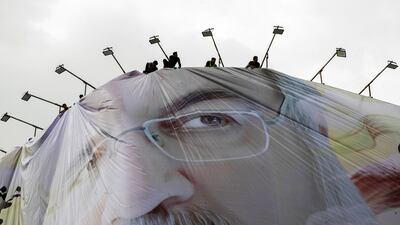
Workers drape a building in a vast banner depicting Nasrallah in Tehran, two days after his assassination by Israeli forces in Beirut. Getty Images -
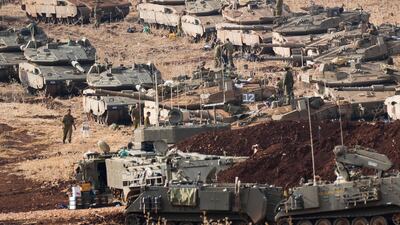
Israeli soldiers work on tanks at a staging post near the border with Lebanon on October 1, 2024. AP -
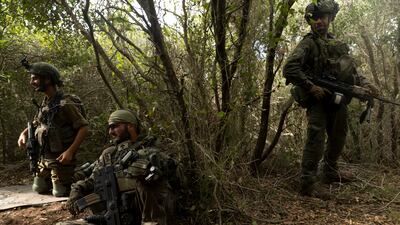
Israeli soldiers rest in an operation zone near Naqoura, southern Lebanon on October 13, 2024, after a ground invasion was launched. Getty Images -
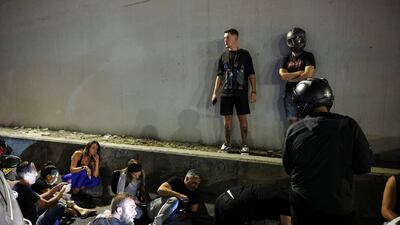
People take cover by a roadside in Tel Aviv as a siren sounds after Iran fired a salvo of ballistic missiles at Israel. Reuters -

Iranian-launched projectiles being intercepted by Israel above Jerusalem on October 1, 2024. AFP -

The aftermath of a rocket salvo in Petah Tikva, near Tel Aviv, on November 24, 2024. Hezbollah said it launched the missiles from Lebanon at an Israeli army intelligence base. AFP -
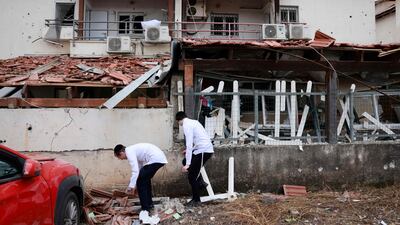
Residents in Petah Tikva check the damage after the rockets were fired from Lebanon. AFP


Hezbollah’s tactics to avoid disarmament are fast turning into ammunition for Israel.
One day we hear that the group is thinking about limiting its role as an armed movement without fully disarming. Another day we hear it might hand over more weapons on the condition that Israel withdraw from the south. What remains constant, as Reuters reported citing sources within Hezbollah, is that the group “does not intend to hand over its full arsenal and will retain light weapons and anti-tank missiles to defend against any future attacks”.
The weakness of the Lebanese state is the result of an equation it has created for itself, with its top three leaders having surrendered their sovereign authority and placed it at the mercy of Hezbollah.
The talk of the trio demanding prior guarantees from US Special Envoy for Syria, Tom Barrack – including that Israel withdraw completely from southern Lebanon – is little more than a contrived excuse, a deliberate obstruction and a severing of the hand that the Trump administration is extending to help Beirut. The necessary guarantees from Israel are already baked into the border normalisation strategy, which is, in itself, the guarantee.
Let’s hope that the coming days bring reassuring surprises when Mr Barrack returns to Lebanon for talks. Let’s hope for a fundamental shift in the strategies of the three leaders, as well as in Hezbollah’s positions. But this requires serious American resolve towards Iran. Demonstrating seriousness means proving that Washington is truly determined to stop Tehran’s continued investment in its proxy doctrine, which undermines the sovereignty of independent states like Lebanon.
Whether Washington, and Beirut itself, can prevent Lebanon from becoming a victim of both Israel’s destructive ideology and Tehran’s expansionist ambitions remains to be seen.

