


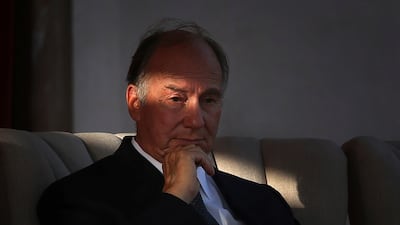
The Aga Khan was more than the spiritual leader of the world’s 15 million Ismailis. He was an advocate of Islamic art and architecture who championed both on the world stage.
I learnt of his death while I was visiting the Mughal emperor Humayun’s tomb in New Delhi. One of the great early Mughal monuments, it had recently been restored by the Aga Khan Trust for Culture. Decades ago, I wrote my dissertation about the tomb, and I was one of the first graduate students to benefit from the joint programme he endowed for the study of Islamic architecture at Harvard University and the Massachusetts Institute of Technology, so his death felt somehow very personal.
I remember at the launch of the programme in 1979 how passionate he was about his desire to improve the built environment of the Muslim world. What he said to us left a profound mark on me. He talked about how change could only come through a sustained effort that combined research and scholarship with the recognition of outstanding examples of recent architecture that could stand as models for other projects. He had a plan and a vision that since then has helped communities across the Muslim world recognise the importance of architecture to their lives.
Years later, when I served on the steering committee for his architectural awards, I had a chance to see him in action. Deeply curious, he regularly convened scholars and architects to debate critical issues around sustainability, materials, design, and urban and rural infrastructure.
He was an excellent interlocutor and listened carefully. He understood that to achieve his goals, it was critical to disseminate the results of these debates through the publications and exhibitions that accompanied the awards, which were given every three years. His manner was always courteous, courtly even, but he could be both intimidating – he often knew as much if not more than the people gathered around him – and impatient – he wanted to see measurable results in real time.
-

Prince Karim Aga Khan arrives at Belem Palace in Lisbon on July 9, 2018. The Aga Khan, imam of the Ismaili Muslims, died in Lisbon on February 4, aged 88. AFP -
Sheikh Mohammed Bin Rashid Al Maktoum, Vice President and Prime Minister of United Arab Emirates and Ruler of Dubai with His Highness Aga Khan view the scale model of Khor Dubai during launching ceremony of Khor Dubai Cultural Foundation. Paulo Vecina / The National -
The Aga Khan at the inauguration of the restored 16th century Humayun's Tomb in New Delhi, India. AP -

Britain's Prince Charles is greeted by the Aga Khan in London on November 18, 2010. Reuters -
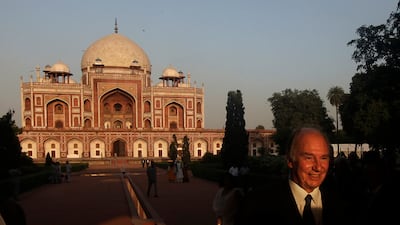
The Aga Khan leaves after the inauguration of the restored 16th century Humayun's Tomb in New Delhi on Wednesday, September 18, 2013. AP -
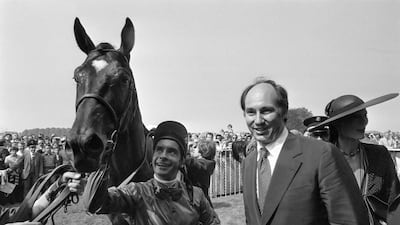
The Aga Khan, greets French jockey Yves Saint-Martin at Chantilly Racecourse, France, on June 3, 1979. AFP -
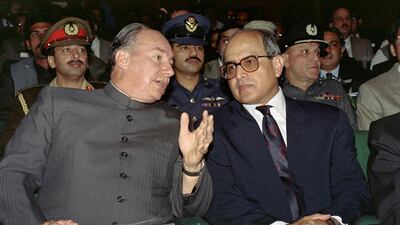
The Aga Khan with Pakistani President Farooq Ahmed Leghari on November 12, 1994. AFP -
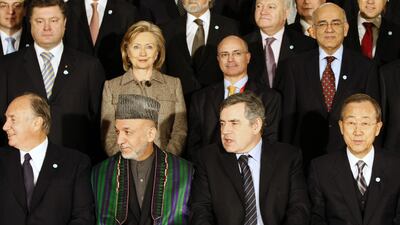
Front row from left to right, the Aga Khan, former Afghan president Hamid Karzai, former UK prime minister Gordon Brown, former UN Secretary-General Ban Ki-moon, and back row second from left, former US Secretary of State Hillary Clinton, with other delegates at the Afghanistan Conference at Lancaster House in London. PA -

The Aga Khan and Princess Salimah Aga Khan leave the Elysee Palace in Paris. AFP -
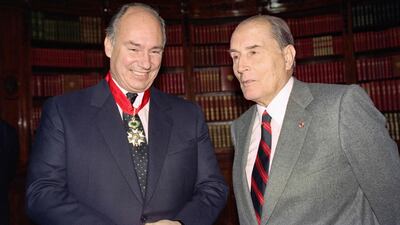
The Aga Khan, left, with former French president Francois Mitterrand at the Elysee Palace on November 7, 1990. AFP -
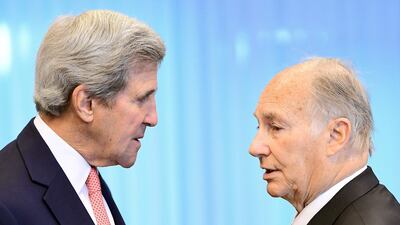
Former US State Secretary John Kerry, left, with the Aga Khan at the European Council in Brussels on October 5, 2016. AFP


I remember thinking at the first steering committee meeting that I attended, that you could feel his presence. It was a kind of aura, or moral authority, centred in his leadership of the Ismaili community. But unlike many leaders today, his vision was capacious and generous, and it went well beyond the community he represented.
The Aga Khan Award for Architecture was part of a larger network of programmes that he supported under the Aga Khan Trust for Culture. He understood that systemic change could be made only through a long-term effort that addressed the full range of cultural needs within and beyond his community. The parks, museums and monuments that he either created or restored in Cairo, Delhi, Herat, Toronto and elsewhere are just a small fraction of what he was able to do to preserve and enhance the built environment. It does not take into account the hospitals and universities that he also invested in.
His vision of the Muslim world was of an open and engaged community that lived by the values of knowledge and generosity despite legacies of colonisation, war and disruption. At a time of rising nationalism and ethnic and political polarisation, his commitment to pluralism and tolerance seems all the more remarkable. That he believed so forcefully in the power of art and architecture to foster respect and across cultures was even more impressive.
It is hard to believe that mosques like the sublime Baitur Rauf in Dhaka or the intimate garden of Samir Kassir Square in Beirut, or the imaginative Kamana Secondary School in Senegal, all of which won an Aga Khan award, could have happened without the decades he spent encouraging architects to find innovative solutions.
The legacy he leaves, from Canada to Pakistan and from India to China, is unparalleled.

