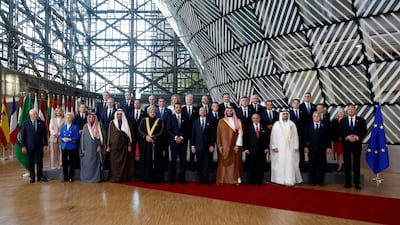
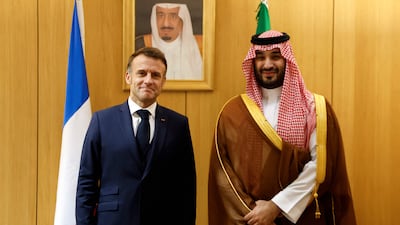
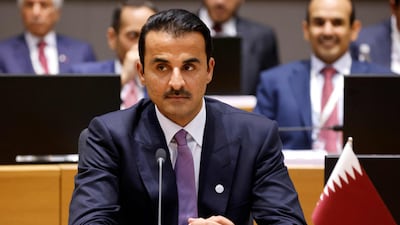
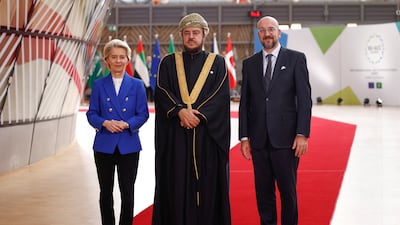
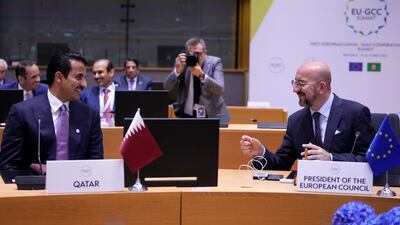
As the European Commission prepares for its new term next month, on the heels of the first EU-GCC Summit in October, Gulf countries will be looking to finally secure a free trade agreement after talks began in the late 1980s. Success may depend on Gulf countries studying the EU’s complex structure and processes more closely.
The EU is a strong proponent of regionalism, and while it is open to free trade agreements with individual countries, it favours dealing with economic blocs. For this reason, ever since the then-European Economic Community and GCC established contact in the 1980s, such a deal has been high on the agenda. Unfortunately, a variety of disagreements on economic and non-economic issues have impeded progress, leading to the GCC unilaterally suspending negotiations in 2008.
However, that was at a time when economic diversification was not the utmost priority for the Gulf. Today, that is no longer the case, with the region’s collective strategy to reduce its economic dependence on hydrocarbons being arguably the most important element of its policy programmes.
A free trade agreement with the EU is especially attractive because it offers Gulf countries tariff-free access to one of the largest markets in the world. Many of the industries that Gulf countries are investing in, such as renewable energy and military manufacturing, exhibit “economies of scale”, meaning that the higher the production level, the lower the unit cost. Being able to sell competitively to the half-a-billion EU residents is a potential gamechanger from the perspective of production efficiency, and it is therefore an important plank on the road to a knowledge economy.
On the flipside, securing a deal with the GCC offers EU exporters a considerable advantage over their competitors from East Asia, at a time when much of the bloc’s economy is experiencing sluggish growth. Moreover, it would provide it with a much-needed confidence boost in its efforts to propagate multilateralism and rule of law globally, as the GCC is a significant bloc economically and diplomatically.
Should the GCC be convinced of the advantages of reopening negotiations with the EU, its member states may benefit from a larger investment in understanding their prospective partners.
The EU is an exceptionally complex system that most Europeans themselves struggle to comprehend. Its byzantine structures are rendered even more impregnable by the fact that underneath the bloc’s supranational institutions lie the traditional government institutions of 27 diverse and sovereign states. Moreover, each of these countries has a rich civil society and a vibrant, independent private sector, multiplying the number of relevant actors to an unfathomable degree.
When dealing with one another, GCC members are used to agreeing about issues at the level of heads of state internationally, and then leaving each country the task of filling in the gaps domestically. While GCC-level committees exist in a number of areas, their deference to the upper echelons of government is unquestionable, making negotiations structurally straightforward.
Should the GCC be convinced of the advantages of reopening negotiations with the EU, its member states may benefit from a larger investment in understanding their prospective partners
However, this kind of approach is unsuited to the EU, where a comparable hierarchy is absent by design, and where the multiplicity of government and non-government stakeholders transforms negotiations into a Herculean task.
Hercules did eventually triumph in his mythical missions, and a critical element of his success was understanding what he needed to do. In the Gulf, while there exist many impressive universities, there is a dearth of European studies programmes. Gulf diplomats working in Europe surely gain valuable knowledge of the EU’s peculiar systems, but there is no substitute for acquiring a scientific understanding of the bloc through the accumulation of rigorous, interdisciplinary research.
The near absence of European studies programmes in some Gulf countries is symptomatic of a broader lack of area studies programmes, be it Chinese studies, American studies, African studies, Iranian studies and so on. This can sometimes be seen in the Gulf think tank circuit that supports foreign policy: not enough researchers speak any language except Arabic and English, regardless of their area of expertise. On the other hand, foreign researchers focusing on the Gulf often have at least a basic understanding of Arabic, in addition to English and their native tongue.
While there are a number of reasons why Israel and Turkey have prevailed in their free trade negotiations with the EU, it is notable that both countries have an abundance of European studies programmes in their universities. Their private sector and civil society links to Europe, developed over a long period of time, also run deep. This plays an important supporting role in negotiations.
The lack of area studies programmes in the GCC cannot be resolved by merely establishing a sufficient number, as students have to want to enrol in them. That requires a cultural curiosity among students in the Gulf that translates into a greater number of enrolments – proportional to the levels we see in countries such as the US. Otherwise, the knowledge that can critically support complex negotiations will accumulate too slowly.
The increasing incidence of EU-GCC exchange programmes is certainly a step in the right direction, as is the rise in the frequency of track 1 and track 2 dialogues between the two blocs. However, for GCC countries to fully realise their potential, greater investment in gaining a scientific, interdisciplinary understanding of their European brethren is crucial.

THE BIO
Favourite car: Koenigsegg Agera RS or Renault Trezor concept car.
Favourite book: I Am Pilgrim by Terry Hayes or Red Notice by Bill Browder.
Biggest inspiration: My husband Nik. He really got me through a lot with his positivity.
Favourite holiday destination: Being at home in Australia, as I travel all over the world for work. It’s great to just hang out with my husband and family.
What can victims do?
Always use only regulated platforms
Stop all transactions and communication on suspicion
Save all evidence (screenshots, chat logs, transaction IDs)
Report to local authorities
Warn others to prevent further harm
Courtesy: Crystal Intelligence
Read more about the coronavirus
Dengue%20fever%20symptoms
%3Cp%3EHigh%20fever%20(40%C2%B0C%2F104%C2%B0F)%3Cbr%3ESevere%20headache%3Cbr%3EPain%20behind%20the%20eyes%3Cbr%3EMuscle%20and%20joint%20pains%3Cbr%3ENausea%3Cbr%3EVomiting%3Cbr%3ESwollen%20glands%3Cbr%3ERash%26nbsp%3B%3C%2Fp%3E%0A
COMPANY PROFILE
Name: Kumulus Water
Started: 2021
Founders: Iheb Triki and Mohamed Ali Abid
Based: Tunisia
Sector: Water technology
Number of staff: 22
Investment raised: $4 million
Jetour T1 specs
Engine: 2-litre turbocharged
Power: 254hp
Torque: 390Nm
Price: From Dh126,000
Available: Now
Specs
Engine: Dual-motor all-wheel-drive electric
Range: Up to 610km
Power: 905hp
Torque: 985Nm
Price: From Dh439,000
Available: Now
BACK%20TO%20ALEXANDRIA
%3Cp%3E%3Cstrong%3EDirector%3A%20%3C%2Fstrong%3ETamer%20Ruggli%3C%2Fp%3E%0A%3Cp%3E%3Cstrong%3EStarring%3A%20%3C%2Fstrong%3ENadine%20Labaki%2C%20Fanny%20Ardant%3C%2Fp%3E%0A%3Cp%3E%3Cstrong%3ERating%3A%20%3C%2Fstrong%3E3.5%2F5%3C%2Fp%3E%0A
The National's picks
4.35pm: Tilal Al Khalediah
5.10pm: Continous
5.45pm: Raging Torrent
6.20pm: West Acre
7pm: Flood Zone
7.40pm: Straight No Chaser
8.15pm: Romantic Warrior
8.50pm: Calandogan
9.30pm: Forever Young
The specs
Engine: 2.0-litre 4cyl turbo
Power: 261hp at 5,500rpm
Torque: 405Nm at 1,750-3,500rpm
Transmission: 9-speed auto
Fuel consumption: 6.9L/100km
On sale: Now
Price: From Dh117,059
The specs
Engine: 4.0-litre flat-six
Torque: 450Nm at 6,100rpm
Transmission: 7-speed PDK auto or 6-speed manual
Fuel economy, combined: 13.8L/100km
On sale: Available to order now
Brief scores:
Scotland 371-5, 50 overs (C MacLeod 140 no, K Coetzer 58, G Munsey 55)
England 365 all out, 48.5 overs (J Bairstow 105, A Hales 52; M Watt 3-55)
Result: Scotland won by six runs
Profile
Company: Justmop.com
Date started: December 2015
Founders: Kerem Kuyucu and Cagatay Ozcan
Sector: Technology and home services
Based: Jumeirah Lake Towers, Dubai
Size: 55 employees and 100,000 cleaning requests a month
Funding: The company’s investors include Collective Spark, Faith Capital Holding, Oak Capital, VentureFriends, and 500 Startups.
ANDROID%20VERSION%20NAMES%2C%20IN%20ORDER
%3Cp%3EAndroid%20Alpha%3C%2Fp%3E%0A%3Cp%3EAndroid%20Beta%3C%2Fp%3E%0A%3Cp%3EAndroid%20Cupcake%3C%2Fp%3E%0A%3Cp%3EAndroid%20Donut%3C%2Fp%3E%0A%3Cp%3EAndroid%20Eclair%3C%2Fp%3E%0A%3Cp%3EAndroid%20Froyo%3C%2Fp%3E%0A%3Cp%3EAndroid%20Gingerbread%3C%2Fp%3E%0A%3Cp%3EAndroid%20Honeycomb%3C%2Fp%3E%0A%3Cp%3EAndroid%20Ice%20Cream%20Sandwich%3C%2Fp%3E%0A%3Cp%3EAndroid%20Jelly%20Bean%3C%2Fp%3E%0A%3Cp%3EAndroid%20KitKat%3C%2Fp%3E%0A%3Cp%3EAndroid%20Lollipop%3C%2Fp%3E%0A%3Cp%3EAndroid%20Marshmallow%3C%2Fp%3E%0A%3Cp%3EAndroid%20Nougat%3C%2Fp%3E%0A%3Cp%3EAndroid%20Oreo%3C%2Fp%3E%0A%3Cp%3EAndroid%20Pie%3C%2Fp%3E%0A%3Cp%3EAndroid%2010%20(Quince%20Tart*)%3C%2Fp%3E%0A%3Cp%3EAndroid%2011%20(Red%20Velvet%20Cake*)%3C%2Fp%3E%0A%3Cp%3EAndroid%2012%20(Snow%20Cone*)%3C%2Fp%3E%0A%3Cp%3EAndroid%2013%20(Tiramisu*)%3C%2Fp%3E%0A%3Cp%3EAndroid%2014%20(Upside%20Down%20Cake*)%3C%2Fp%3E%0A%3Cp%3EAndroid%2015%20(Vanilla%20Ice%20Cream*)%3C%2Fp%3E%0A%3Cp%3E%3Cem%3E*%20internal%20codenames%3C%2Fem%3E%3C%2Fp%3E%0A
Desert Warrior
Starring: Anthony Mackie, Aiysha Hart, Ben Kingsley
Director: Rupert Wyatt
Rating: 3/5
The%20specs
%3Cp%3E%3Cstrong%3EEngine%3A%3C%2Fstrong%3E%206.4-litre%20V8%0D%3Cbr%3E%3Cstrong%3ETransmission%3A%20%3C%2Fstrong%3E8-speed%20auto%0D%3Cbr%3E%3Cstrong%3EPower%3A%20%3C%2Fstrong%3E470bhp%0D%3Cbr%3E%3Cstrong%3ETorque%3A%20%3C%2Fstrong%3E637Nm%0D%3Cbr%3E%3Cstrong%3EPrice%3A%20%3C%2Fstrong%3EDh375%2C900%20(estimate)%0D%3Cbr%3E%3Cstrong%3EOn%20sale%3A%3C%2Fstrong%3E%20now%3C%2Fp%3E%0A
KILLING OF QASSEM SULEIMANI
Mercer, the investment consulting arm of US services company Marsh & McLennan, expects its wealth division to at least double its assets under management (AUM) in the Middle East as wealth in the region continues to grow despite economic headwinds, a company official said.
Mercer Wealth, which globally has $160 billion in AUM, plans to boost its AUM in the region to $2-$3bn in the next 2-3 years from the present $1bn, said Yasir AbuShaban, a Dubai-based principal with Mercer Wealth.
“Within the next two to three years, we are looking at reaching $2 to $3 billion as a conservative estimate and we do see an opportunity to do so,” said Mr AbuShaban.
Mercer does not directly make investments, but allocates clients’ money they have discretion to, to professional asset managers. They also provide advice to clients.
“We have buying power. We can negotiate on their (client’s) behalf with asset managers to provide them lower fees than they otherwise would have to get on their own,” he added.
Mercer Wealth’s clients include sovereign wealth funds, family offices, and insurance companies among others.
From its office in Dubai, Mercer also looks after Africa, India and Turkey, where they also see opportunity for growth.
Wealth creation in Middle East and Africa (MEA) grew 8.5 per cent to $8.1 trillion last year from $7.5tn in 2015, higher than last year’s global average of 6 per cent and the second-highest growth in a region after Asia-Pacific which grew 9.9 per cent, according to consultancy Boston Consulting Group (BCG). In the region, where wealth grew just 1.9 per cent in 2015 compared with 2014, a pickup in oil prices has helped in wealth generation.
BCG is forecasting MEA wealth will rise to $12tn by 2021, growing at an annual average of 8 per cent.
Drivers of wealth generation in the region will be split evenly between new wealth creation and growth of performance of existing assets, according to BCG.
Another general trend in the region is clients’ looking for a comprehensive approach to investing, according to Mr AbuShaban.
“Institutional investors or some of the families are seeing a slowdown in the available capital they have to invest and in that sense they are looking at optimizing the way they manage their portfolios and making sure they are not investing haphazardly and different parts of their investment are working together,” said Mr AbuShaban.
Some clients also have a higher appetite for risk, given the low interest-rate environment that does not provide enough yield for some institutional investors. These clients are keen to invest in illiquid assets, such as private equity and infrastructure.
“What we have seen is a desire for higher returns in what has been a low-return environment specifically in various fixed income or bonds,” he said.
“In this environment, we have seen a de facto increase in the risk that clients are taking in things like illiquid investments, private equity investments, infrastructure and private debt, those kind of investments were higher illiquidity results in incrementally higher returns.”
The Abu Dhabi Investment Authority, one of the largest sovereign wealth funds, said in its 2016 report that has gradually increased its exposure in direct private equity and private credit transactions, mainly in Asian markets and especially in China and India. The authority’s private equity department focused on structured equities owing to “their defensive characteristics.”
Top investing tips for UAE residents in 2021
Build an emergency fund: Make sure you have enough cash to cover six months of expenses as a buffer against unexpected problems before you begin investing, advises Steve Cronin, the founder of DeadSimpleSaving.com.
Think long-term: When you invest, you need to have a long-term mindset, so don’t worry about momentary ups and downs in the stock market.
Invest worldwide: Diversify your investments globally, ideally by way of a global stock index fund.
Is your money tied up: Avoid anything where you cannot get your money back in full within a month at any time without any penalty.
Skip past the promises: “If an investment product is offering more than 10 per cent return per year, it is either extremely risky or a scam,” Mr Cronin says.
Choose plans with low fees: Make sure that any funds you buy do not charge more than 1 per cent in fees, Mr Cronin says. “If you invest by yourself, you can easily stay below this figure.” Managed funds and commissionable investments often come with higher fees.
Be sceptical about recommendations: If someone suggests an investment to you, ask if they stand to gain, advises Mr Cronin. “If they are receiving commission, they are unlikely to recommend an investment that’s best for you.”
Get financially independent: Mr Cronin advises UAE residents to pursue financial independence. Start with a Google search and improve your knowledge via expat investing websites or Facebook groups such as SimplyFI.
The specs
Engine: 2-litre 4-cylinder and 3.6-litre 6-cylinder
Power: 220 and 280 horsepower
Torque: 350 and 360Nm
Transmission: eight-speed automatic
Price: from Dh136,521 VAT and Dh166,464 VAT
On sale: now
The Vile
Starring: Bdoor Mohammad, Jasem Alkharraz, Iman Tarik, Sarah Taibah
Director: Majid Al Ansari
Rating: 4/5
Name: Peter Dicce
Title: Assistant dean of students and director of athletics
Favourite sport: soccer
Favourite team: Bayern Munich
Favourite player: Franz Beckenbauer
Favourite activity in Abu Dhabi: scuba diving in the Northern Emirates
IF YOU GO
The flights: FlyDubai offers direct flights to Catania Airport from Dubai International Terminal 2 daily with return fares starting from Dh1,895.
The details: Access to the 2,900-metre elevation point at Mount Etna by cable car and 4x4 transport vehicle cost around €57.50 (Dh248) per adult. Entry into Teatro Greco costs €10 (Dh43). For more go to www.visitsicily.info
Where to stay: Hilton Giardini Naxos offers beachfront access and accessible to Taormina and Mount Etna. Rooms start from around €130 (Dh561) per night, including taxes.
AGL AWARDS
Golden Ball - best Emirati player: Khalfan Mubarak (Al Jazira)
Golden Ball - best foreign player: Igor Coronado (Sharjah)
Golden Glove - best goalkeeper: Adel Al Hosani (Sharjah)
Best Coach - the leader: Abdulaziz Al Anbari (Sharjah)
Fans' Player of the Year: Driss Fetouhi (Dibba)
Golden Boy - best young player: Ali Saleh (Al Wasl)
Best Fans of the Year: Sharjah
Goal of the Year: Michael Ortega (Baniyas)
Company profile
Name: One Good Thing
Founders: Bridgett Lau and Micheal Cooke
Based in: Dubai
Sector: e-commerce
Size: 5 employees
Stage: Looking for seed funding
Investors: Self-funded and seeking external investors
F1 The Movie
Starring: Brad Pitt, Damson Idris, Kerry Condon, Javier Bardem
Director: Joseph Kosinski
Rating: 4/5
BMW M5 specs
Engine: 4.4-litre twin-turbo V-8 petrol enging with additional electric motor
Power: 727hp
Torque: 1,000Nm
Transmission: 8-speed auto
Fuel consumption: 10.6L/100km
On sale: Now
Price: From Dh650,000
THE BIO
Occupation: Specialised chief medical laboratory technologist
Age: 78
Favourite destination: Always Al Ain “Dar Al Zain”
Hobbies: his work - “ the thing which I am most passionate for and which occupied all my time in the morning and evening from 1963 to 2019”
Other hobbies: football
Favorite football club: Al Ain Sports Club
LEADERBOARD
%3Cp%3E-19%20T%20Fleetwood%20(Eng)%3B%20-18%20R%20McIlroy%20(NI)%2C%20T%20Lawrence%20(SA)%3B%20-16%20J%20Smith%3B%20-15%20F%20Molinari%20(Ita)%3B%20-14%20Z%20Lombard%20(SA)%2C%20S%20Crocker%20(US)%3C%2Fp%3E%0A%3Cp%3E%3Cstrong%3ESelected%3A%20%3C%2Fstrong%3E-11%20A%20Meronk%20(Pol)%3B%20-10%20E%20Ferguson%20(Sco)%3B%20-8%20R%20Fox%20(NZ)%20-7%20L%20Donald%20(Eng)%3B%20-5%20T%20McKibbin%20(NI)%2C%20N%20Hoejgaard%20(Den)%3C%2Fp%3E%0A
How to wear a kandura
Dos
- Wear the right fabric for the right season and occasion
- Always ask for the dress code if you don’t know
- Wear a white kandura, white ghutra / shemagh (headwear) and black shoes for work
- Wear 100 per cent cotton under the kandura as most fabrics are polyester
Don’ts
- Wear hamdania for work, always wear a ghutra and agal
- Buy a kandura only based on how it feels; ask questions about the fabric and understand what you are buying