


As climate change dominates global discussions, some alarming events may have slipped under the radar.
The Arabian Gulf endured extreme heat and humidity in mid-July, with heat indexes soaring to 60-65°C in some areas. In Abu Dhabi, temperatures surged to 61°C, while Oman's Khasab Air Base recorded a blistering 58°C.
According to data from the National Oceanic and Atmospheric Administration, sea surface temperatures were as warm as 35°C during the same time. Researchers have pointed out that this region could experience dangerous heat levels regularly over the next 30 to 50 years.
Meanwhile, severe droughts are becoming more widespread, as evidenced by the Brazilian port of Manaus reaching record-low water levels last October and Nepal experiencing below-average winter rainfall for six out of the past 10 years.
The increasingly dry weather and escalating water crisis directly threaten food security, public health and livelihoods. Countries such as Spain and South Africa are experiencing devastating agricultural losses due to prolonged dry spells, with cities such as Cape Town having had to implement water restrictions to manage shrinking resources.
These issues are not isolated. They're symptomatic of a warming planet, where rising temperatures speed up the water cycle, intensifying rainfall in some areas and worsening droughts in others.
The UN predicts that by 2050, drought could affect 75 per cent of the global population. Even more alarming, by 2100, rising temperatures could render groundwater undrinkable for up to 75 million people worldwide, according to the Karlsruhe Institute of Technology in Germany.
-
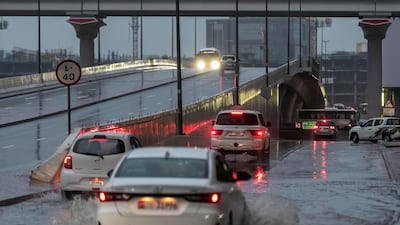
Safety alerts were issued as large parts of the UAE were hit by heavy rain, thunder and lightning overnight and into Monday morning. Antonie Robertson/The National -
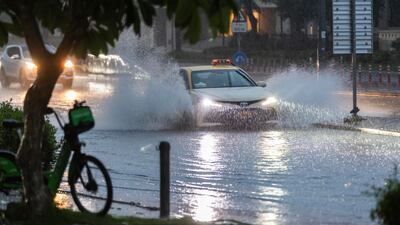
Thunder rumbled and lightning streaked across the skies in Abu Dhabi and Dubai in the early hours amid persistent heavy rain. Antonie Robertson/The National -

Authorities sent an alert to mobile phones shortly after 6am to warn of "weather fluctuations" in parts of the UAE. Antonie Robertson/The National -
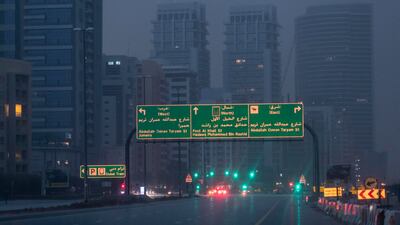
Police reduced speed limits to 80kph temporarily on key routes. Antonie Robertson/The National -
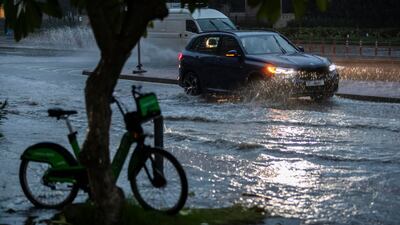
The rain comes down in Dubai. Antonie Robertson/The National -
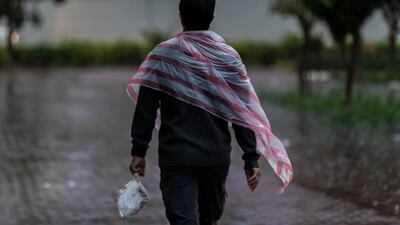
The National Centre of Meteorology has weather warnings in place for much of the country until noon on Tuesday. Antonie Robertson / The National -
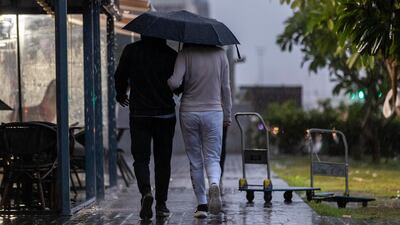
It issued its most severe red alert – urging people to be extremely vigilant over hazardous weather – for some areas of Abu Dhabi. Antonie Robertson/The National -
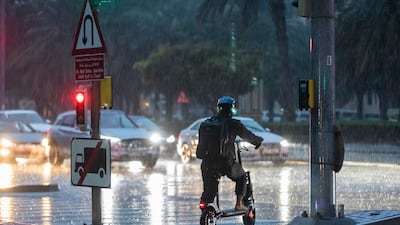
Heavy rain began falling early in the morning in The Greens, Dubai. Antonie Robertson/The National -

Building obscured by rain and clouds in The Greens. Antonie Robertson/The National -

Cars cautiously manoeuvre through flooded roads in Barsha Heights, Dubai. Antonie Robertson/The National -

A man stands in the rain, smiling under an umbrella, in Al Quoz, Dubai. Antonie Robertson/The National -
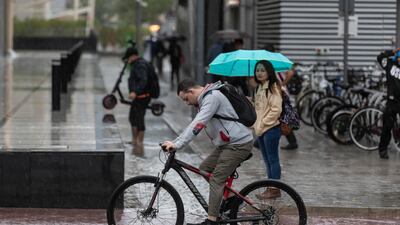
A man pedals through the rain on his bicycle, in Barsha Heights. Antonie Robertson/The National -
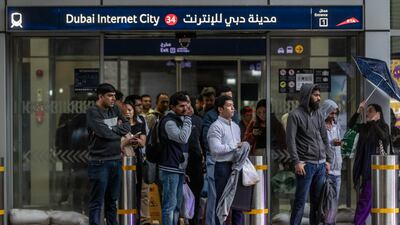
People gather at the Dubai Internet City metro station, seeking refuge from the rain. Antonie Robertson/The National -
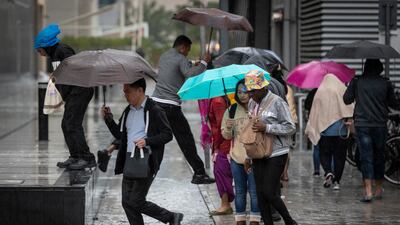
Pedestrians walk with umbrellas unfurled, navigating the rain-soaked streets in Barsha Heights. Antonie Robertson/The National -

Vehicles navigate flooded roads cautiously in Al Quoz, Dubai. Antonie Robertson/The National -
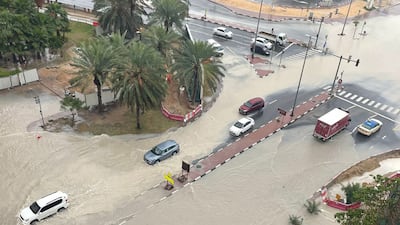
Flooded roads near Ibn Battuta Mall created a watery obstacle course, challenging drivers and pedestrians alike. James O'Hara/ The National -
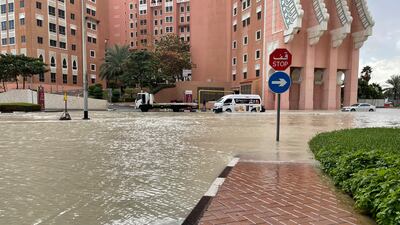
Flooding is seen at the Garden cross roads intersection next to Ibn Battuta mall. James O'Hara / The National -
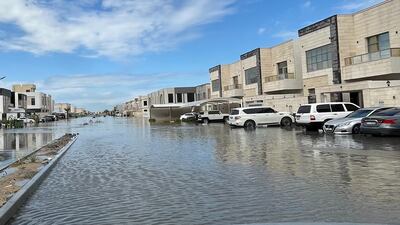
Flooding in Al Yasmeen villa community, Ajman. Salam Al Amir/ The National


In this context, the case for rainfall enhancement as a potential solution becomes more compelling. The UAE, with its naturally arid climate, has long sought innovative approaches to diversify its water-food-energy nexus. Significant strides have been made towards energy-efficient solutions. However, two-thirds of our domestic water needs are still met by groundwater, and with rising temperatures, water scarcity remains a pressing concern.
This has led us to explore forward-thinking solutions, including the UAE Research Programme for Rain Enhancement Science (UAEREP), in its 10th year, which contributes to advancing rain enhancement science through innovative solutions.

Rainfall enhancement applications have been employed worldwide for decades. This solution is more relevant today due to recent scientific advancements that have clearly demonstrated its effectiveness by distinguishing between natural and induced precipitation. This has prompted several countries, including India, to invest millions in rainmaking technology. The technology is also being explored as a tool to address air pollution in Pakistan, mitigate forest fires in Indonesia and sustain water levels that are safe for maritime navigation through the Panama Canal.
The UAE's rain-enhancement programme stands out for its novel approach, emphasising global collaboration, innovative technology, and multidisciplinary research. This is all to address the water security challenges faced by arid and semi-arid regions across the globe. By working at the intersection of water, energy, food and the environment, UAEREP is establishing rainfall enhancement as a key component of sustainability and climate change adaptation strategies.
Under the patronage of Sheikh Mansour bin Zayed, Vice President, Deputy Prime Minister and Chairman of the Presidential Court, we intend to accelerate research and development, offering grants of up to $1.5 million for each of the three winning research proposals. The programme has funded 14 groundbreaking projects to date, cementing the UAE’s leadership in scientific innovation and rain enhancement technology. The sixth cycle of the programme will begin soon, continuing to explore new areas for development.
In parallel, we are expanding our unique international platform, the International Rain Enhancement Forum, created by the government for the global rain enhancement scientific community. This forum provides a space to discuss the latest advancements and offers new researchers opportunities to collaborate with leading scientists worldwide.
Since 2016, UAEREP has invested more than $22.5 million in research grants to 14 principal investigators, supported by 208 researchers from 45 institutions worldwide. Our vision is to pool knowledge, resources and technologies to develop more effective methods of increasing rainfall where it is most needed.
Complementarily, Abu Dhabi’s G42 has teamed up with Nvidia to develop AI-driven solutions that improve global weather forecasting using Nvidia’s Earth-2 platform.
This partnership includes a climate tech lab in Abu Dhabi, which will create tailored climate solutions. In line with the UAEREP mission, this initiative supports the UAE’s broader vision of leading from the front by connecting climate science with societal benefits.
Critics may point to uncertainties about the long-term effects and scientifically flawed conspiracy theories of manipulating weather systems, but the urgency of the water crisis demands the exploration of all viable solutions. While not a silver bullet, rain enhancement provides a proactive measure that can help mitigate water shortages and offer relief to regions struggling with drought and increasingly unbearable heat.
The method also fits into larger water management strategies to build resilience against climate change. While reducing emissions and adopting sustainable practices remain critical, this domain offers a complementary remedy for regions in crisis. It represents a step towards adaptive solutions that buy time while long-term climate mitigation efforts continue. Ultimately, the future of water security depends on our capacity to innovate, collaborate and take decisive action.

