


In the 1960s, social critic Paul Goodman offered a parable to describe what had gone wrong with American higher education.
He wrote: “Millennia ago, there were wise people who knew many things that they were eager to share. Young people came to them and asked, ‘Would you teach us?’ And they did. Over time more students came to learn. And after learning, there were many more wise ones able and willing to teach.
“The enterprise grew with more students, more teachers, and more subjects to teach. It became so complicated that the wise ones hired clerks to keep track of who was teaching, what they were teaching, and which students were with which teachers. The problem today is that the clerks are running the show deciding who will teach, what they will teach, and who is qualified to learn.”
The lesson conveyed by this parable is relevant to understanding worrisome developments unfolding on US college campuses. Israel’s assault on Gaza, following Hamas’s attack of October 7, spawned a nationwide revolt of the young. While organised groups helped mobilise demonstrations demanding a ceasefire and Palestinian rights, the breadth and depth of the effort was more akin to a spontaneous eruption.
In this regard, it was not unlike earlier spontaneous protest movements that sprang up over the past decade: the Women’s March; the “Welcome immigrants” demonstrations that filled US airports in response to the “Muslim ban”; the student-led “March for our Lives” after repeated mass shootings; and the Black Lives Matter movement that erupted after the murder of George Floyd.
The ceasefire/pro-Palestinian movement had much in common with these earlier efforts. Its politics skewed left, it was youth-led, and racially, ethnically and religiously diverse. The difference was that a main locus of its activities was college campuses.
It began with demonstrations, teach-ins and vigils. But as the war continued into the spring and the world became aware of the mass killings and devastation inflicted by Israel – and the Joe Biden administration’s unconditional support in the face of the enormity of human loss and suffering – the intensity of the student response grew as well. This gave birth to the “encampment movement” that rapidly spread to hundreds of campuses across the country.

From the early stages, the campus anti-war protests were confronted by a number of malign actors who sought to silence or discredit the dissent. Charging that administrations weren’t acting to quash the protests, a number of pro-Israel donors and trustees at some elite universities withdrew their financial support.
While most of the early protests were self-policed, there were often instances where students on both sides of this emotionally charged conflict engaged in hurtful or threatening behaviours. At this point, a second group of malign actors entered the fray.
A few prominent pro-Israel Jewish organisations drummed up an exaggerated campaign charging that the entire protest effort was at its core anti-Semitic and should be stopped to protect Jewish students who felt threatened or excluded. They published reports, conducted a huge media campaign and testified before Congress making their case. While some examples they used were clearly hurtful, the bulk of the instances they cited were not, by any reasonable standard, anti-Semitic.
This effort was enough to provide the impetus for a third group of malign actors: Republican members of Congress. For the GOP, this was “a perfect storm”. The cast of villains were “elite” universities with their spoiled upper-class students, those who oppose Israel, and Democrats who tolerate, or even encourage, disruptive behaviours.
Ivy League university presidents were summoned to testify before congressional committees, where they were badgered and confronted by deceptive and misleading questions designed more for media hits than information. The pressures placed on these presidents after they bungled their confrontations before different committees resulted in many feeling compelled to resign.
Republicans sensing victory and smelling blood in the water went further in their campaigns of harassment – threatening funding for colleges that didn’t act as the GOP saw fit and demanded more oversight. They also moved from maligning the movement as anti-Semitic to also supporting “terrorist ideology”.
-
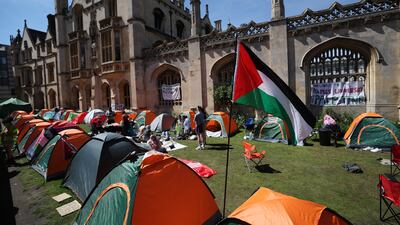
Students at King's College Cambridge University camp out in solidarity with Palestinians, in Cambridge, Britain, on May 9. EPA -
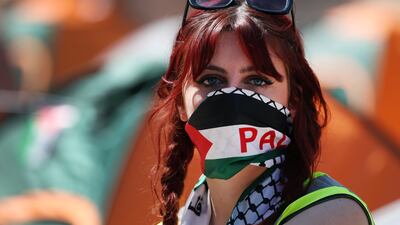
A woman takes part in the King's College Cambridge University protest camp on May 9. EPA -
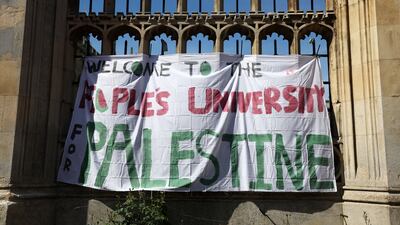
A banner at King's College shows the students' determination to support Palestinians under siege in Gaza. EPA -
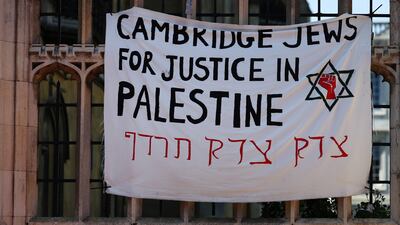
Another banner, from Jewish students at Cambridge University, supporting Gaza's Palestinians. EPA -
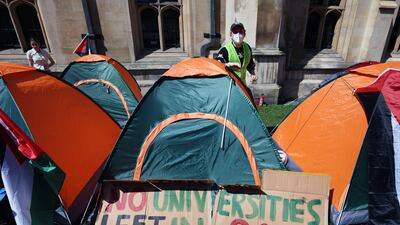
The pro-Palestinian camp at King's College. EPA -
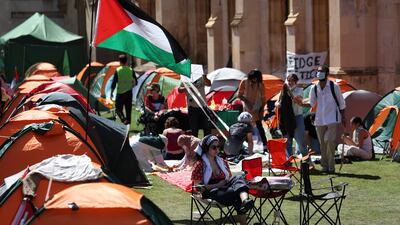
Students at the university maintain their vigil. EPA -

A protest outside Senate House at Cambridge University on Wednesday over the Gaza conflict. PA


Confronted by these multi-layered challenges and fearful of the pressures from donors and congressional meddling, many universities reacted by inviting in police to dismantle the protests – often using brutal force. In a few weeks, police arrested more than 3,000 students nationwide, with universities suspending many and banning several student groups from operating on campus.
When students and faculty returned to their campuses this month, they discovered that college administrators had been hard at work during the summer revamping policies with regard to both allowable protest activity and acceptable speech. While there were some differences from campus to campus, the new regulations had enough in common to lead researchers to uncover an industry of “security consultants” who had been brought in to advise on changing campus policies and practices.
The new procedures place limits on time, place and duration of protests and require that sponsoring groups secure permission for protest activity and, in some instances, the content of signs to be used. Some faculty have been required to submit their curriculum for review (not only by administrators but by requesting members of Congress). More problematic has been the fact that all of these changes have been made without involvement of the schools’ faculty or student senates or the established faculty/student judicial committees. Instead of dealing with infractions internally, they involve external police enforcement.
While many have expressed concern that these policies are similar to McCarthy-era repression and intimidation, equally worrisome is what all of this means for the future of the university. And this is where Goodman’s parable is relevant, because what we have is a situation where the clerks, driven by fear, political pressure and donors have engineered a power grab bypassing the established structures of governance and have securitised campuses, restricting both academic freedom and freedom of expression.
And all of this was done to silence a new awakening in support of Palestinian human rights.

