


Muhammad Ali once famously said: "Service to others is the rent you pay for your room here on Earth.” On September 5, 1960, the late boxer and activist won a gold medal at the Rome Olympics. The passing of this week’s seemingly unremarkable date is in contrast to a remarkable man.
Ali’s service in and outside the ring left a role model’s legacy decades on from that pivotal moment. His boxing prowess was just one element of his status alongside his conscientious objection to the Vietnam War – for which he lost his world champion status – along with his lyricism and invention of today’s “trash talk”, and his ability to articulate right and wrong. It’s little wonder that his funeral in 2016 was watched by a billion people, exceeded only by the services for Queen Elizabeth and Princess Diana.
It feels like a double punch in the gut (pun intended) that his pivotal date coincides with the death anniversary of Mother Teresa, another global role model, revered for her service over decades to the poor of India.
This is because we are faced with the question, where are the role models that we need today? We live in a period of conflict, revolution and death on a scale our brains can’t compute. Climate change poses a threat and many worry about a possible Third World War on the horizon. All these challenges are wrapped up in an era of misinformation, disinformation and the muddying of what once appeared to be a consensus on moral values.
It is reasonable to consider that this dearth of larger-than-life heroes is, in part, down to the fact that the moral clarity to even identify who such people might be seems murkier than ever. After all, earlier this year, in response to an order from a judge to stop Donald Trump’s verbal abuse during a court case, the now convicted former US president offered himself as a “modern-day Mandela” fighting for free speech. Andrew Tate, considered a role model for “alpha males”, is seen as fighting back against the weakening of men, yet he is also under arrest for rape and human trafficking.
Role models in this sense seem not to need moral purpose, just large numbers of followers built on controversial viewpoints and exacerbated by algorithms.
It is challenging to know if the world could have another Nelson Mandela in the digital age. For every action or statement made by a public figure is subjected to immediate and often relentless scrutiny. This isn’t to say that role models from the earlier times did not polarise opinion. But social media platforms amplify both admiration and criticism of today’s leaders, making it difficult for them to maintain an unblemished public image.
But I’m not despondent. The process of blurring out role models who challenge authority is itself part of the role model’s creation. We don’t always recognise their heroic status at the time. They were controversial, anger was whipped up about them, they were insulted and persecuted, and considered fringe and disruptive in their times. Their myths are often post-hoc. And so it will be for the role models that are being nurtured now.
This century has also seen a shift from singular people as role models to collective movements and collective leadership. Campaigns such as MeToo and Black Lives Matter, as well as the protest camps on university campuses in the US and elsewhere about the war in Gaza, have been collective rather than individualised. But clearly, within these collectives are visionary people.
-

-
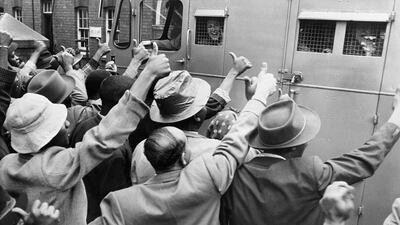
1956 - ANC supporters give the thumb up as a prison van with anti-apartheid militants go to Johannesburg’s courthouse, 28 December 1956. 152 anti-apartheid militants, in which Nelson Mandela, are on trial in Johannesburg. AFP PHOTO -
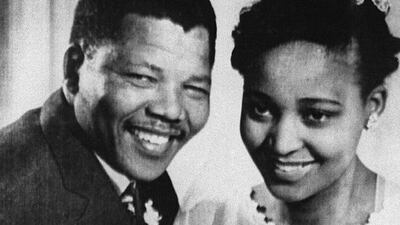
1957: South African anti-apartheid leader and African National Congress (ANC) member Nelson Mandela posing with his wife Winnie during their wedding. AFP PHOTO -

1961: Nelson Mandela. AFP PHOTO -

Circa 1964: Nelson Mandela, President of the African National Congress, left, in discussion with C Andrews, a Cape Town teacher. Three Lions / Getty Images -
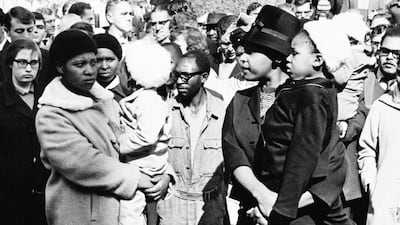
June 12, 1964: Winnie Mandela, right, waits in vain for a glimpse of her husband, Nelson Mandela, outside the Palace of Justice in Pretoria. AP Photo -

June 16, 1964: A pictures shows eight men, among them Nelson Mandela, sentenced to life imprisonment in the Rivonia trial leaving the Palace of Justice in Pretoria with their fists raised in defiance through the barred windows of the prison car. AFP -
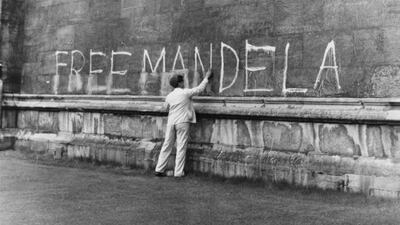
A man washing a ‘Free Mandela’ slogan off the side of King’s College Chapel in Cambridge, UK. Peter Dunne / Getty Images -
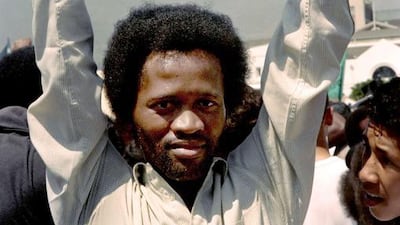
February 02, 1990: A young man holds a local newspaper in Cape Town announcing that ANC is unbanned, during a demonstration of anti-Apartheid marchers demanding the release of all the political prisoners in South Africa. AFP PHOTO -
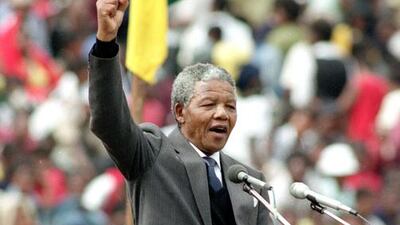
February. 13, 1990: Mandela salutes to 120,000 ANC supporters packing Soccer City stadium in the Soweto, shortly after his release from 27 years in prison. AP Photo -

February 13, 1990: Nelson Mandela and Winnie Mandela give salutes as they enter Soccer City stadium in the Soweto. Udo Weitz / AP Photo -

March 12, 1990: Mandela, left and Oliver Tambo meet for the first time after 28 years in Stockholm, Sweden. Anders Holmstroem / Reuters -
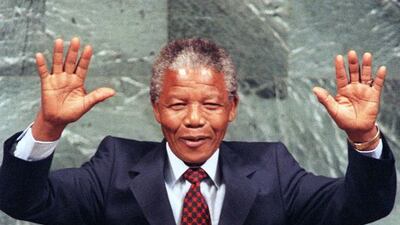
June 22, 1990: Mandela in New York, raising his arms over his head as he receives applause at the United Nations. Mandela urged the UN to maintain sanctions against South Africa until apartheid is abolished. AFP -
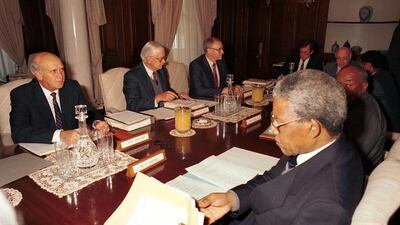
August 6, 1990: Former South African President Nelson Mandela, representing the African National Congress (ANC), begins peace talks known as the ‘Pretoria Minute’ with incumbent State President FW de Klerk at the Presidency in Pretoria, South Africa. EPA -
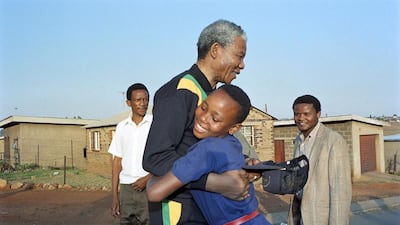
October 4, 1990, Mandela hugs a young Sowetan girl during his visit to the township near Johannesburg. -

December 14, 1990: African National Congress (ANC) President Oliver Tambo (C), ANC deputy president Nelson Mandela (L) and Winnie Mandela (R) attend Tambo’s first ANC conference in South Africa after 30 years in exile in Soweto. Mandela in 1952 opened the first black law practice in Johannesburg with Oliver Tambo. Trevor Samson / AFP Photo -

May 15, 1992: Mandela shakes hands with South Africa’s President FW de Klerk in Johannesburg, after the first day of the Convention for a Democratic South Africa (CODESA). -
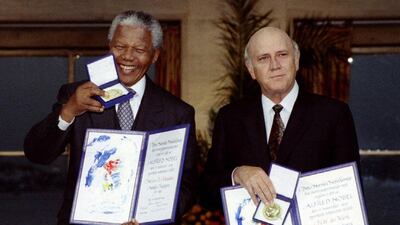
December 10, 1993: South African President FW de Klerk, right, and Mandela, left, hold up medals and certificates after they were jointly awarded the 1993 Nobel Peace Prize at a ceremony in Oslo. Reuters -

May 10, 1994: Mandela takes the presidential oath during his inauguration at the Union Building in Pretoria. Mandela was elected president at the first session of the country’s post-apartheid parliament. Walter Dhladhla / AFP Photo -
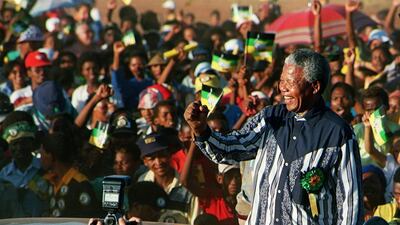
February 24, 1994, Mandela waves to the crowd as he enters Roodepan township in Kimberley during an electoral meeting. Guy Tillim / AFP Photo -
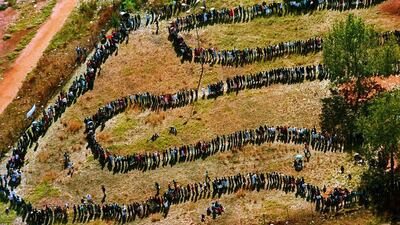
April 27, 1994: A long line of people wait outside the polling station in Soweto to vote in South Africa’s first all-race elections. Denis Farrell / AP Photo


It’s not all about the online space; people are out in the real world, doing things. We just may not be attuned to it. Perhaps, they are not adequately covered in mainstream media, and probably edged out by the online algorithms.
Building role model status takes hard graft and long engagement – anathema to our digital age of short attention spans, fragmentation of public focus and the existence of echo chambers. Yet if we think of cultural figures such as Mahmoud Darwish, Umm Kulthum and Fairuz, we can be certain that they would have burst out of the corners of TikTok and Instagram. We know that today’s equivalent of the real-world halls of Malcolm X and Martin Luther King Jr are still full of people hungry to fight for equality and overturn injustice.
The streets have been filled with millions of people fighting to save the planet, for racial equality and for peace and self-determination in Palestine, among other causes.
Not all role models need to be global figures. Community leaders, grassroots activists, and even parents can inspire and drive change within their own spheres. It is also common for people to say their role model is their mum or dad – it is something I’ve said myself. September 5 also marks Teacher’s Day in many countries, a reflection on how educators change lives.
Of course, there is always the ultimate option when it comes to seeking leadership and role models. Which is to step up ourselves. To quote Ali: “We become heroes when we stand up for what we believe in.”

