


Through the UAE Consensus reached at Cop28 in Dubai last December, negotiators secured historic commitments to expand renewable energy. Today, work is under way to deliver on that pledge, as governments, companies and civil society take action to increase access to affordable, clean power.
Nowhere is this transformation more urgently needed than in Africa, where 660 million people still live without electricity in their homes and hundreds of millions more rely on unstable grid connections. Expanding power at such a scale is difficult on its own – doing it sustainably is even harder.
To overcome these challenges and broaden the benefits of renewable energy, some argue that the grid model that worked in the West should be transplanted to emerging economies.
However, Africa’s vast lands, dispersed population and lack of last-mile technicians make utility-scale grids expensive and complicated to implement in many locations. Instead, mounting evidence shows that a decentralised approach is more effective.
Distributed Renewable Energy, or DRE, is an alternative to the traditional centralised power plant model of energy generation. In the DRE approach, energy is generated by small-scale devices, such as solar panels, close to the point of service. Instead of relying on one centralised grid, households and communities are able to generate their own energy in a more reliable, sustainable and affordable fashion. This energy can be used directly by the household or distributed elsewhere for a premium.

As a result, DRE offers a more flexible and faster way to turn on the lights in hard-to-reach communities. DRE systems can be installed anywhere, no matter how remote, and tap into Africa’s most abundant resource – sunlight. According to research published last year by the Oxford Institute for Energy Studies in the UK, the results are “increased access to electricity, cost savings, energy security, environmental benefits and job creation”.
Ignite Power, which won the Zayed Sustainability Prize in the Energy Category at Cop28, offers one example of how the DRE approach can succeed. Growing from its first project in Rwanda, the company is connecting deep-rural communities across Africa to reliable solar-based solutions. Propelled by the proceeds of the Zayed prize, Abu Dhabi-based Ignite now provides three million people in nine countries with electricity, irrigation, clean cooking and internet access.
Gaining access to these services creates a profound impact, regardless of the size of the system. With power, users can light their homes, charge their mobile phones and stay connected.
The impact goes deeper, too. In a survey conducted by Ignite across Mozambique and Rwanda, farmers report two extra hours of productivity each day because they can cook dinner after sunset. Family expenditures drop as they no longer need to visit local kiosks to charge their phones or pay for expensive kerosene. And 93 per cent of households say their children perform better in school when they have light to study after dark.
While DRE has been especially effective in reaching remote areas, the technology holds considerable promise in urban environments as well. In one report, the Resilient Cities Network and consultancy Arup highlight that many city dwellers in Africa reside in slum-like conditions without grid access. As urbanisation accelerates, DRE is an affordable and adaptable way to connect these communities, thus addressing not only climate concerns but also economic and social disparities.
The urban deployment of DRE has found success in Cape Town, South Africa where the Energy2040 initiative set more ambitious renewables targets and formed a directorate focused on implementing distributed solutions. The city of Cape Town has developed regulations to encourage decentralised generation, recognising the benefits for both power access and user fees.
Along those lines, DRE addresses important economic challenges with regard to energy distribution. In many developing-country contexts, consumers pay artificially low prices to draw energy from the grid, placing burdens on state budgets and power companies.
-
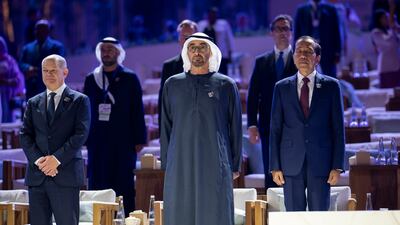
President Sheikh Mohamed with Joko Widodo, President of Indonesia, and German Chancellor Olaf Scholz stand for the national anthem during the Zayed Sustainability Prize for Climate Action, during COP28. All pictures, UAE Presidential Court unless stated. -

Crown Prince of Abu Dhabi Sheikh Khaled bin Mohamed, Sheikh Theyab bin Mohamed, Chairman of the Office of Development and Martyrs Families Affairs at the Presidential Court during the national anthem during the Zayed Sustainability Prize for Climate Action. -

The Zayed Sustainability Prize for Climate Action was held at Al Wasl Plaza, Expo City Dubai during Cop28. -

President Sheikh Mohamed presents the Zayed Sustainability Prize to a winner -
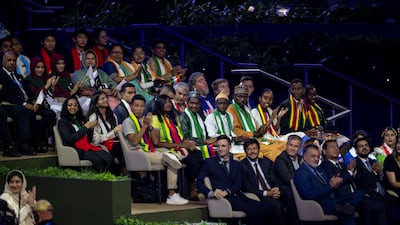
President Sheikh Mohamed and several high-level guests attended Expo City Dubai to see 11 winners announced across six categories. -

President Sheikh Mohamed presents the Zayed Sustainability Prize to Victor Sanchez Gutierrez, the winner of the Zayed Sustainability Global High Schools - The Americas category. -
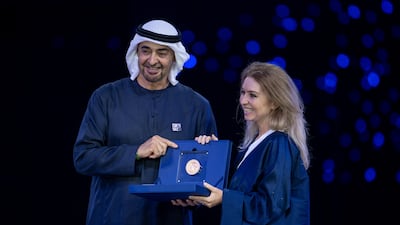
In the energy category, the winner was Ignite Power from Rwanda, which specialises in delivering solar-powered pay-as-you-go solutions to electrify last-mile communities. -
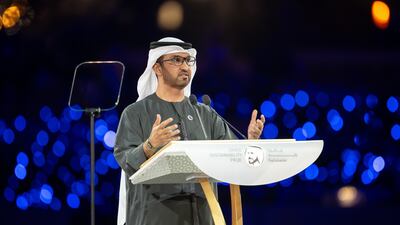
Cop28 President Dr Sultan Al Jaber and Minister of Industry and Advanced Technology delivers the welcome speech during the Zayed Sustainability Prize ceremony. -
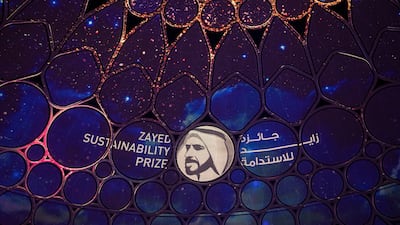
Over the past 15 years, the prize has been a powerful force for positive change, transforming the lives of more than 378 million people across 151 countries. -

The annual prize was launched in 2008, named in honour of UAE Founding Father, the late Sheikh Zayed bin Sultan Al Nahyan, recognises and rewards people, organisations and high schools that have demonstrated exceptional efforts in promoting sustainability across various sectors. -

President Sheikh Mohamed presents an award to Caroline Slootweg from Kelp Blue. -
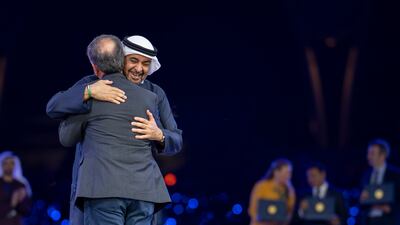
President Sheikh Mohamed handed out prizes to 11 winners. Judges for the award were elected in September by a panel. -
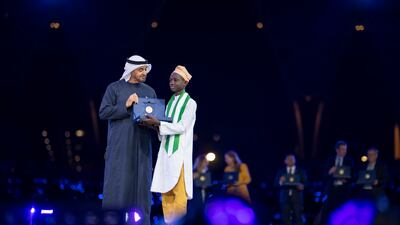
The prize this year had a Climate Change category – introduced this year in celebration of the UAE's Year of Sustainability and Cop28 -

The Global High School winners were Colegio De Alto Rendimiento La Libertad (Peru), Gwani Ibrahim Dan Hajja Academy (Nigeria), International School (Morocco), Northfleet Technology College (UK), Kort Education Complex (Pakistan) and Beijing No 35 High School (China). -
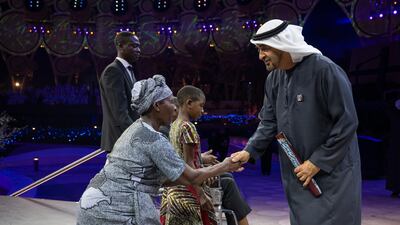
President Sheikh Mohamed greets a participant during the Zayed Sustainability Prize for Climate Action. -

The awards ceremony at Al Wasl Plaza coincided with the UAE's hosting of the Cop28 climate conference and was attended by global leaders. -
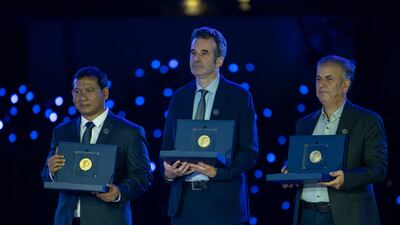
The winners of the Zayed Sustainability Prize, stand for a photograph during a ceremony, at Al Wasl Plaza, Expo City Dubai. -
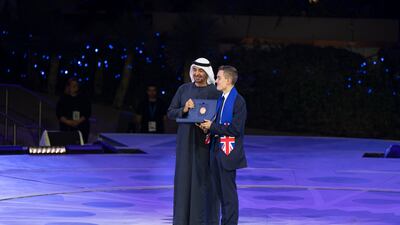
President Sheikh Mohamed handed out the prizes to the winners. -
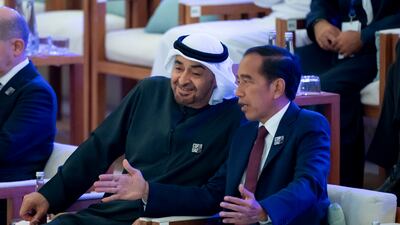
President Sheikh Mohamed speaks with Joko Widodo, President of Indonesia during the Zayed Sustainability Prize. -

Eleven winners announced across six categories will share a total prize fund of $3.6 million. -
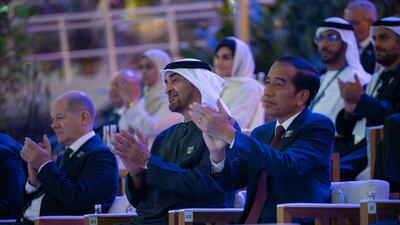
President Sheikh Mohamed and Joko Widodo, President of Indonesia at Al Wasl Plaza, at Expo City Dubai. -

Expo City Dubai during the Zayed Sustainability Prize. -

President Sheikh Mohamed hugs a winner of the award. -
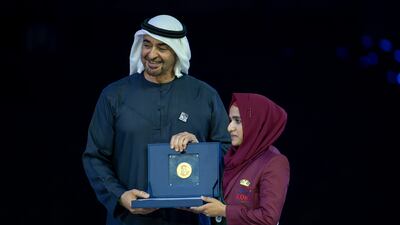
President Sheikh Mohamed smiles for a photograph with a winner. -

A ceremony took place to mark the Zayed Sustainability Prize for Climate Action. -
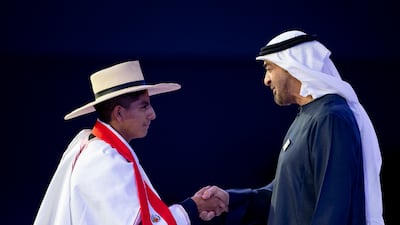
President Sheikh Mohamed shakes hands with prize winner, Victor Sanchez Gutierrez. -
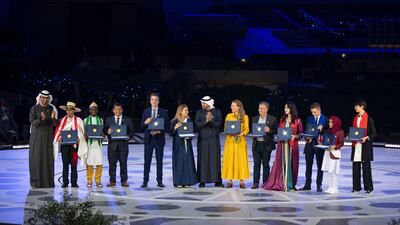
President Sheikh Mohamed and Cop28 President and Minister of Industry and Advanced Technology Dr Sultan Al Jaber stand for a photograph with the Zayed Sustainability Prize winners during Cop28 at Expo City Dubai. -

President Sheikh Mohamed and several high-level guests attended Expo City Dubai to see 11 winners announced across six categories. -
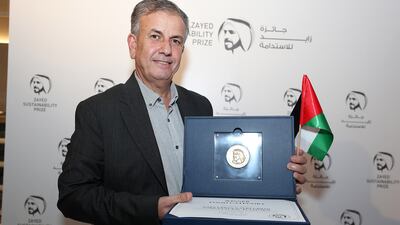
Ahmed Sourani from Gaza Urban & Peri-Urban Agricultural Platform winner of Zayed Sustainability Food category. Launched in 2013, the non-profit organisation helps small-scale, female urban producers in Gaza to achieve food security in their communities by bringing together those involved in developing the Palestinian agricultural sector. -
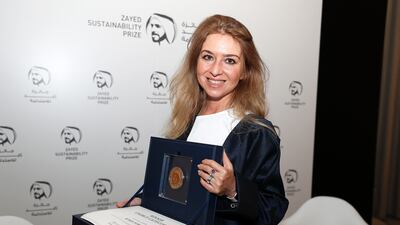
Angela Homsi from Ignite Power, the winner of Zayed Sustainability Energy Category award after the presentation ceremony at the Expo City Dubai. Pawan Singh / The National -

Caroline Slootweg from Kelp Blue winner of Zayed Sustainability Climate Action category award. Kelp Blue contributes to the restoration of natural ocean wilderness and the mitigation of excess CO2 by establishing large-scale kelp forests in deep waters. Pawan Singh / The National -

Angela Homsi from Ignite Power winner of Zayed Sustainability Energy Category. Ignite Power specialises in delivering solar-powered pay-as-you-go solutions to electrify last-mile communities. Pawan Singh / The National -
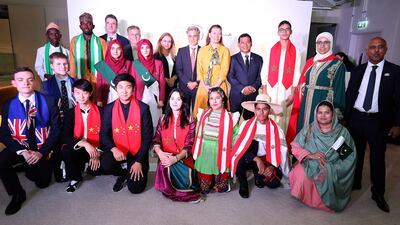
Zayed Sustainability prize winners after the presentation ceremony. Pawan Singh / The National -

From left, Victor Sanchez Gutierrez and Xiomara Calderon Avila from Colegio De Alto Rendimiento De La Libertad, the winner of Zayed Sustainability Global High Schools The Americas category. Pawan Singh / The National


An analysis by the Rocky Mountain Institute, a US think tank, explains that DRE solutions in India have the potential to lessen the gap between revenue and costs, thereby delivering more economically and environmentally sustainable energy.
With current population growth exceeding electrification rates in many emerging economies, there is no time to waste. DRE has a vital role to play in achieving the Cop28 goal of tripling renewable energy globally as part of a just transition.
The UAE’s support for these types of innovative solutions through the Zayed prize is a fitting way to honour the legacy of its Founding Father, the late Sheikh Zayed bin Sultan Al Nahyan, as an environmentalist and humanitarian. It will also help cement the country’s position as a global leader in the growing climate tech sector.

