


In his 1997 satirical novel Great Apes, the English author Will Self pokes fun at humanity’s self-regard as the planet’s dominant species. The novel’s protagonist wakes up one day in a London where it is Pan troglodytes – chimpanzees – who rule the Earth, not Homo sapiens.
In a superficial sense, the chimps’ world looks much like our own – business, technology and economics are as advanced as ever – but the chimps wear clothing on their top halves only, communicate with sign language and are grouped in extended communities where the pecking order is defined and enforced by frequent violence. The few humans left cling on as brutish figures of fun in the world’s zoos or as a bedraggled, endangered species in remote jungles, roaming wild and lacking any self-awareness.
As a way of showing up the haughty superiority often displayed by humankind towards the great apes, our nearest genetic relatives, Self’s novel remains a powerful piece of commentary. Nearly 30 years later, we are coming to better know and understand these intelligent creatures with whom we share so much. However, the more we learn, the more we will have to grapple with some profound questions, such as: what does it mean to be human, what is “personhood”, and if apes can – as some argue – be thought of as non-human persons, should they have the same kind of rights that we do?
Such questions are not exercises in niche philosophy. Scientists are continuously learning more and more about apes’ behaviour and internal life, and these findings tend to uncover further commonalities between humans and their evolutionary kin. Last month, scientists from Cornell University in the US released research on Bornean orangutans that revealed the primates possess a vocal communications range of previously unknown depth and intricacy. Orangutans, much like us, also use facial expressions, touch and gestures to communicate emotions and information.
Plenty of animals communicate, one may argue, but that does not make them deserving of “rights”. Perhaps not, but how many animals also tease each other? According to research published in February by the Royal Society, the UK’s national academy of sciences, all great ape species “engage in intentionally provocative behaviour, frequently accompanied by characteristics of play”. The team identified 18 distinct teasing behaviours that included tickling, tug of war, hair pulling and poking with an object. These, the scientists argue, draw on “complex cognitive abilities: understanding social norms, theory of mind, anticipating others' responses and appreciating the violation of others’ expectations”.
There is little doubt that our relationship with the great apes is complicated. Even referring to them as “animals” can, for many people, feel as if something important is missing – we resemble each other too much to consider chimps, gorillas, orangutans or bonobos in the same way we regard cats and dogs, let alone creatures with whom we have little connection, such as fish or insects. Few doubt that apes should be protected, but some argue that their particular kinship with humans demands a rights-based approach.
Perhaps the best-known advocates of such a position are the philosophers Peter Singer and Paola Cavalieri, whose seminal book The Great Ape Project (published just a few years before Self’s novel) was accompanied by a declaration on the great apes that its authors hoped the UN would adopt.
This called for the “extension of the community of equals to include all great apes: human beings, chimpanzees, gorillas and orangutans”. This community would be a moral one “within which we accept certain basic moral principles or rights as governing our relations with each other and enforceable at law”. Prime among the rights to be defined for people and great apes alike would be the right to life, the protection of individual liberty and a prohibition on torture.
To those who opposed the inclusion of apes in such a legal or moral community, the declaration stated, “we respond that human guardians should safeguard [apes’] interests and rights, in the same ways as the interests of young or intellectually disabled members of our own species are safeguarded”.
It was a bold take on humanity’s privileged position as the Earth’s dominant species but it failed to gain widespread international traction. It has also been critiqued many times over the years. An interesting dissection of the rights-for-apes argument came in April 2018 from US environmental anthropologist Dr Adam Johnson. In an article called The Personhood and Rights of Apes, Dr Johnson used a non-western conception of personhood derived from the Akan, an ethnolinguistic group along Africa’s Gold Coast that have close contact with several ape species.
-
-

Fishing boats sit on the waterway in Conakry, Guinea. Waldo Swiegers / Bloomberg -
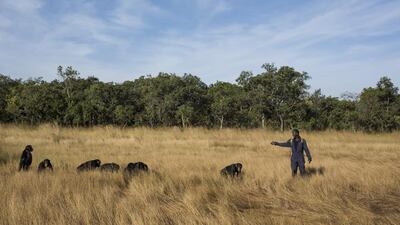
Keeper Sekou Kourouma with chimps on a bush walk at the Chimpanzee Conservation Center. Dan Kitwood / Getty Images -
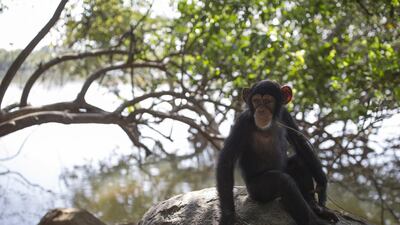
Hawa sits on a rock next to the River Niger during a bushwalk, at the Chimpanzee Conservation Centre. Dan Kitwood / Getty Images -
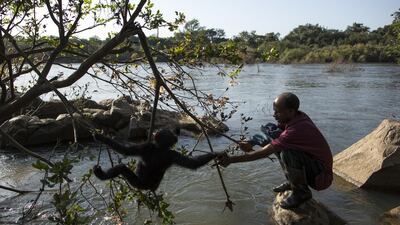
The Chimpanzee Conservation Centre in Somoria, Guinea. Dan Kitwood / Getty Images -
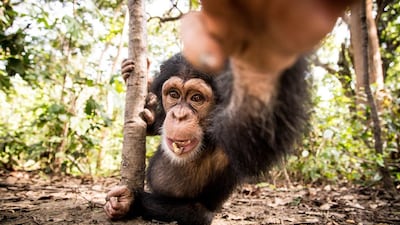
Guinea’s Chimpanzee Conservation Center. Photo by Stuart Butler -
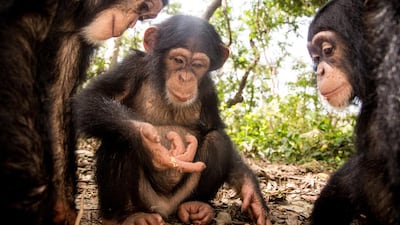
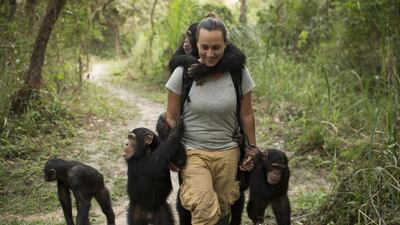
Baby chimpanzees at the Chimpanzee Conservation Center in the Parc National du Haut Niger, Guinea. The centre rehabilitates chimpanzees that have been rescued from the exotic pet trade. Photo by Stuart Butler


The Akan, Dr Johnson says, have a word – onipa – that is a synonym for “human” but also refers to a special social status enjoyed by an entity “that belongs to a moral community which carries with it moral responsibilities”.
“Onipa, according to the Akan, have access to rights and responsibilities that are afforded to beings with the ability to reflexively reason,” Dr Johnson argues. “Reason allows individuals to engage with the moral community, and even those that fail or refuse to fully participate are still afforded rights and dignity belonging to all persons because they possess the capacity to reason.
“The question then becomes: do apes have the capacity to reason reflexively? Do they have the capacity to consider the implications of their decisions and engage in the greater moral community?”
In his view, the answer is no; as humans are the only species that engages with the nature of personhood and rights in the first place, this renders us “a non-arbitrary category separate from all other animals, including the apes”.
It is a compelling point. Moving beyond the laudable position of wanting to do good by vulnerable ape species, does conferring personhood and rights upon them – things that they cannot understand – actually do anything to protect them? In addition, would granting special status to some non-human species merely redraw the boundaries of privilege, leaving many more creatures without comparable legal protection?
Nevertheless, some countries have been open to persuasion on this issue. In 2008, Spain’s parliament became the first legislature to back the Great Ape Project’s call for core rights for non-human primates. Dozens of countries have banned the use of wild animals – including apes – in circuses and several, including the UK, Japan and the Netherlands, have ended experimentation on great apes on ethical grounds.
More recently, however, a broader push towards ascribing rights to nature in general has been gaining ground. In 2021, the Magpie River in Quebec, Canada was granted legal personhood by the local authorities in an attempt to protect it. A year earlier, a Maori tribe in New Zealand succeeded in having the country’s third-largest river granted the same rights as a human being, with a board appointed to act on its behalf. Similarly, Article 71 of Ecuador’s constitution says nature “has the right to integral respect for its existence and for the maintenance and regeneration of its life cycles, structure, functions and evolutionary processes”. Such developments contain the same spirit of those great-apes campaigners who seek to extend protective rights beyond humanity.
But perhaps whether apes should have rights is not the correct question for now. There are immediate wrongs to right: all great ape species face threats from hunting, habitat destruction, trafficking and human population growth. These are issues that can be confronted by using and improving existing animal protection legislation and government policy. But as we learn more about intelligent species, the issue of their “personhood” – and our humanity – will not go away.

