


Watching Gaza’s agony from outside the Palestinian enclave, it’s easy to pontificate on how to ease the suffering. But one possible solution raised last week at the Arab League meeting in Bahrain is the deployment of a multinational UN Peacekeeping Force.
On paper, it sounds good. It should happen. But there are arguments for why this could never happen.
The most obvious is a lack of international political will – beyond the Arab League, of course. In the Yugoslav Wars in 1999, 19 Nato countries fought together to protect Kosovar Albanians from Serb militias. The Kosovars had plenty of international sympathy for their plight, and Nato won after 78 days of battle. The Kosovars subsequently inherited a small country that needed help stabilising, and KFOR – Nato’s peacekeeping troops, remain there to help with that effort to this day.
But today, Europe’s strongest economy, Germany, and the US are both hawkishly pro-Israel. When asked at a press briefing in Washington whether peacekeepers’ deployment could be an option, US State Department spokesman Vedant Patel was blunt, saying that bringing in “additional security forces” could potentially compromise Israel’s campaign to dismantle Hamas.
The decision to deploy peacekeepers would also require approval from the UN Security Council. Even without a unity of purpose within the Security Council – the US would probably cast its veto – the warring parties would have to be committed to UN operations.
Would either party allow peacekeepers? Hamas might agree, but I doubt the Israeli government – which has expressed disdain for the UN – would ever allow such operations in Gaza while they are still fighting Hamas.
In addition, the parties involved must be genuinely committed to a political process. At the moment, negotiations for ceasefires and return of hostages have ended up nowhere, due in part to Israel’s ground invasion in Rafah. Neither Israel nor Hamas seem are anywhere near “committed” to an end of war.
-
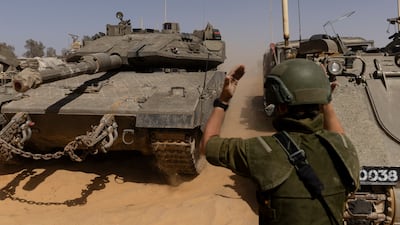
An Israeli soldier directs a tank near Israel's border with southern Gaza. Getty Images -
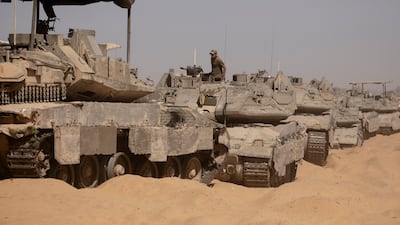
An Israeli soldier stands on a tank in southern Israel. Getty Images -
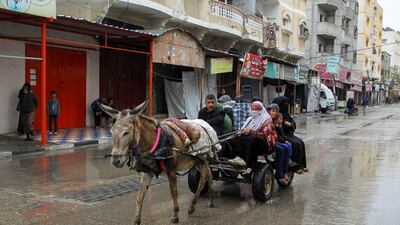
People flee the eastern parts of Rafah ahead of a threatened Israeli incursion. Reuters -
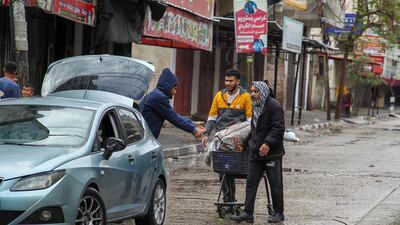
Palestinians leave ahead of a threatened assault on Rafah. Reuters -

Palestinians search for casualties in the rubble of a house destroyed in an Israeli strike in Rafah. AFP -
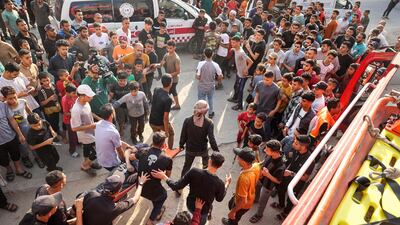
Palestinians carry an injured man who was pulled from the rubble of a house destroyed in an Israeli strike in Rafah. AFP -
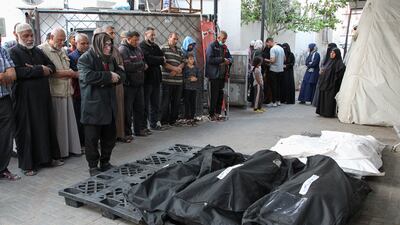
Mourners next to the bodies of Palestinians killed in an Israeli strike in southern Gaza. Reuters -
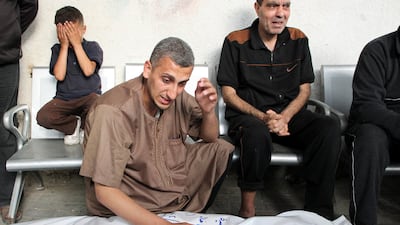
Mourners at Abu Yousef El-Najjar Hospital in Rafah. Reuters


Finally, for deployment to occur, there must be “clear, credible and achievable mandates to the mission with matching personnel, logistic, and financial resources”. That requires synergy that doesn’t exist.
And while the thought of peacekeepers protecting Gazan civilians works in theory, in practice troops are rarely empowered to battle zones nor engage in active fighting, even if that is what they are trained for.
Often this is a source of huge frustration for both the soldiers and the population they are meant to protect.
During the siege of Sarajevo, for instance, UNPROFOR soldiers were sent initially to protect the airport and to help deliver humanitarian aid. Their mandate expanded gradually to protect safe areas. But they could not actively protect the Bosnian population without breaking their rules of engagement.
Many soldiers felt frustrated and powerless watching Serbian snipers shoot women and children in the knees, knowing that they could not shoot unless shot upon.
Fundamentally, moreover, in order to deploy peacekeepers, there has to be a peace to keep.
All that aside, it’s also worth asking: do peacekeepers save lives? Recent history has shown numerous failures.
Somalia was one, because of lack of communication between government and the UN, as well as attacks on UN soldiers. Bosnia and Rwanda – both conflicts resulting in genocides – were two of the most grievous examples of lack of co-ordination resulting in catastrophic outcomes.
There are some positive outcomes. The UN cites “hard data” that proves peacekeepers can save lives. They believe the soldiers significantly reduce civilian casualties, shorten conflicts and help make peace agreements stick.
According to their research, in two thirds of completed missions since the Cold War, UN peacekeepers, who are recruited from many different countries around the world, have succeeded in fulfilling their mandate. Over the past 75 years, the UN has sent more than two million peacekeepers to help countries move away from conflict. When they look to success, they look to Liberia and Cambodia.
The UN view is that , in the majority of cases, peacekeeping works.
Although I have spent years criticising the UN (most notably in Bosnia, Rwanda and Syria), I was in South Sudan in 2014 when peacekeepers were effective.
In my view, they actively prevented the civilian population from a potential genocide by opening the gates of their compound and allowing them to shelter. My foster son, Marial, was one of those unaccompanied minors whose lives was saved by a Unicef official who brought him to safety inside the compound.
-

A team of 157 cadets are put through their paces during a UN peacekeeping training programme at the Khawla bint Al Azwar Military School in Abu Dhabi. All photos: Victor Besa / The National -
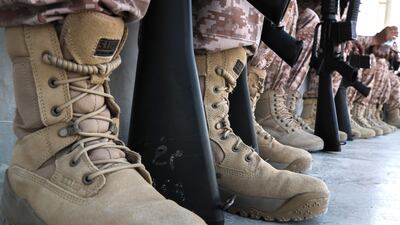
The women could soon be engaged in challenging situations around the world. -
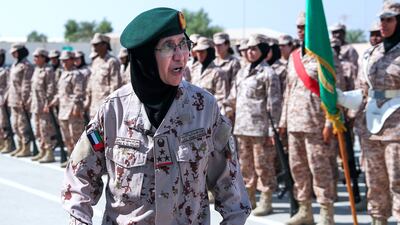
Brig Afra Al Falasi, commander of the military school, rallies the troops for another day of crucial training. -

The trainees aim to make a difference in the world. -
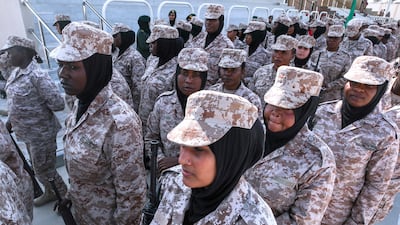
The UAE has trained more than 350 peacekeepers under a partnership between the General Women's Union, UN Women and the Ministry of Defence. -
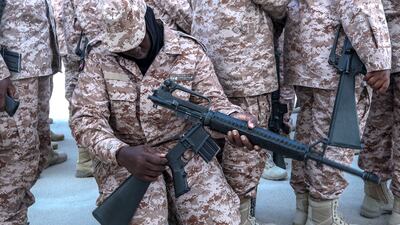
The cadets must complete eight weeks of military training and another two weeks focused on peacekeeping. -
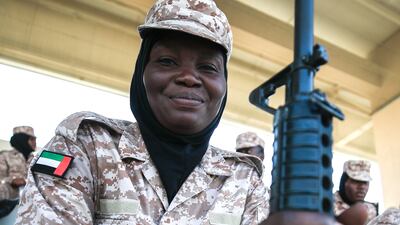
The trainees have come to Abu Dhabi from around the world. -

The Emirates is the first country to train UN Women peacekeepers under an agreement signed in September 2018. -
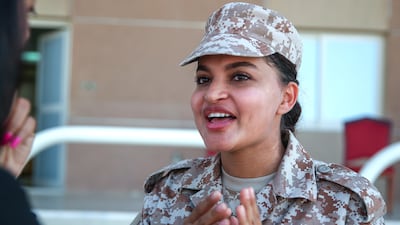
Doha Harbi Sharhan from Iraq is excited to be given the opportunity to serve in a military setting. -
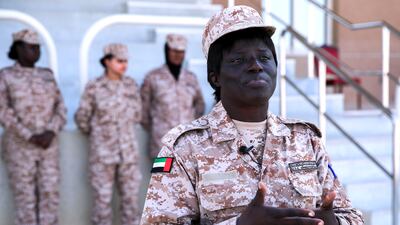
Fatima Anne T Mendy from Gambia feels confident she can defend herself and others in any situation. -
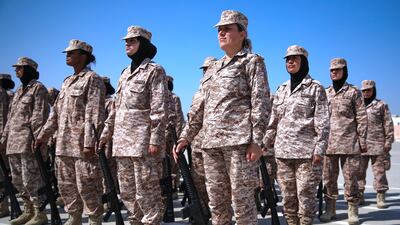
The UN is keen to increase the number of female peacekeepers.


Peacekeepers do not do state building or even reconciliation. They are not a stabilisation force. But the fact is that the war will end eventually and Gaza will need help.
US Department of Defence officials are apparently in “preliminary conversations” about how Gaza can be stabilised after the war. This would certainly not involve US boots on the ground after the forever wars in Iraq and Afghanistan. The US has been spooked and traumatised by losing so many soldiers and failing to accomplish its initial goals.
Israel has talked about occupying Gaza post-war, as it did prior to 2006. This would be a disaster. There would be keen resistance; Hamas, perhaps in a different form than it is now, would likely be empowered further, and Israel would become even more of an isolated pariah and seen as an even greater occupier.
US Secretary of State Anthony Blinken has been urging Israel to work with regional countries as well as pro-peace Palestinian leaders on a “day after” plan. But most regional actors only want to take this discussion forward after a two-state process is in place. And most want, after an interim period when peacekeepers could help, the Palestinians to govern themselves. They want the West to recognise Palestine as a state, supporting its full UN membership.
But all of this seems so far off as we look at images of 2,000 pound bombs dropping on Rafah or Israeli soldiers looting houses and jeering at civilians. As in Ukraine, where it is hard to discuss transitional justice while the Russian invasion continues, it is hard to look at Gaza’s future when the immediate situation is so bleak.
Terrified families, who have already been displaced numerous times, are being driven to seek shelter at the edge of the sea. Humanitarian packages, frequently hindered by Israeli forces from reaching hungry people, are rotting in the sun. Counting the dead is impossible because so many are still under the rubble.
As someone who has worked in Gaza for decades, I’ve seen it go from hope – in the immediate days after the Oslo Accords in 1995 – to the most painful of despair during the crippling blockade of Gaza that began after Hamas came to power. And now this war, which is being called a second nakba.
And yet, Gazans have an ability to overcome, with high levels of education and a strong sense of community. Even now, when I speak to friends and colleagues from the enclave, they talk about how they live to be stronger.
But Gaza’s agony is a collective stain on all of us, the international community. We can never bring back the dead. But we can help Gaza heal. Having abandoned them and left them alone in their agony, it is the responsibility of the same people who allowed this to happen to then come to now come to their aid.

