


Having covered Arab League summits for several consecutive years now, I have seen a growing sense among both diplomats and journalists covering the Middle East that the “Arab unity” slogan is being tested at the highest political levels. This is becoming especially true as Israel’s war on Gaza enters its eighth month and the bloodshed continues with no immediate end in sight.
At this year’s Arab League summit, held in Bahrain and regarded by many to be the most consequential in recent years, diplomatic sources I spoke to were cognisant of the fact that any final communique that did not include actionable clauses would simply not be enough.
“The summit will be an important opportunity to come up with recommendations to strengthen the Palestinian position and find ways to end this war,” Khaled Al Manzalawi, the League’s assistant secretary general and head of its international political affairs section, said.
During Secretary General Ahmed Aboul Gheit’s speech at the preparatory session of foreign ministers, there were early signs of those “actionable” clauses. Mr Aboul Gheit explicitly called on the Arab and international communities to intervene in Gaza “in all forms” possible.
“We call on international efforts to organise behind the creation of a two-state solution because the two parties, Palestinian and Israeli, are unable to reach an agreement on their own,” Mr Aboul Gheit told his audience. “Therefore, international intervention, in all its forms, has become a necessity ... and returning to the path of bilateral negotiations is no longer a possible option. How can this negotiation take place when there is a party that rejects it in the first place?”
-
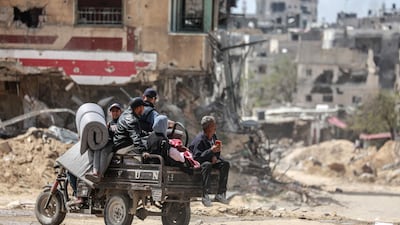
Palestinians move with their belongings on a road lined with destroyed buildings, in Khan Younis, in the south of the Gaza Strip, on April 22. AFP -
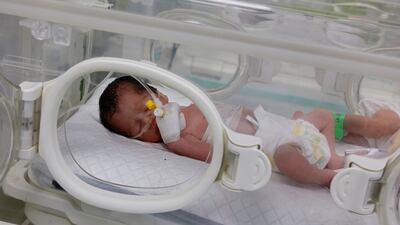
An infant saved from the womb of her mother Sabreen Al Sheikh, who was killed in an Israeli strike along with her husband Shokri and her daughter Malak, lies in an incubator at Al Emirati hospital in Rafah, on April 21. Reuters -

A man rides a bicycle, on April 2, past a damaged vehicle where employees from the World Central Kitchen non-profit, including foreigners, were killed in an Israeli air strike. Reuters -

A woman at the damaged Al Shifa Hospital, on April 1, after Israeli forces withdrew from the medical complex following a two-week siege. Reuters -
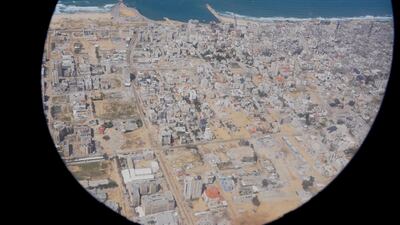
The view from a Jordanian flight dropping vital aid by parachute into Gaza, in March. Matthew Kynaston / The National -

Nozha Awad flees Al Shifa hospital with her triplet children, after an Israeli raid siege began at the medical complex, in March. Reuters -

Palestinians gather to receive aid outside a UNRWA warehouse, in March. Reuters -

A family end their fast amid the rubble of their destroyed home, during Ramadan in Rafah, in March. Reuters -

Wafaa Tabasi with her twin malnourished daughters, at Al Awda health centre in Rafah, in March. Reuters -

Palestinians carry bags of flour taken from an aid lorry near an Israeli checkpoint in Gaza City, in February. Reuters -

Fernando Simon Marman and Louis Hare, two Israeli hostages who, according to the Israeli military, were freed in a special forces operation in Rafah, reunite with loved ones at Sheba Medical Centre, in Ramat Gan, Israel, in February. Reuters -
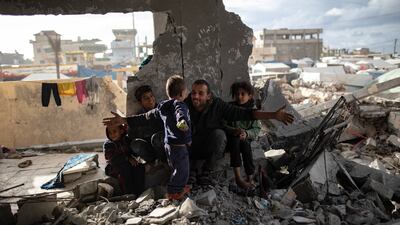
Palestinian Muhammad Al Durra with his children in the ruins of a house in Rafah where they sheltered on January 11, 2024. EPA -
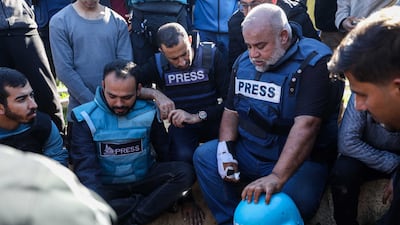
Family and friends at the funerals of journalists Hamza Al Dahdouh and Mustafa Thuraya on January 7, 2024 in Rafah, Gaza. Getty Images -
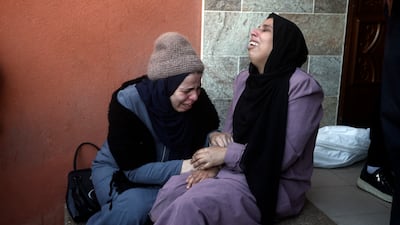
Palestinians mourn relatives killed by Israeli bombardment of the Gaza Strip outside a mortuary in Khan Younis January 4, 2024. AP Photo -
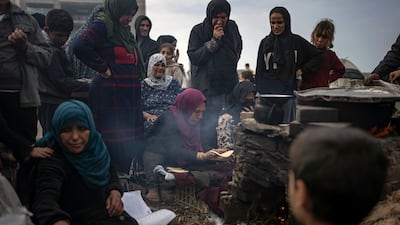
Displaced Palestinians queue to bake bread at a camp in the Muwasi area of Rafah, Gaza Strip, on December 23, 2023. AP Photo -
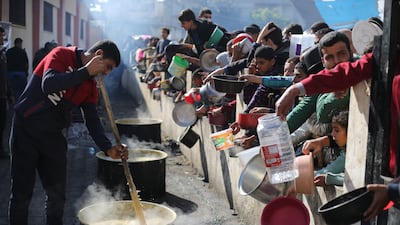
Palestinians queue for food in Rafah, the Gaza Strip, on December 20, 2023. AP Photo -

The ruins of Rafah on December 14, 2023. AFP -
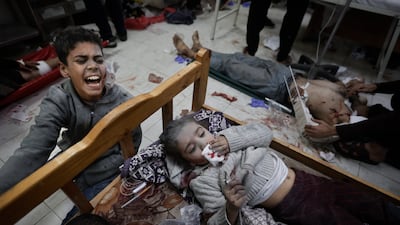
Palestinians wounded in the Israeli bombardment of the Gaza Strip arrive at a hospital in Khan Younis on December 8, 2023. AP Photo -
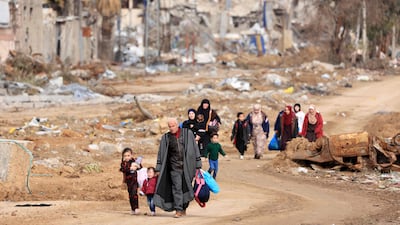
Palestinians flee Israeli bombing along the Salaheddine Road in the Zeitoun district of Gaza city on November 28, 2023. AFP -

A Red Cross vehicle takes Israeli hostages from the Gaza Strip into Egypt in Rafah on November 25, 2023. AP -
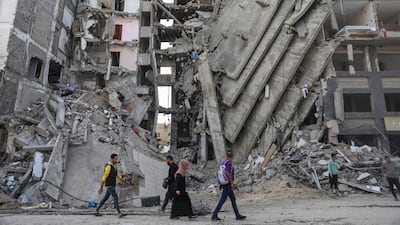
The ruins of buildings in Gaza city on November 24, 2023, as a temporary truce between Israel and Hamas took effect. AP Photo -
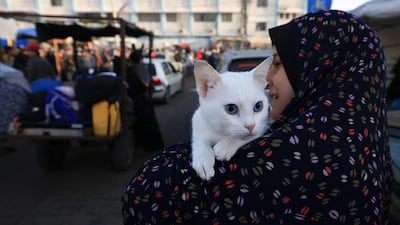
A woman and her cat return home to eastern Khan Younis in the southern Gaza Strip during the first hours of a four-day truce between Israel and Hamas forces on November 24, 2023. AFP -
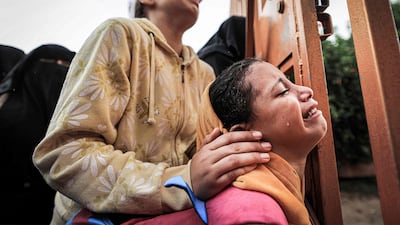
Mourning the dead of Israeli bombardment outside the mortuary at Nasser Hospital in Khan Younis on November 14, 2023. AFP -
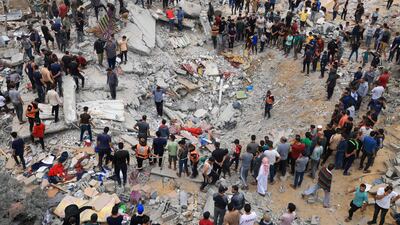
Civilians and rescuers look for survivors in the rubble of a building after Israeli bombing of Khan Younis in the southern Gaza Strip on November 12, 2023. AFP -

November 7, 2023, a month to the day after Hamas attacked Israel, a victim of an Israeli bombardment in Rafah is moved from the rubble. AFP -
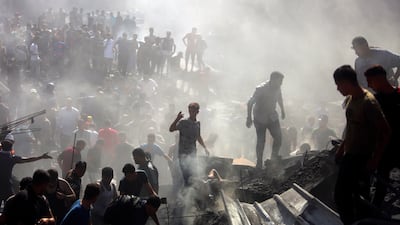
Searching the rubble after Israeli air strikes on the town of Khan Younis, southern Gaza Strip, on October 26, 2023. AP Photo -
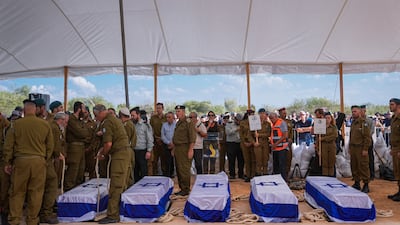
Mourning the Kotz family at their funeral in Gan Yavne, Israel, on October 17, 2023. AP Photo -
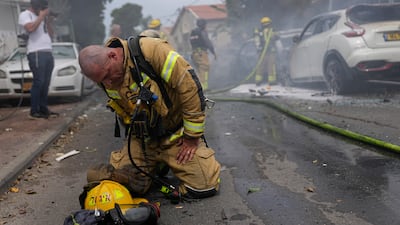
An Israeli firefighter composes himself after he and his colleagues extinguished cars set on fire by a rocket fired from the Gaza Strip in Ashkelon, Israel, on October 9, 2023. AP Photo -
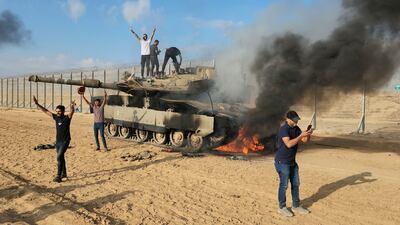
Palestinians with the wreckage of an Israeli tank at the Gaza Strip fence east of the city of Khan Younis on October 7, 2023, the day Hamas forces swept unopposed into Israel. AP Photo -
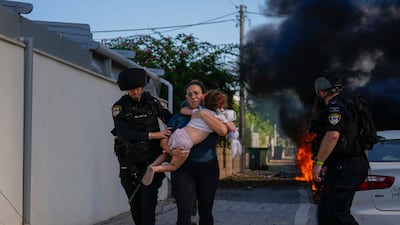
Israeli police officers evacuate a woman and a child from a site hit by a rocket fired from the Gaza Strip, in Ashkelon, southern Israel, on October 7, 2023. AP Photo


The League held an emergency summit together with the Organisation of Islamic Co-operation in Riyadh in November, a month after the Hamas attack and Israel launched its war on the besieged Gaza Strip. While Arab and Muslim leaders condemned Israel’s “barbaric” actions in Gaza and demanded an end to the war during that summit, their meetings showed that opinion was divided over how to respond to the situation.
A final communique was produced, but it fell short of any clauses that could enforce an immediate end to the war, one month in at the time.
Nonetheless, analysts say that joint summit still managed to convey significant messages and warnings to Israel, the US and western powers.
At the time, Aziz Alghashian, a Saudi analyst who researches Riyadh’s relationship with Israel, told me: “I think that the consensus was that this is really more about symbolism, narrative and diplomacy.”
But six months later, here in Bahrain, it seems Arab diplomats are seeking to move beyond words and warnings.
One of the clauses that will be included in the final communique, dubbed the Bahrain Declaration, will be a call for a revival of the peace process between Palestinians and Israelis with the aim of achieving the ever-elusive two-state solution.
A Bahraini diplomat told me his country was aware that reviving the process through another peace conference would be “no small feat”.
While any peace conference in Bahrain would take months of preparation before it could be held, diplomats are aware of the time constraint they are up against. That is why words such as “time constraint” and “deadlines” will be included in the final communique.
But everyone in Manama has acknowledged the growing shift in the international arena when it comes to the Palestinian cause and the atrocities of Israel’s war on Gaza. They all realise that the time for action, not just words and statements, is non-negotiable at this stage of the war.
Ambassador Ahmed Al Turaifi, the head of Arab and African Affairs at Bahrain’s Ministry of Foreign Affairs, told me: “We understand that the summit in Bahrain is taking place at a very difficult geopolitical stage in our part of the world. But the diplomats gathered in Manama were cognisant of the fact that the world’s view of the Palestinian cause is now changing more than ever.”
The war has, thus far, killed more than 35,000 Palestinians, according to the latest figures from Gaza’s health authorities. Before it began, none of the EU’s 27 member states formally recognised Palestine. That mindset is changing. Now, Slovenia, Spain and Ireland are moving towards recognising a Palestinian state.
Speaking to me on the summit’s sidelines, Hossam Zaki, the League’s Assistant Secretary General, said the Manama summit has, “without a doubt, unanimous total and complete Arab consensus” regarding the League’s action plan for the next year, with the war on Gaza at its centre.
There’s a sense that Arab states have now the leverage, more than ever, to push for the Palestinian cause and a resolution to the conflict that would garner widespread international support. Yet they are aware that any peace deal would require a more co-operative Israeli government. And that appears unlikely in the near future so long as Prime Minister Benjamin Netanyahu and his right-wing coalition remain in power.

