

Free speech at American universities is enduring one of its most severe stress tests in decades. Israel’s war of vengeance in Gaza, precipitated by the October 7 killing spree by Hamas-led militants from Gaza, has riveted and appalled the world, even eclipsing the perhaps historically more significant Russian assault on Ukraine.
Huge coalitions of US students have united against Israel’s rampage that has targeted not just Hamas but Gaza society generally, damaged or destroyed the vast majority of buildings, and killed at least 35,000 Palestinians, mainly civilians. The slaughter has been shocking, even given the vicious savagery of the October 7 attack.
Since the end of South African apartheid, Palestine has been the most likely focal point of US student international social justice outrage. This movement was predictable and predicted. Yet pro-Israel constituencies appear taken aback by outrage at the butchery in Gaza and sympathy for Palestinians roiling American campuses, particularly at elite schools. Not since the Vietnam War have university leaders looked this discombobulated, unable to placate any faction or to credibly and creditably defend their institutions from such intense internal and external pressure.
Turmoil over Gaza has already contributed to the downfall of several major university presidents. Others, most recently the Egyptian-American president of Columbia, Minouche Shafik, have committed extraordinary miscalculations. Following several other elite university leaders, she was recently grilled by a highly aggressive Republican congressional committee, and told to take tougher action against pro-Palestinian protesters, particularly by Representative Elise Stefanik who is angling to be Donald Trump’s running mate in the coming election.
Ms Shafik tried to placate the right-wingers by labelling phrases such as “from the river to the sea” and even just the word “intifada” as “incredibly hurtful”, without any additional context. Upon returning to campus, she ordered police to arrest more than 100 students encamped on a campus lawn. Even the authorities appeared uneasy at the operation, with New York Police Department Chief John Chell noting that “the students that were arrested were peaceful, offered no resistance whatsoever, and were saying what they wanted to say in a peaceful manner”.

This unnecessary and chilling crackdown had the inevitable effect of galvanising student protests at Columbia and elsewhere. Ms Shafik is now predictably squeezed between demands for her resignation from dissatisfied pro-Israel Democratic and Republican legislators and a pro-free-speech censure motion filed by outraged faculty in the University Senate.
University leaders find themselves trapped between two competing and crucial values: upholding the protesters’ right of free speech while simultaneously protecting a sense of safety and security for pro-Israel Jewish students.
While the protests have been almost entirely nonviolent, instances of harassment and speech that either is, or is interpreted as, hateful have left many Jewish students – like their Arab and Muslim counterparts, some of whom have even been shot – feeling shaken and unsafe. Both are left wondering if they are truly welcome at their own schools.
Meanwhile, the demonstrators are being systematically and unfairly painted as all or mostly followers of Hamas, proponents of terrorism, and violent anti-Semites. They are being generally conflated with the worst elements of the far left that have, of course, seized a golden opportunity of outbidding everyone with extremist rhetoric that dominates media attention and trying to gain control of a potent fledgling oppositional movement.
The political right, abetted by some liberals, is similarly relishing the chance to paint criticism of Israel as inherently anti-Semitic and claim that liberal-dominated universities have in recent decades created an atmosphere of casual left-wing extremism by not being more conservative. For supporters of Israel’s otherwise indefensible bloodbath in Gaza, pointing to the genuinely extreme, rhetorically violent, or effectively anti-Semitic screeds of the most radical protesters is a desperately needed means of discrediting and delegitimising vigorous opposition to the war.
Panicky universities are not just mishandling a delicate and difficult fissure. They are missing a rare and profound opportunity for academia to demonstrate its unique social role and putative worth.
Rather than arresting students en masse and denouncing them as anti-Semitic because they object to a barbaric war on top of an unjust, predatory occupation, university leaders should be embracing their institutional mission of education. Nothing is going to magically make traumas and bitter divisions evaporate. But everything necessary for universities to foster serious dialogue on a mass and highly sophisticated level is readily available.
-

Activists and students take part in an encampment protest at George Washington University, in Washington. AFP -
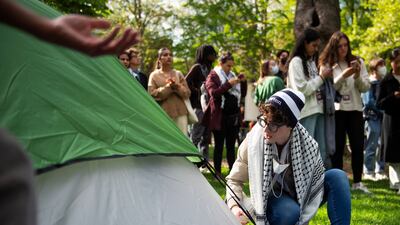
Students and faculty of Drexel University and University of Pennsylvania erect an encapment to protest against the war in Gaza, at the University of Pennsylvania campus, in Philadelphia. AFP -
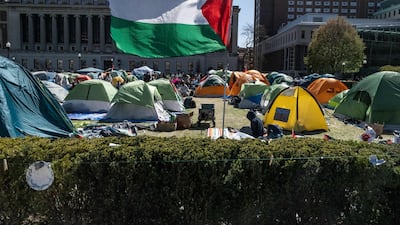
Columbia University students continue their demonstration on campus afterlast week's arrest of more than 100 protesters, in New York City. Getty Images -
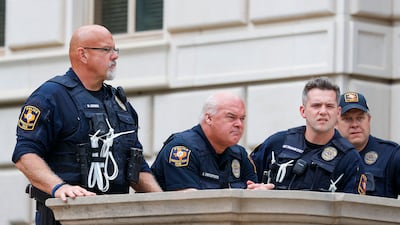
Police watch as students and faculty show support at a Protect Palestine Rally at the University of Texas, in Austin. EPA -
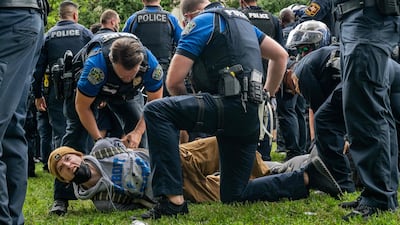
A student is arrested during a pro-Palestine demonstration at the University of Texas at Austin. Getty Images -
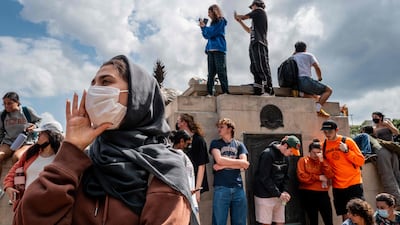
Students rally at the University of Texas at Austin, where police arrested scores of protesters. Getty images -
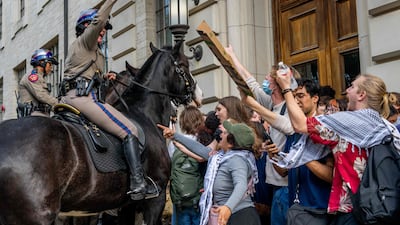
Mounted police confront students protesting against the war in Gaza, at the University of Texas at Austin. Getty Images -
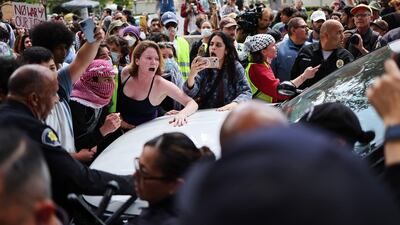
Pro-Palestine demonstrators argue with University of Southern California officials, who attempted to take down an encampment set up in support of Gaza, at the institution in Los Angeles. Getty images -
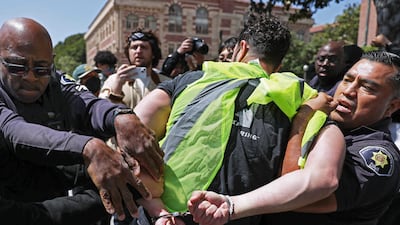
University of Southern California police officers detain a pro-Palestine demonstrator. Getty Images -
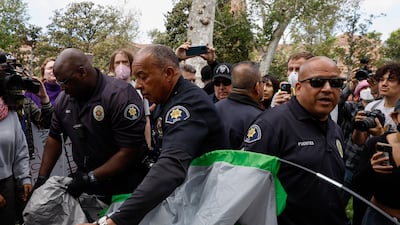
University of Southern California officers dismantle protesters' tents. EPA -
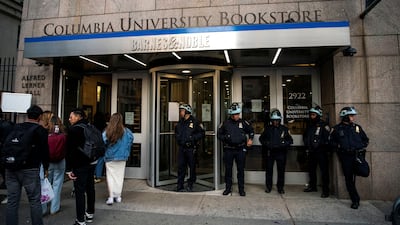
Police stand guard at an entrance to Columbia University, in New York City, where students continue to protest in support of Palestinians, amid the war in Gaza. Reuters -
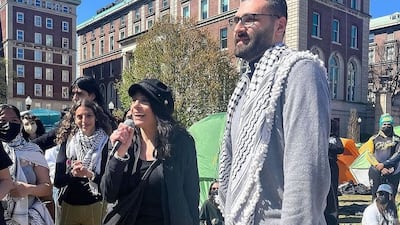
Najla Said, daughter of Palestinian-American academic and literary critic Edward Said, and Motaz Azaiza, a Palestinian photojournalist from Gaza, join the Gaza solidarity encampment at Columbia University. Photo: Columbia Students for Justice in Palestine -
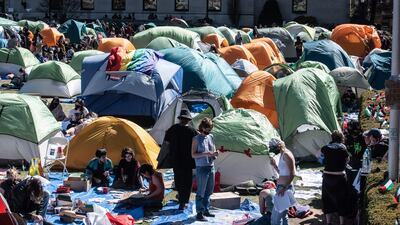
As the campus protests continue, Columbia has moved its classes online. AFP -
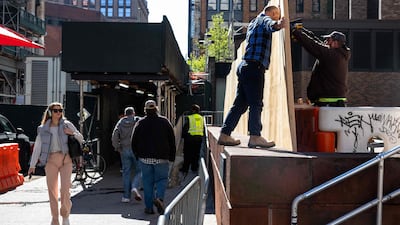
Workers erect a wooden barrier at New York University Stern School of Business after an encampment set up by students was cleared out on Monday night. Getty Images -
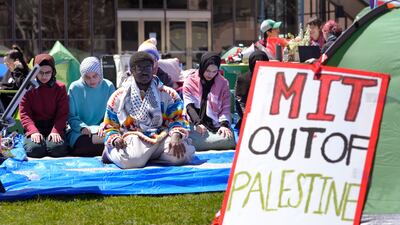
Massachusetts Institute of Technology student Isa Liggans, front left, takes part in Muslim prayer with others, at an encampment of tents at the college, in Cambridge, Massachusetts. AP -
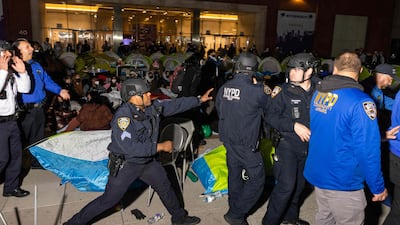
Police officers disperse pro-Palestinian students and protesters who set up an encampment on the campus of New York University. AFP -
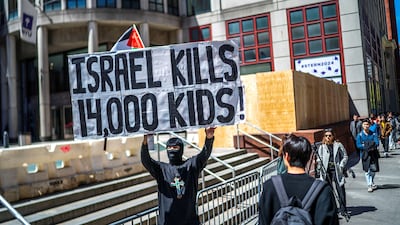
A protester outside New York University. Reuters -
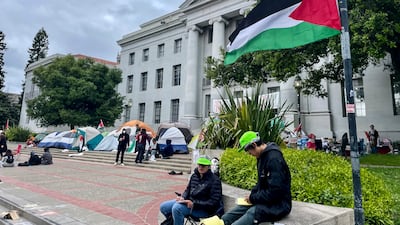
Pro-Palestinian protesters gather in front of Sproul Hall on the campus of the University of California, Berkeley. AP -
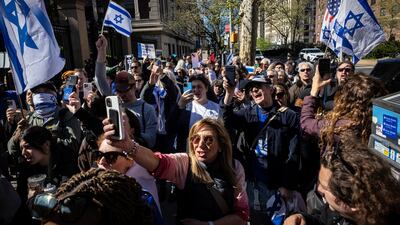
Pro-Israeli demonstrators chant 'shame' after Columbia University assistant professor Shai Davidai was denied access to the main campus. AP -
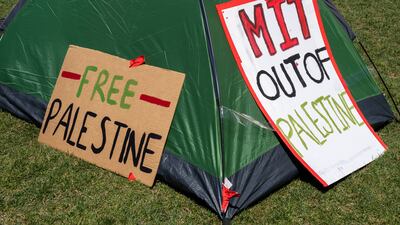
A tent used by pro-Palestinian demonstrators at MIT. Bloomberg -
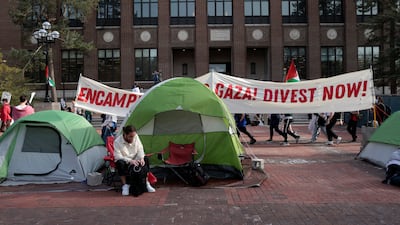
A coalition of University of Michigan students rally to pressure the university to divest its endowment from companies that support Israel. Reuters -
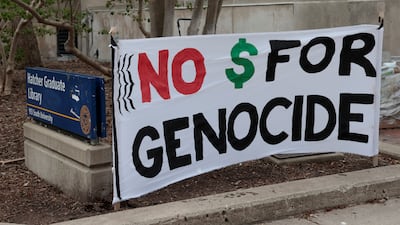
A sign at the University of Michigan. Reuters -
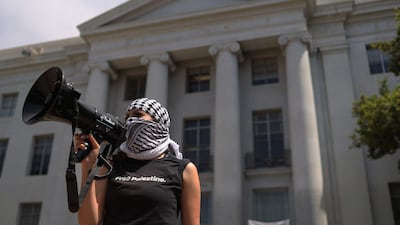
A pro-Palestinian protester in front of Sproul Hall in Berkeley, California. Getty Images / AP -
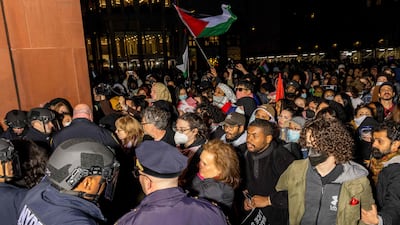
Police officers detain pro-Palestinian students and protesters at New York University. AFP -
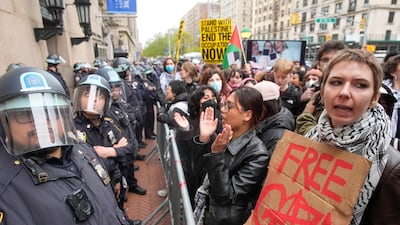
Police in Riot gear stand guard as demonstrators chant slogans outside the Columbia University campus. AP -
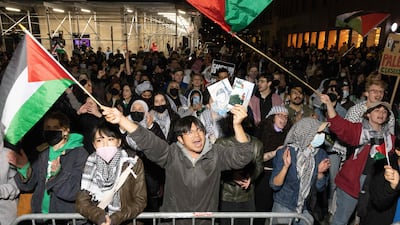
Pro-Palestinian students and activists protest against the Israel-Gaza war on the campus of New York University. AFP


There are countless constructive and serious scholars and advocates on both sides who are ready for such a conversation, which should most certainly include students. And the communication technology that all students, and much of society, access daily provides many excellent platforms. These forums should resonate with calm but passionate and principled voices on all sides.
While many Jewish students hear the chant “from the river to the sea, Palestine will be free” as an exclusionary call to get rid of Jews, surveys demonstrate that most Arab and Muslim students hear merely a call for freedom. No one is asking the demonstrators what they mean by such slogans. Instead, malign sentiments are being inferred or presumed. A dialogue is therefore urgently required. What would freedom from the river to the sea entail? Is anyone against freedom? Can everyone have it equally? Must an area be under a single sovereign or system to be free? Is this really anti-Semitism?
Rather than fostering such a novel and broad conversation, many universities are instead trying to limit speech, not just by arresting or otherwise punishing and maligning protesters, but also, as in the shocking and shameful case of the University of Southern California, silencing it outright.
USC cancelled the graduation ceremony speech by valedictorian Asna Tabassum because of her criticism of Israel, citing highly credible and numerous violent threats. This yet again confirms that extreme harassment and intimidation are coming from both sides. Worse, assuming its rationale is sincere, USC is effectively pioneering a preemptive and presumptive heckler’s veto.
Like Columbia and others, USC is charging headlong in the wrong direction. Rather than finding creative ways of tapping into a huge appetite, and the vast intellectual and other resources at hand, for serious, albeit difficult and potentially painful, dialogue – and thereby fulfilling academia’s socially indispensable educational mission – these schools are turning to suppression, marginalisation and demonisation of speech that offends some students, reactionary politicians and pro-Israel donors.
It’s a betrayal of the core mission of academia, a cowardly and short-sighted blunder, and a missed opportunity of epic and historic proportions.

