


As Israel and Iran give each other some serious side-eye, regional geopolitical winds may be shifting in favour of a larger role for Turkey in this slowly metastasising Middle East war.
Start with the long-running Israel-Iran shadow conflict bursting into the open in recent weeks. Despite Tehran’s muted response to Israel’s latest strikes, negotiations may be required to avoid escalation, which could make Ankara’s friendly ties with Tehran invaluable.
Turkey already served as the key backchannel for Tehran and Washington as Iranian officials mulled retaliation options earlier this month. After Israel and its allies shot down nearly all of Iran’s 300 projectiles, US Secretary of State Antony Blinken publicly thanked Turkish Foreign Minister Hakan Fidan for serving as a go-between – a significant show of US appreciation at a fraught regional moment.
Second, Doha may be ending its role as Hamas-Israel mediator after being criticised by some members of the US Congress for failed peace talks. “We have seen insults against our mediation and its exploitation for the sake of narrow political interests,” Prime Minister Sheikh Mohammed bin Abdulrahman said last week in Doha at a news conference with Mr Fidan.
Meanwhile, reports emerged on the weekend that Hamas leaders are being pressured to leave Qatar, alongside additional reports that Turkey is the leading relocation option.
Third, Ankara’s flurry of diplomatic activity suggests a clear desire for greater involvement. Mr Fidan’s Doha visit last week almost seemed a passing of the proverbial baton. He met the Qatari Prime Minister and with Hamas leader Ismail Haniyeh, after which he laid out the group’s potential willingness to disband its armed wing and become a political party if a Palestinian state is agreed to along the 1967 borders.
-
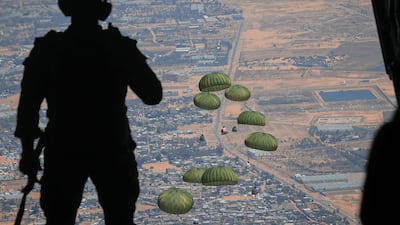
Humanitarian aid being dropped from a Jordan military aircraft over the Gaza Strip amid battles between Israel and Hamas. AFP -

British military personnel during the international aid air drop into Gaza. PA -
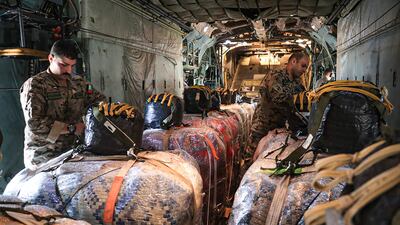
Humanitarian aid before being dropped from a military aircraft. AFP -
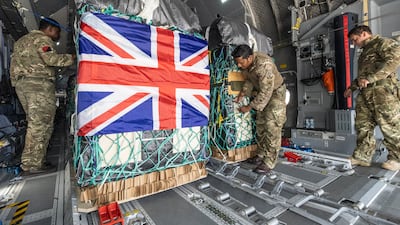
Hundreds of tonnes of resources were delivered into the enclave. The UAE, US, Germany, France, Indonesia, the Netherlands and Egypt also took part. PA -
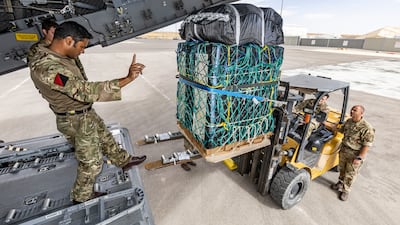
British military personnel took part in the international aid drop into Gaza. PA -
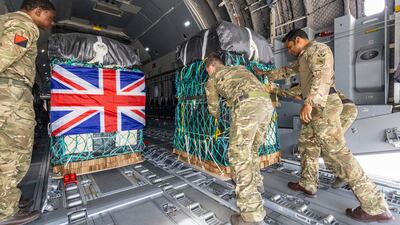
The operation was led by the Jordanian Armed Forces and coincided with Eid Al Fitr. PA -
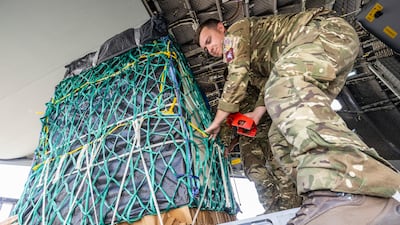
Led by the Jordanian Armed Forces, the delivery coincided with the end of Ramadan. PA


Mr Haniyeh then hopped over to Istanbul to meet Turkish President Recep Tayyip Erdogan on Saturday.
Mr Erdogan also met Egyptian Foreign Minister Sameh Shoukry on Saturday, and on Monday flew to Baghdad and met Iraqi Prime Minister Mohammed Shia Al Sudani, who is close to Tehran. Also on Monday, amid reports that Mr Erdogan’s May 9 visit to Washington may be cancelled, US counter-terrorism ambassador Elizabeth Richard arrived in Ankara to meet top Turkish officials. There’s also the new Gaza aid flotilla, which is expected to set sail this week and should further boost Turkey’s profile in the Levant.
Lastly, a presidential decree issued this month laid out plans to reform Turkey’s Foreign Ministry with the creation of a mediation directorate. This might strike some as a desperate stab at regional relevance, but this is not an unfamiliar role for Ankara.
Turkey hosted peace talks between the Taliban, the US and the Afghan government in 2021, and for years worked with Russia, Iran and Qatar to achieve a political solution in Syria, though both of those efforts fell short.
Turkey has offered to mediate Egypt and Ethiopia’s Renaissance Dam dispute, and of course, brokered two rounds of Russia-Ukraine talks in 2022: failed peace negotiations and a successful grain deal that probably helped stave off famine in Africa. “In a broken world,” I argued at the time, “unpalatable solutions are often our only recourse.”
Ankara now appears to have embarked on a public campaign to mediate: a senior Turkish official discussed the idea with The National; an Ankara-based affairs analyst addressed it in an Arab news outlet; and columnist Burhanettin Duran, head of the government-backed Seta think tank, wrote that he expects Mr Erdogan “to work more closely with world leaders to try and save the region from the Israeli-Iranian escalation”.
Is Ankara better positioned to mediate than Doha? Both are among the few countries that can ring top officials from Hamas, Iran, the US and Israel and expect an answer. Qatar is home to the region’s largest US military presence, but Turkey also hosts a sizable US troop contingent, as well as US nuclear weapons, at its Incirlik base.
Turkey also offers an element Qatar lacks: major involvement in Eastern Mediterranean energy. Ankara could present some sort of maritime energy concession to the allied trio of Israel, Egypt and Greece.
As a Nato member and EU-candidate country, Ankara is firmly ensconced in the western economic and security architecture. As a Hamas supporter and friend to Tehran, regional extremist groups tend to trust Turkey’s leadership.
This is a strength from the view of Iran and Hamas, but for western and Israeli eyes it may be the biggest strike against Turkey. Few states have been as critical of Israel in recent months. Mr Erdogan has repeatedly accused Israel of committing genocide in Gaza and in December said that Israeli Prime Minister Benjamin Netanyahu is “worse than Hitler”.
Turkey recently banned a long list of exports to Israel, but Ankara maintains a free trade agreement and diplomatic ties with Israel and enables its oil trade with Azerbaijan. Still, Turkey’s Gaza stance has not gone unnoticed. On the weekend, Israeli Foreign Minister Israel Katz posted a picture of Mr Erdogan and Mr Haniyeh on social media and wrote that Turkey’s leader “should be ashamed”.
Many observers responded similarly to a statement Mr Erdogan made last week. At an AKP parliamentary gathering, he made a stunning assertion, arguing that Hamas is the equivalent of the national resistance movement that won Turkey’s independence a century ago.
Why would Mr Erdogan compare the perpetrators of the horrific October 7 assault to Turkey’s revered founder, Mustafa Kemal Ataturk? To appeal to Turkish voters who are firmly pro-Palestinian, for one. But also, perhaps because he sees the opportunity before him.
Pressure is growing on US President Joe Biden and the Netanyahu government to find some way to halt the war and gain the release of the Israeli hostages. And much the way Ataturk secured his legacy by winning the war and founding the Turkish Republic, if Mr Erdogan were to help resolve this crisis and put Palestinians on the road to their own state, he would secure himself an unimpeachable and enduring regional legacy.
Getting there will likely require strategic brilliance, moral courage and dogged commitment to solving one of the world’s knottiest conundrums. Best of luck to Turkish diplomats, should they be handed the largely thankless task.

