Raghida Dergham is the founder and executive chairwoman of the Beirut Institute, and a columnist for The National
April 21, 2024
It appears that the recent escalation between Iran and Israel won’t lead to an all-out war that could threaten regional stability, at least for now. This much is clear after the Iranian regime’s measured reaction to Israel’s limited strike on a military base in Isfahan on Friday.
The de-escalatory path currently being taken by the two adversaries gives the impression of a tacit understanding between them. Even though they conducted direct strikes against each other during the past week, their battlegrounds will continue to be outside their respective territories.
China and Russia have publicly taken stands to push Iran to settle for a limited retaliation, affirming their opposition to a regional war. Beijing is especially wary of a full-blown conflict, given its military and strategic relations with Tehran, and its ties with Israel in the high-tech sector.
Remarkably, the latest conflict seems to have been telegraphed and co-ordinated through the administration of US President Joe Biden. Iranian Foreign Minister Hossein Amirabdollahian said that Tehran informed Washington before and after its missile and drone strikes inside Israel more than a week ago. “We made it very clear in these conversations, we told the Israelis that Iran does not want escalation,” Mr Amirabdollahian said.
So what happens next? Who benefits from the latest confrontation? And who pays the price?
The winners are primarily Iran and Israel themselves. The losers are ordinary Palestinians in Gaza, where Israel’s war has killed more than 34,000 people over the past six months. Moreover, the Israeli war cabinet intends to invade Rafah, with its stated aim to eliminate Hamas’s infrastructure with implicit western approval, while issuing Gazans only promises of humanitarian relief.
Israel's air defence system intercepts projectiles amid an attack by Iran, as seen from Ramallah in the occupied West Bank. Screengrab from AFPTV / AFP
Missiles fired from Iran towards Israel are intercepted over the northern part of the country. AFP
Explosions light up the sky in Hebron in the Palestinian territories during the attack. Screengrab from AFPTV / AFP
Explosions occur over Hebron. Screengrab from AFPTV / AFP
Explosions light up the skies over Jerusalem during the attack. Screengrab from AFPTV / AFP
Explosions occur over Jerusalem. Screengrab from AFPTV / AFP
Israel's Iron Dome air defence system moves to intercept missiles fired from Iran. AP
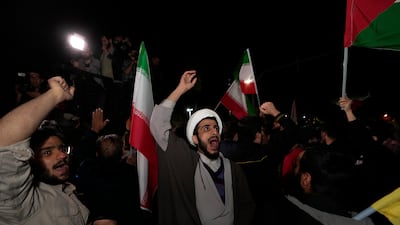
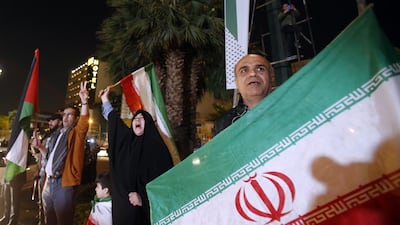
Iranian demonstrators chant slogans during an anti-Israel gathering in Tehran. AP
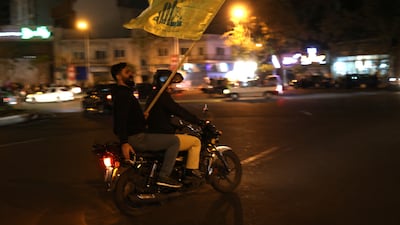
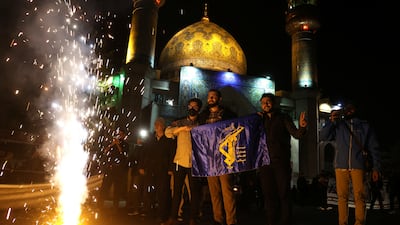
People in Tehran appear to celebrate in the street after the attack on Israel. Wana (West Asia News Agency) / Reuters
Iranians appear to celebrate in the street after the attack. Wana (West Asia News Agency) / Reuters
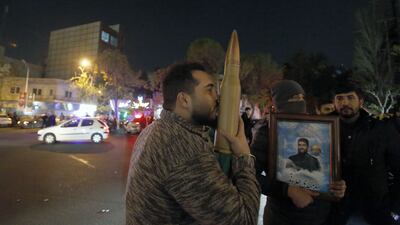
A man kisses a mock rocket during an anti-Israel rally in Tehran after Iran launched the attack. EPA
People hold Iranian and Palestinian flags at Palestine Square in Tehran. EPA
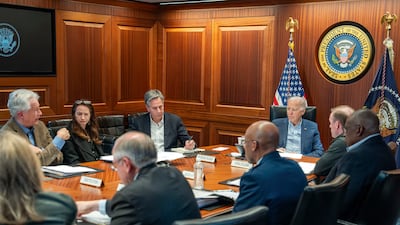
US President Joe Biden meets members of his national security team about the attack on Israel by Iran. The White House / AP
Both Iran and Israel seek a price – a reward for de-escalating – from the West
The other losers include the countries that have become arenas for Iran’s proxy wars, namely Iraq, Lebanon, Syria and Yemen. Major powers such as Iran, Israel and those in the West are all exploiting these countries as a pretext to avoid a direct Iran-Israel confrontation.
This level of strategic shamelessness, as I call it, is unparalleled.
Previously, when the administration of former US president Barack Obama and its European allies agreed to a nuclear deal with Iran in 2015, there was an understanding that they would acquiesce to Tehran’s condition not to interfere in its regional policies. Today, that strategic shamelessness has reached a troubling level under the guise of saving the Middle East from devastating regional wars.
But no major regional war will break out as long as Iran and Israel continue to have a tacit agreement with each other. There will be no more than occasional skirmishes, such as the one we witnessed over the past month, as the two adversaries maintain a shadow war that is within their regulated rules of engagement.
The Iranian regime’s most significant gain from its strikes on Israel is the domestic support it has rallied for itself. This has served to contain domestic discontent and dissent by dispelling the notion that the regime had become weak.
It has also imposed its priorities on the US and European powers to safeguard its own interests, particularly in preventing Israel from targeting its nuclear facilities. Tehran’s nuclear weapons programme, meanwhile, has made significant strides towards acquiring a bomb.
I am given to understand that the Biden administration had warned Israel against any unilateral actions to strike Iranian nuclear facilities, making it clear that it would stand alone in such a scenario and would not receive the necessary air cover from Washington. This was a clear message conveyed not only by the US to Israel but also by key European powers involved in deterring Iranian missile attacks against Israel.
In exchange, Israel may have extracted an approval from the West to carry out its long-intended invasion of Rafah. If true, this presents a dangerous trade-off with significant implications. Among these is Tehran’s willingness to sacrifice not only the Palestinian cause, which it claims to champion for the sake of shoring up domestic support, but also Hamas, which has apparently outlived its usefulness.
This brings us to Iran’s third achievement, which is sending a message to other powers in the Middle East that after demonstrating its capability and readiness to launch missiles at Israel, it is an even stronger regional force to be reckoned with.
While it’s true that Tehran has initiated a new phase in its relations with Saudi Arabia, there are no indications that it intends to revise its doctrine to cease using proxies across the Arab world.
It’s also true that while Israel seeks to establish relations with Riyadh, it has so far refused to meet the necessary conditions, notably recognising the inherent Palestinian rights to statehood. Instead, it adheres to its fundamental doctrine of forcibly displacing Palestinians, and seizing their homes and land to complete, once and for all, its occupation and then remove that word from existence.
In other words, Iran and Israel have once again converged in a tactical manoeuvring that is aimed at diminishing Arab influence in the grand scheme of things.
How do the roles of Iran’s partners and proxy groups figure in the equation of appeasement and carefully calculated escalations?
The Houthis will remain essential as a tool for Tehran to use to coerce and intimidate the US, Europe and Israel – even as the Yemeni people remain hostage to Iran. Hezbollah will persist in what it perceives to be a war of attrition against Israel, but the reality is that the attrition is mutual – with the people living in Lebanon’s south paying the price for Hezbollah’s decision to serve Iran’s interests.
The Iranian regime will continue to dominate Iraqi politics through its affiliated factions. And Syria will remain an open arena for Israel to send messages to Tehran, sniping at the regime while avoiding Iranian territory.
It is possible, therefore, that Iran and Israel will settle for their so-far limited responses and move on.
For now, both parties seek a price – a reward for de-escalating – from the West. For Israel it is weapons and ammunition, which it is due to receive after the US Congress approved military aid on Saturday. For Iran it is the preservation of its nuclear weapons programme with promises from the West to lift sanctions against it.
The two countries, meanwhile, will continue to adhere to extremist ideologies that – counterintuitively – serve both their interests.

Between the start of the 2020 IPL on September 20, and the end of the Pakistan Super League this coming Thursday, the Zayed Cricket Stadium has had an unprecedented amount of traffic.
Never before has a ground in this country – or perhaps anywhere in the world – had such a volume of major-match cricket.
And yet scoring has remained high, and Abu Dhabi has seen some classic encounters in every format of the game.
October 18, IPL, Kolkata Knight Riders tied with Sunrisers Hyderabad
The two playoff-chasing sides put on 163 apiece, before Kolkata went on to win the Super Over
January 8, ODI, UAE beat Ireland by six wickets
A century by CP Rizwan underpinned one of UAE’s greatest ever wins, as they chased 270 to win with an over to spare
February 6, T10, Northern Warriors beat Delhi Bulls by eight wickets
The final of the T10 was chiefly memorable for a ferocious over of fast bowling from Fidel Edwards to Nicholas Pooran
March 14, Test, Afghanistan beat Zimbabwe by six wickets
Eleven wickets for Rashid Khan, 1,305 runs scored in five days, and a last session finish
June 17, PSL, Islamabad United beat Peshawar Zalmi by 15 runs
Usman Khawaja scored a hundred as Islamabad posted the highest score ever by a Pakistan team in T20 cricket
Engine: Dual synchronous electric motors Power: 639hp Torque: 1,130Nm Transmission: Single-speed automatic Touring range: 591km Price: From Dh412,500 On sale: Deliveries start in October
Lewis Hamilton in 2018
Australia 2nd; Bahrain 3rd; China 4th; Azerbaijan 1st; Spain 1st; Monaco 3rd; Canada 5th; France 1st; Austria DNF; Britain 2nd; Germany 1st; Hungary 1st; Belgium 2nd; Italy 1st; Singapore 1st; Russia 1st; Japan 1st; United States 3rd; Mexico 4th
Winner Rusumaat, Dane O’Neill, Musabah Al Muhairi.
8.50pm Al Maktoum Challenge Round-2 Group Two $450,000 (D) 1,900m
Winner Benbatl, Christophe Soumillon, Saeed bin Suroor.
9.25pm Handicap $135,000 (T) 1,800m
Winner Art Du Val, William Buick, Charlie Appleby.
10pm Handicap $135,000 (T) 1,400m
Winner Beyond Reason, William Buick, Charlie Appleby.
Who was Alfred Nobel?
The Nobel Prize was created by wealthy Swedish chemist and entrepreneur Alfred Nobel.
In his will he dictated that the bulk of his estate should be used to fund "prizes to those who, during the preceding year, have conferred the greatest benefit to humankind".
Nobel is best known as the inventor of dynamite, but also wrote poetry and drama and could speak Russian, French, English and German by the age of 17. The five original prize categories reflect the interests closest to his heart.
Nobel died in 1896 but it took until 1901, following a legal battle over his will, before the first prizes were awarded.
Sharrie Williams
The American singer is hugely respected in blues circles due to her passionate vocals and songwriting. Born and raised in Michigan, Williams began recording and touring as a teenage gospel singer. Her career took off with the blues band The Wiseguys. Such was the acclaim of their live shows that they toured throughout Europe and in Africa. As a solo artist, Williams has also collaborated with the likes of the late Dizzy Gillespie, Van Morrison and Mavis Staples. Lin Rountree
An accomplished smooth jazz artist who blends his chilled approach with R‘n’B. Trained at the Duke Ellington School of the Arts in Washington, DC, Rountree formed his own band in 2004. He has also recorded with the likes of Kem, Dwele and Conya Doss. He comes to Dubai on the back of his new single Pass The Groove, from his forthcoming 2018 album Stronger Still, which may follow his five previous solo albums in cracking the top 10 of the US jazz charts. Anita Williams
Dubai-based singer Anita Williams will open the night with a set of covers and swing, jazz and blues standards that made her an in-demand singer across the emirate. The Irish singer has been performing in Dubai since 2008 at venues such as MusicHall and Voda Bar. Her Jazz Garden appearance is career highlight as she will use the event to perform the original song Big Blue Eyes, the single from her debut solo album, due for release soon.
Dubai Bling season three
Cast: Loujain Adada, Zeina Khoury, Farhana Bodi, Ebraheem Al Samadi, Mona Kattan, and couples Safa & Fahad Siddiqui and DJ Bliss & Danya Mohammed
Under the UK government’s proposals, migrants will have to spend 10 years in the UK before being able to apply for citizenship.
Skilled worker visas will require a university degree, and there will be tighter restrictions on recruitment for jobs with skills shortages.
But what are described as "high-contributing" individuals such as doctors and nurses could be fast-tracked through the system.
Language requirements will be increased for all immigration routes to ensure a higher level of English.
Rules will also be laid out for adult dependants, meaning they will have to demonstrate a basic understanding of the language.
The plans also call for stricter tests for colleges and universities offering places to foreign students and a reduction in the time graduates can remain in the UK after their studies from two years to 18 months.
Countdown to Zero exhibition will show how disease can be beaten
Countdown to Zero: Defeating Disease, an international multimedia exhibition created by the American Museum of National History in collaboration with The Carter Center, will open in Abu Dhabi a month before Reaching the Last Mile.
Opening on October 15 and running until November 15, the free exhibition opens at The Galleria mall on Al Maryah Island, and has already been seen at the Jimmy Carter Presidential Library and Museum in Atlanta, the American Museum of Natural History in New York, and the London School of Hygiene and Tropical Medicine.
UN Panel of Experts found regime secretly sold a fifth of the country's gold reserves.
The panel’s 2017 report followed a trail to West Africa where large sums of cash and gold were hidden by Abdullah Al Senussi, Qaddafi’s former intelligence chief, in 2011.
Cases filled with cash that was said to amount to $560m in 100 dollar notes, that was kept by a group of Libyans in Ouagadougou, Burkina Faso.
A second stash was said to have been held in Accra, Ghana, inside boxes at the local offices of an international human rights organisation based in France.
Tips to keep your car cool
Place a sun reflector in your windshield when not driving
Park in shaded or covered areas
Add tint to windows
Wrap your car to change the exterior colour
Pick light interiors - choose colours such as beige and cream for seats and dashboard furniture
Avoid leather interiors as these absorb more heat
Who's who in Yemen conflict
Houthis: Iran-backed rebels who occupy Sanaa and run unrecognised government
Yemeni government: Exiled government in Aden led by eight-member Presidential Leadership Council
Southern Transitional Council: Faction in Yemeni government that seeks autonomy for the south
Habrish 'rebels': Tribal-backed forces feuding with STC over control of oil in government territory
For the karak and Yoodo's house platter with includes eggs, balaleet, khamir and chebab bread.
Golden Dallah
For the cappuccino, luqaimat and aseeda.
Al Mrzab Restaurant
For the shrimp murabian and Kuwaiti options including Kuwaiti machboos with kebab and spicy sauce.
Al Derwaza
For the fish hubul, regag bread, biryani and special seafood soup.
Who has lived at The Bishops Avenue?
George Sainsbury of the supermarket dynasty, sugar magnate William Park Lyle and actress Dame Gracie Fields were residents in the 1930s when the street was only known as ‘Millionaires’ Row’.
Then came the international super rich, including the last king of Greece, Constantine II, the Sultan of Brunei and Indian steel magnate Lakshmi Mittal who was at one point ranked the third richest person in the world.
Turkish tycoon Halis Torprak sold his mansion for £50m in 2008 after spending just two days there. The House of Saud sold 10 properties on the road in 2013 for almost £80m.
Other residents have included Iraqi businessman Nemir Kirdar, singer Ariana Grande, holiday camp impresario Sir Billy Butlin, businessman Asil Nadir, Paul McCartney’s former wife Heather Mills.
Hunting park to luxury living
Land was originally the Bishop of London's hunting park, hence the name
The road was laid out in the mid 19th Century, meandering through woodland and farmland
Its earliest houses at the turn of the 20th Century were substantial detached properties with extensive grounds
Starring: Ramy Youssef, Steve Carell, Jason Schwartzman
Director: Jesse Armstrong
Rating: 3.5/5
Tributes from the UAE's personal finance community
• Sebastien Aguilar, who heads SimplyFI.org, a non-profit community where people learn to invest Bogleheads’ style
“It is thanks to Jack Bogle’s work that this community exists and thanks to his work that many investors now get the full benefits of long term, buy and hold stock market investing.
Compared to the industry, investing using the common sense approach of a Boglehead saves a lot in costs and guarantees higher returns than the average actively managed fund over the long term.
From a personal perspective, learning how to invest using Bogle’s approach was a turning point in my life. I quickly realised there was no point chasing returns and paying expensive advisers or platforms. Once money is taken care off, you can work on what truly matters, such as family, relationships or other projects. I owe Jack Bogle for that.”
• Sam Instone, director of financial advisory firm AES International
"Thought to have saved investors over a trillion dollars, Jack Bogle’s ideas truly changed the way the world invests. Shaped by his own personal experiences, his philosophy and basic rules for investors challenged the status quo of a self-interested global industry and eventually prevailed. Loathed by many big companies and commission-driven salespeople, he has transformed the way well-informed investors and professional advisers make decisions."
• Demos Kyprianou, a board member of SimplyFI.org
"Jack Bogle for me was a rebel, a revolutionary who changed the industry and gave the little guy like me, a chance. He was also a mentor who inspired me to take the leap and take control of my own finances."
"Obsessed with reducing fees, Jack Bogle structured Vanguard to be owned by its clients – that way the priority would be fee minimisation for clients rather than profit maximisation for the company.
His real gift to us has been the ability to invest in the stock market (buy and hold for the long term) rather than be forced to speculate (try to make profits in the shorter term) or even worse have others speculate on our behalf.
Bogle has given countless investors the ability to get on with their life while growing their wealth in the background as fast as possible. The Financial Independence movement would barely exist without this."
"Jack Bogle was one of the greatest forces for wealth democratisation the world has ever seen. He allowed people a way to be free from the parasitical "financial advisers" whose only real concern are the fat fees they get from selling you over-complicated "products" that have caused millions of people all around the world real harm.”
• Tuan Phan, a board member of SimplyFI.org
"In an industry that’s synonymous with greed, Jack Bogle was a lone wolf, swimming against the tide. When others were incentivised to enrich themselves, he stood by the ‘fiduciary’ standard – something that is badly needed in the financial industry of the UAE."
Open Men (bonus points in brackets)
New Zealand 125 (1) beat UAE 111 (3)
India 111 (4) beat Singapore 75 (0)
South Africa 66 (2) beat Sri Lanka 57 (2)
Australia 126 (4) beat Malaysia -16 (0)
Open Women
New Zealand 64 (2) beat South Africa 57 (2)
England 69 (3) beat UAE 63 (1)
Australia 124 (4) beat UAE 23 (0)
New Zealand 74 (2) beat England 55 (2)
Dr Afridi's warning signs of digital addiction
Spending an excessive amount of time on the phone.
Neglecting personal, social, or academic responsibilities.
Losing interest in other activities or hobbies that were once enjoyed.
Having withdrawal symptoms like feeling anxious, restless, or upset when the technology is not available.
Experiencing sleep disturbances or changes in sleep patterns.
What are the guidelines?
Under 18 months: Avoid screen time altogether, except for video chatting with family.
Aged 18-24 months: If screens are introduced, it should be high-quality content watched with a caregiver to help the child understand what they are seeing.
Aged 2-5 years: Limit to one-hour per day of high-quality programming, with co-viewing whenever possible.
Aged 6-12 years: Set consistent limits on screen time to ensure it does not interfere with sleep, physical activity, or social interactions.
Teenagers: Encourage a balanced approach – screens should not replace sleep, exercise, or face-to-face socialisation.