


Iran's retaliatory attack against Israel on April 13 was unnecessary, unsuccessful and self-defeating, indicating a deeply flawed national security decision-making process. However, should Israel's response be limited to the April 19 attack on Isfahan, the conflict can still be contained.
Before April 13, Iran seemed to be on a favourable trajectory. Hamas' attack against Israel on October 7 not only discredited Israel's intelligence and security services but also fundamentally challenged the myth of Israel’s invulnerability. Then, Israel's initial response in Gaza derailed the potential for normalisation of diplomatic relations between Israel and Saudi Arabia. Additionally, as the Israeli military entered Gaza, the suffering of civilians there increasingly dominated the news cycle, leading to growing international criticism of Israel's conduct of the war. These events likely pleased Tehran.
Israel did conduct pinpoint strikes against Iranian and allied militia positions, including ongoing attacks on Hezbollah positions in Lebanon, which have resulted in the deaths of at least 269 Hezbollah fighters. Israel’s January 20 bombing of the Quds Force intelligence headquarters in Damascus and April 1 targeting of an Iranian consular building in Damascus, too, were clear escalations by Israel. However, these operations did not significantly degrade Hezbollah's capabilities nor irreparably disrupt Iran's ability to operate in the region. The Quds Force, like any military organisation, has a large pool of officers capable of replacing slain commanders.
-
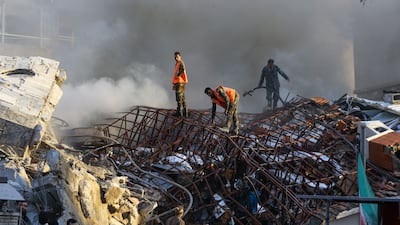
Emergency personnel extinguish a fire at the Iranian embassy compound in Damascus after it was hit by an Israeli air strike. AFP -
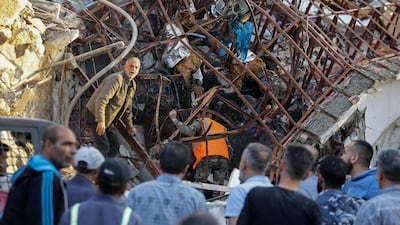
Emergency and security workers comb the rubble following the attack, which killed at least 11 people including senior Islamic Revolutionary Guard Corps commanders, in the Syrian capital. AFP -

Syrian Foreign Minister Faisal Mekdad (centre) visits the embassy compound, in the central Mezzeh area of the city. AFP -
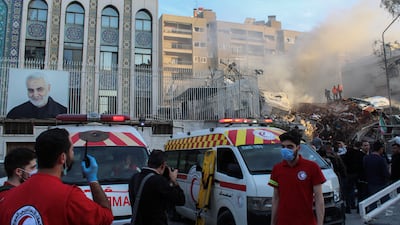
Members of the Syrian Red Crescent work at the scene in Damascus. The head of the Quds Force in Lebanon was among the dead. Reuters -
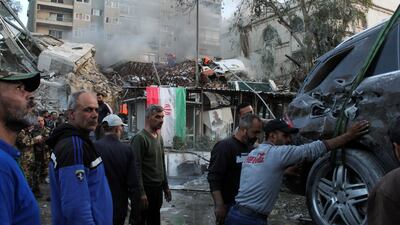
A destroyed vehicle is taken away from the Iranian embassy compound in the Syrian capital. Reuters -

Iranian President Ebrahim Raisi warned that the attack would 'not go unpunished'. AFP -

The strike is the most significant attack against an Iranian target since the Gaza war began. EPA -
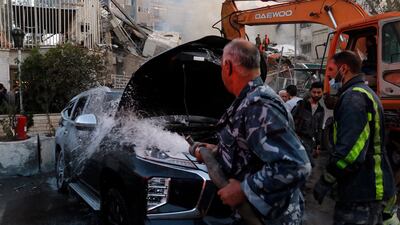
A damaged vehicle is doused following the air strike in Damascus. EPA -
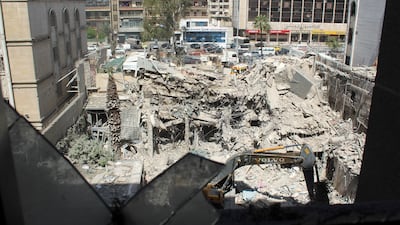
An Israeli army spokesman claimed the embassy compound was a military site 'disguised' as a diplomatic site. Reuters -

Brig Gen Mohammad Reza Zahedi, a senior commander of the Islamic Revolutionary Guard Corps' Quds Force, was killed. AFP


As the injured party whose diplomatic mission had been targeted, Iran could have held the moral high ground following the April 1 strike. Iran could also have kept the Israeli public in suspense by indicating a potential willingness to retaliate against Israel while continuing its policy of "strategic patience" adopted since the beginning of the war in Syria in 2011.
Instead, Iran launched a direct attack against Israel. Iranian officials argue the retaliatory operation was necessary to establish deterrence against Israel and prevent future Israeli attacks against Iran and Iranian interests. Early indications, however, suggest it had the opposite effect.
Israel's multi-layered air defence systems, along with support from the US military and other allies, neutralised almost all Iranian drones and missiles. Israeli reports suggest some Arab states may have provided Israel with early warnings and one, Jordan, even intercepted drones. The news cycle is no longer focused on the suffering of civilians in Gaza, and in many corners sympathy has shifted back to Israel, portraying Iran as the aggressor. The Israeli public no longer fears Iran's missiles and drones; Israel’s Iron Dome missile defence system appears as impenetrable as ever. Worse still from Tehran's perspective, despite President Joe Biden's advice to the contrary, Israel may yet use the Iranian attack as a pretext to launch a military operation against Iran, counting on automatic US support if Iran responds.
Iran's miscalculation and failure can be attributed to a deeply flawed national security decision-making process under President Ibrahim Raisi. Under his predecessor, Hassan Rouhani, strategic decisions were shaped by the Supreme National Security Council (SNSC), composed of representatives from major government departments. While representatives from the Islamic Revolutionary Guard Corps (IRGC) and its most powerful branch, the Quds Force, had a greater say on matters of hard national security, each government agency was free to contribute with its expertise. The SNSC secretary under Mr Rouhani, Admiral Ali Shamkhani, would consider these recommendations before presenting them to the president, who would then seek Supreme Leader Ali Khamenei's final approval. In most cases, Mr Khamenei would approve of the policy recommendations rather than impose his own preferences on the SNSC, which would avoid him being personally responsible should the decision prove erroneous. This process ensured that all government agencies and elite groups were stakeholders in the adopted policy, thus protecting the regime against catastrophic miscalculations.
In the case of the April 14 retaliatory attack, the strategic decision-making process was reversed: Mr Khamenei publicly promised to "punish" Israel and then tasked the SNSC with presenting a plan. The wisdom of retaliating against the Israeli bombing of the Iranian consulate was never debated in the SNSC, as Mr Khamenei's public promise took precedence. An adviser to the Iranian interior minister further disclosed that there was no dissent at the SNSC's April 2 meeting, with all members allegedly backing the IRGC’s proposal to target Israel directly from Iran.
This indicates a broken national security decision-making process in Iran, where integrity is replaced with obsequiousness, expert opinion with groupthink and adventurism supersedes prudence. Mr Raisi's weakness in standing up to Mr Khamenei's impulses, coupled with a timid Cabinet and government bureaucracy, has allowed for the unchecked, damaging adventurism of the IRGC and Quds Force.
If Israel launches a humiliating military operation against Iran, the Islamic Republic will face the choice of returning to its policy of "strategic patience", thus losing face at home and abroad, or escalating further with more attacks against Israel, potentially leading to American intervention. If the latter occurs, there is a real risk Iran may even dash for the nuclear bomb to establish the deterrence that its failed drone and missile attack could not achieve, potentially causing further calamities at home and in the region. None of this would have happened had cooler heads prevailed in Tehran and continued the regime's more effective policy of "strategic patience" in the face of Israeli provocations.

