


Until 2020, the town of Brookline, Massachusetts was probably best known for being the birthplace of US president John F Kennedy and for having what American landscape designer Andrew Jackson Downing in 1841 called “quite an Arcadian air of rural freedom and enjoyment”.
Three years ago, the authorities in this bucolic town of about 60,000 people decided that its “Arcadian air” would henceforth be unsullied by smoking and passed a bylaw that banned people born in the 21st century from buying tobacco products. Given the public health struggle over smoking that raged in the US for decades, it may come as a surprise to learn that Brookline’s tobacco-control measure was the first of its kind in the entire country. With the stroke of a pen, the town had gone from New England idyll to pioneering national health champion.
Critics of the ban, who included some local retailers, claimed that it ran contrary to Massachusetts state law that set the minimum age limit for buying tobacco at 21. A lawsuit followed but earlier this month the Massachusetts Supreme Judicial Court upheld a lower court’s 2022 decision that found in favour of Brookline’s anti-smoking stance, describing it as “a rational alternative to an immediate and outright ban on sales of all tobacco products”.
-

UAE has one of the lowest smoking rates in the Middle East and North Africa region, according to the seventh the Tobacco Atlas — a global analysis of smoking. Pawan Singh / The National -

Smoking rates in the UAE, as a percentage of the population, are thought to be less than the worldwide average, at around 14 per cent for men and 2 per cent for women. Reem Mohammed / The National -
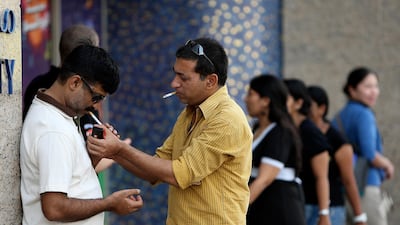
The Tobacco Atlas reports that only Yemen has a lower smoking figure than the UAE in the region. Pawan Singh / The National -

In Saudi Arabia, the country with the third-lowest figure, 485 cigarettes are smoked per person annually. AFP -

In Libya, 1,764 cigarettes are smoked per person per year. Reuters -

In Kuwait, 1,849 cigarettes are smoked per person per year. Ryan Carter / The National -

Lebanon has the highest smoking rate in the region with 1,955 cigarettes smoked per person. AFP


Graduated, age-linked tobacco bans are among the toughest proposals to not just reduce the considerable harm done by tobacco but, in the long run, eliminate smoking altogether. Proponents say the generational phasing-out of smoking would save countless lives and billions in healthcare costs. The idea has been around for some time; as far back as 2014, the British Medical Association, a professional body for doctors in the UK, overwhelmingly voted in favour of a permanent ban on the sale of cigarettes to those born after 2000.
A ban on tobacco products to those born in the 21st century has gained traction in several countries. According to the World Economic Forum, Portugal, Canada, Australia, France, Mexico and the UK are among those nations that want to raise a smoke-free generation. In 2022, legislators in New Zealand went even further, introducing what were arguably the world’s strictest anti-tobacco laws that steadily increased the legal smoking age to stop those born after January 2009 from ever buying cigarettes legally.
With prevention being better than cure, it surely makes sense to develop an anti-tobacco strategy that not only helps current smokers fight their dependency, but also prevents people, especially the young, from developing an addiction in the first place. A gradual ban on tobacco stands on the shoulders of previous public-health strategies. Bans on smoking indoors and tobacco advertising in many countries have had a major effect in reducing the harm done by this addictive substance in almost all regions of the world – except the Middle East.
Euromonitor International, a consultancy, released research in 2022 that showed the tobacco industry in the Middle East and North Africa was actually growing. The Middle East was the only region in its research with a predicted rise in cigarette sales and there was also a worrying predicted increase in the number of female smokers. This is in stark contrast to the US, where the Centres for Disease Control and Prevention says that although tobacco use is still the leading cause of preventable disease, disability and death in the country, current smoking rates have declined from 20.9 per cent (nearly 21 of every 100 adults) in 2005 to 11.5 per cent in 2021.
Levels of tobacco use vary across the Mena region, but the UAE has been a leading nation when it comes to taking action. The country has clear – and enforced – laws that include, but are not limited to, sales taxes, a ban on tobacco advertising, health warnings on tobacco products and a ban on smoking in cars when children are present. Shisha cafes are forbidden to operate within 150 metres of residential areas, schools or mosques. Some emirates have additional laws; in 2008, Sharjah banned all kinds of smoking in public areas, including the smoking of shisha.
The results have been clear. According to the latest edition of the Tobacco Atlas, a global examination of smoking, the UAE has one of the lowest smoking rates in the Mena region. In 2022, the Oman Medical Journal said that “smoking prevalence in the UAE is reported to be lower than many other Middle East countries”.
-

Atif Amin, owner of My Vapery in Dubai, warns customers about counterfeit vaping products, explains the dangers and what to look out for. -

Genuine products are made in regulated environments using certified ingredients and components, said Mr Amin. -

The counterfeit market has very low standards and ethics, so don’t really care about people’s health or selling to minors, said Mr Amin. -

The market for vaping devices, liquids and e-cigarettes is booming in the UAE after the black market industry was brought into the mainstream by regulators in April 2019. -

There is a vast selection of vape flavours available, widening the appeal of vaping.


So far, so good, but mitigating the damage done by tobacco cannot suffice. What is required globally is engineering a profound social and cultural change that may result in a future generation that looks upon the burning and inhaling of tobacco in the same way that we today might regard the taking of snuff. And for as long as tobacco use continues, the risks to people’s health are considerable. According to Cleveland Clinic Abu Dhabi, lung cancer remains the second-most common cancer among males in the UAE as well as the leading cause of all cancer-related deaths. Even more worryingly, it also warns that smoking rates among younger generations put young people at risk of lung cancer in the future.
It may be time to augment the current strategy of restriction, dissuasion and treatment with a preventive, graduated ban that essentially aims to banish smoking over the course of several generations. However, such steps – no matter how noble the intention – have to be carefully thought through.
Tobacco often provides a major source of revenue for national governments; removing it entirely one day may force countries to make up a significant shortfall elsewhere. A related caveat is that blanket bans often lead to unregulated, black-market trade. There is also the question of what form of tobacco is to be banned? The CDC says the prevalence of cigarette smoking among young people has declined over the past 30 years, but what of e-cigarettes, which are often touted as an anti-smoking aid? There are mounting concerns about the effects of vaping; a recent study from University College London examined samples that suggest vaping could cause similar damage to mouth DNA cells as smoking.
There is also the more ethical issue about the personal freedom of law-abiding adults to indulge in things that are bad for them. In this case, tobacco’s innately dangerous effects differentiate it from many other legal drugs. Its lethality was seized upon as a marketing wheeze in 1990s Britain, when the Enlightened Tobacco Company released a cigarette brand called Death, complete with black packaging that featured a skull and crossbones – the somewhat satirical implication being that if loyal customers used the product as intended, they would eventually sicken and die.
These concerns are capable of derailing efforts to reduce tobacco consumption. Last month, the New Zealand tobacco ban was reversed by a new government that had made clear its desire to remove the legislation, dismaying health campaigners. In California last year, Assembly Bill 935 – proposed legislation that aimed to ban all tobacco sales in the state to those born after 2007 – was tabled but later put on hold before eventually being restricted to flavoured tobacco, such as menthol cigarettes and candy-variety e-cigarettes.
Despite the challenges, the goal of a society that has largely thrown off the self-inflicted sickness, addiction and death caused by tobacco is a worthy one. Much has been done to cut smoking rates around the world, but there is a way to go yet. History may look back on a small New England town that decided that it was time to stub out the habit – for good.

