


Hope narrows, then widens, only to narrow again, before fear takes hold that all diplomatic efforts to achieve a ceasefire in Gaza are failing.
One of the main challenges in this regard has been to get Israeli Prime Minister Benjamin Netanyahu and Yahya Sinwar, the head of Hamas in Gaza, on the same page. Indeed, an existential battle rages between the two men, each believing that winning this war can help them achieve their respective ideological goals.
The problem lies in the inability of negotiators to influence either leader at this juncture of the war.
The administration of US President Joe Biden is unable to use its leverage over the Israeli government. The Israeli public continues to support the goal of eliminating Hamas and crushing its military leadership – and because it’s an election year in the US, that could cost Mr Biden the presidency if the situation is mishandled.
Nor are the key Middle Eastern players involved in the negotiations able to put pressure on Mr Sinwar to prioritise Palestinian national interests over his ideological battle. Indeed, Mr Sinwar views the hostages captured on October 7 as bargaining chips for himself, his group, and the Palestinian future.
This is the spoke in the diplomacy wheel that led US Secretary of State Antony Blinken to return to the Middle East for the sixth time, delicately grasping the reins of engagement with all concerned parties, hoping to accomplish the breakthrough that Mr Biden can show his fellow Americans in a challenging re-election campaign.
Mr Blinken is, however, scaling back his administration’s hopes for a grand bargain. He is merely seeking temporary solutions through soft pressure, fearing that harsh pressure would yield adverse results for the White House.

America’s top diplomat arrived in the region, armed with his administration’s readiness to support a resolution in the UN Security Council calling for a ceasefire – for the first time after the White House’s consistent blockage of any such attempt in the past nearly six months.
On the one hand, this signifies a widening gap between the Biden administration and the Netanyahu government. On the other hand, the US has made it clear to its Arab allies that it links the ceasefire with the release of hostages.
The US proposition also requires Hamas’s co-operation and acquiescence to a compromise solution entailing its disarmament in Rafah and the organised withdrawal of all armed forces, numbering in the thousands, from Rafah specifically and Gaza as a whole, as a key to sparing civilian lives. The Biden administration concurs with the Israeli government on the goal of ending Hamas’s military presence in Gaza. But the question of “how?” remains.
The alternative to Israel’s potential incursion in Rafah – aimed at eradicating Hamas’s military infrastructure – is, in the American view, for those talking to Mr Sinwar to persuade him to agree to leave Gaza and release the hostages, thereby saving Palestinians from annihilation and forced displacement.
The problem is that Mr Sinwar is the one holding the hostage card, which he wants to use for major bargains that serve his interests. He has so far refused to heed the demands of those talking to him. Given his intransigence, the key Arab nations would be better positioned to help revitalise the Palestinian Authority by pushing for internal reforms that could empower it to manage post-war Gaza one day.
During Mr Blinken’s visit to Cairo and his six-way meetings, he was made aware of the cost of the war expanding beyond Gaza. One of Egypt’s priorities lies in preventing the displacement of Palestinians to Sinai. This is a nightmare scenario for Egypt, but also for authorities in Amman who view such a development as a precursor to the forced displacement of Palestinians from the West Bank to Jordan.
Arab officials also expressed their readiness to talk to Israel on a roadmap towards a Palestinian state that is built on reforms, transparency and the involvement of a new generation in its construction.
-
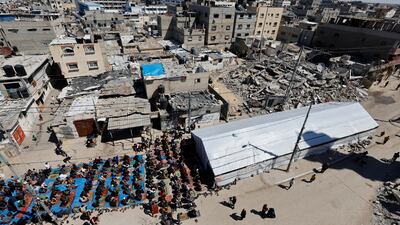
Palestinians perform the first Friday prayers of Ramadan near the ruins of a mosque in Rafah, southern Gaza. Reuters -
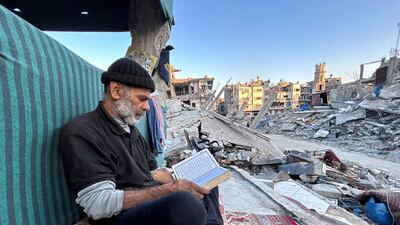
A Palestinian man reads the Quran as he waits to break his fast in Beit Lahia, northern Gaza. Reuters -
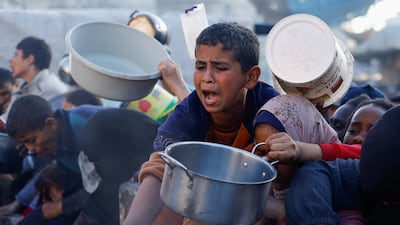
Children wait to receive food in Rafah. The UN has warned that many in Gaza are facing famine. Reuters -

Palestinians break their fast amid the rubble of their destroyed home in Rafah. Reuters -

Displaced Palestinians in Rafah decorate their homes with sheets to mark the holy month. AFP -

Palestinians shop for Ramadan lanterns in Rafah. AFP -
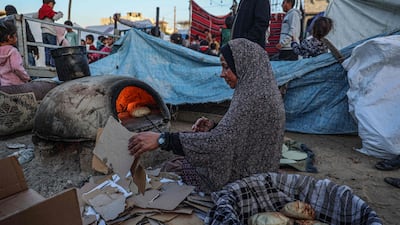
A displaced Palestinian woman bakes bread for iftar in Rafah. AFP -
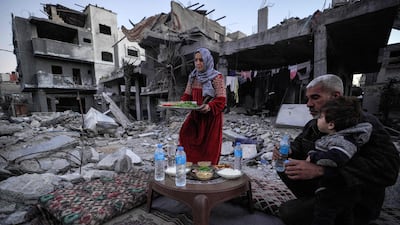
A family break fast amid the ruins of their home in Deir al-Balah, the central Gaza Strip. AFP -
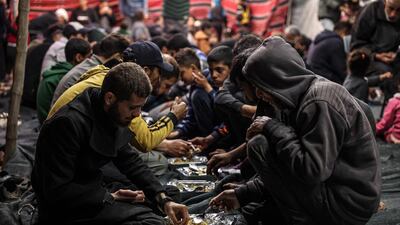
Palestinians share an iftar meal at a camp in Rafah, the southern Gaza Strip. AFP -
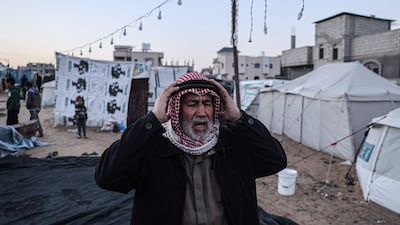
A displaced Palestinian man prays in Rafah, the southern Gaza Strip. AFP -
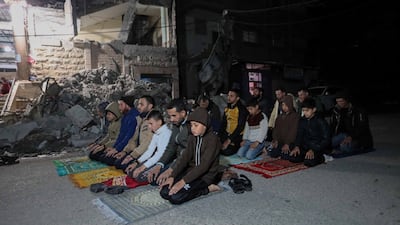
Palestinians pray taraweeh on the rubble of Rafah's Al Huda Mosque, which was destroyed in Israeli air strikes. Getty Images -

Palestinians walk past kiosks set up next to destroyed buildings in Al Nusairat refugee camp, the Gaza Strip EPA -
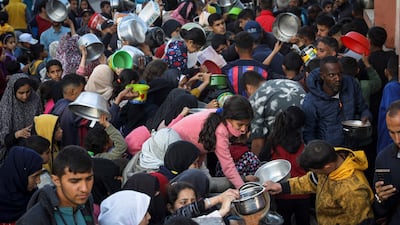
Palestinians collect food before the first iftar of Ramadan in Rafah. AFP -
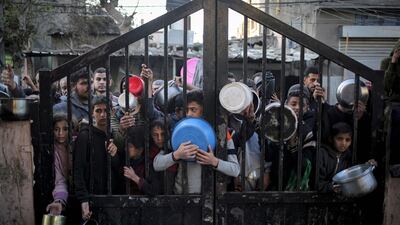
Palestinians gather to collect food in Rafah, the southern Gaza Strip. AFP -

A Palestinian child plays with a sparkler in Rafah, in southern Gaza, on the eve of Ramadan. AFP -

Displaced Palestinians in Rafah decorate their tent in preparation for Ramadan. Getty Images -

Palestinian children carry traditional lanterns in Rafah on the eve of Ramadan. AFP -
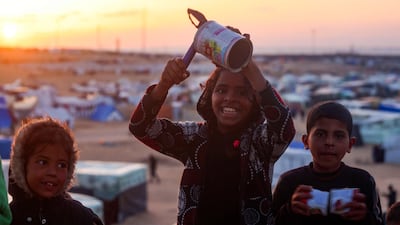
Children play at a camp for displaced Palestinians in Rafah. AFP -

A girl plays with a cat at a camp in Rafah. AFP -

A child carries a small Ramadan lantern in Gaza city. AFP -
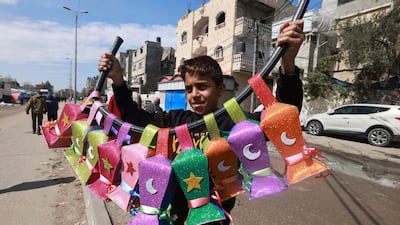
A displaced Palestinian child sells handmade Ramadan lanterns in Rafah. AFP -

A Palestinian street vendor sells traditional 'fanous' lanterns in Rafah. AFP -

A child touches decorative lights and lanterns at a shop in Deir al-Balah in central Gaza. AFP


In reality, however, the veto power over these aspirations remains in the hands of both Mr Sinwar and Mr Netanyahu.
How will the Hamas leader negotiate? So far, he has placed his own fate, and that of Hamas, above the fate of the Palestinian people, who have borne the brunt of the war. Mr Sinwar is banking on a shift in American public opinion, as well as in Israeli public sentiment and its opposition to Mr Netanyahu, for a breakthrough.
However, he is mistaken on both counts.
The October 7 attacks have helped advance the ambitions of extremist members in the Israeli government that include Gaza’s widespread destruction and the displacement of Palestinians. But where will ordinary Gazans go if they are not forcibly relocated to Sinai or Arab countries?
Jared Kushner, the son-in-law of former US president Donald Trump and himself a former White House official, suggested turning Gaza’s waterfront into a major tourist attraction and exploiting its oil and gas resources. He also called for the relocation of Gazans to the Negev desert and other Arab countries, rather than allowing them to remain in the territory.
This would essentially amount to a land grab proposed by someone who doesn’t conceal his allegiance to Israel, even if it’s at the expense of ordinary Palestinians who have already suffered a great deal due to Mr Sinwar’s political miscalculations. Mr Kushner’s remarks will have left many deeply concerned, given that there is a good chance he will handle the Middle East file for a possible second Trump term.
For now, the race between diplomacy and military aggression continues – with the fate of millions of Palestinians hanging in the balance.

