


Supermarket versions of drones are, undoubtedly, the battlefield development of the current decade.
Not only do drones allow frontline commanders to view enemy hills with the kinds of camera devices we all can buy, but even quadcopter devices on stacking shelves near us can be fairly easily adapted to deliver deadly outcomes. This has shaken up warfighting in a way that only happens every couple of decades.
It is arguable that the last such innovation was the vehicle-borne or roadside bomb. Before that, it was the Soviet assault rifle – better known as the AK-47 – which put a reliable fast-firing device into the hands of hundreds of millions of people.
The thing about drones is not just the dangers they pose in the theatre of war. It is that they have shifted alliances between countries.
A knock-on effect of the proliferation of drones is the normalisation of their sales even if it means bypassing the UN sanctions framework. So fast is the situation changing that it is possible to say that the global regime has been rendered non-functional – something that will have huge implications for international relations.
Once the principal parties to the UN sanctions stop adhering to them, previous issues with non-compliance by certain countries will be magnified. There is a concern that the whole edifice that allows the UN to enforce the will of the Security Council is now in tatters. And it is the rise of the drone that has finally pushed it over the edge.
The drone itself is a lawless intruder into the world of war. That in and of itself is having a significant impact that will be felt for years to come.

In a paper last week, the UK’s Royal United Services Institute (Rusi) examined the landscape around the Lethal Autonomous Weapons Systems, or “Laws”. This landscape includes drones, given that their use is increasingly removed from human direction.
The most basic drones, whether autonomous or not, pose an enormous proliferation risk not only as a result of more countries snapping up the capability but also because they are within the reach of rebels, terrorist groups and criminal networks. This feels like a new thing, but the report cites an incident during the 2016 fighting in Mosul when ISIS mounted 70 armed drones to stop an offensive by the Iraqi forces.
The drones employed can vary enormously.
There are those that are factory-made as well as workshop-produced. They may vary in reliability and effectiveness, but their key attribute – regardless of these variations – is that they can be used for mass attacks to overwhelm unprepared defence systems.
The second tier comprises of military-grade, off-the-shelf weapons that an increasing number of states are producing and selling around the world.
The ranks of notable ground-breaking weapons systems are growing, as the impact of these devices spreads. These, too, boast the qualities of mass-scale deployment, and if procured from a top producer, are likely to boast advanced technology, including autonomous operation.
A final category that Rusi has identified comprises of high-impact, boutique weapons systems that are developed and traded only between a few privileged states.
The report points to the call by UN Secretary General Antonio Guterres last year for a drive to ensure that there are legally binding international laws with restrictions on autonomous weapons, including bans in certain areas, by 2026. There is already a Convention on Certain Conventional Weapons, designed against weapons that cause unnecessary or unjustifiable suffering, that has been ratified by 126 states.
The Ukraine war has highlighted to the world what was already a dangerous turn of events in Yemen. Iranian-made drones, particularly the Shahed-136, is an engine-driven drone that has been transferred by the hundreds from Iran to Russia.
-
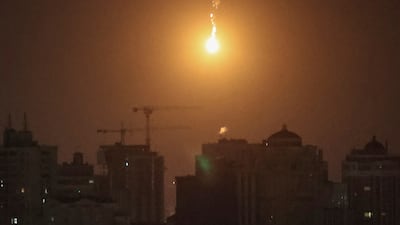
An explosion in the sky over Ukraine's capital, Kyiv, during a Russian drone strike on Saturday. Reuters -
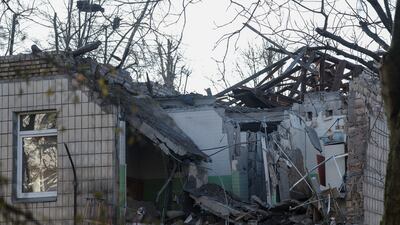
A kindergarten damaged during the drone strikes in Kyiv. EPA -

Ukraine said it downed 71 of 75 drones launched by Russia in an overnight attack. EPA -

Kyiv authorities described the attack as the most intense on the capital since the start of the invasion. EPA -
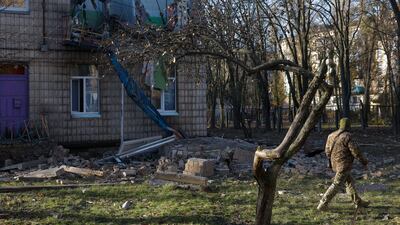
A police officer inspects a kindergarten damaged during the strikes in Kyiv. EPA -
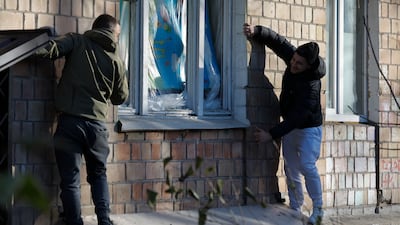
The attack came as Ukrainians marked the 1932-33 Holodomor famine, a national tragedy. EPA -
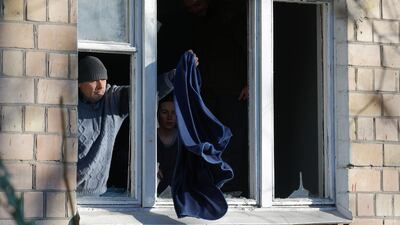
A man shakes out a blanket from a window broken during the explosions. EPA -

An elderly woman sweeps glass broken from windows in her flat after the explosion of a downed Russian drone in a yard between residential buildings in Kyiv. AFP -
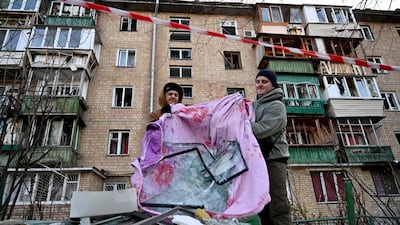
Residents remove debris after the explosion of a downed Russian drone. AFP -

The victims of the Holodomor, Ukrainian for 'death by starvation', are traditionally commemorated in Ukraine on the last Saturday of November. EPA -
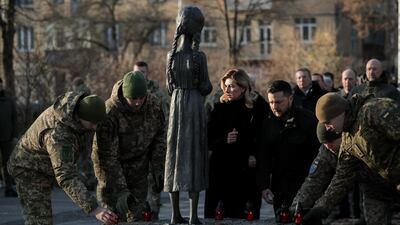
The Holodomor in the former Soviet-era Ukraine in 1932-1933, killed millions of Ukrainians. EPA


The attacks on the Red Sea that forced the US and UK to take action to protect international freedom of navigation have seen Houthi bases targeted by air and missile strikes. This situation would not have come about without international proliferation, as Iran sought first to destabilise its neighbourhood. Now that this capacity exists, it has been turned to target the international economy and destabilise the world order.
The sales of the Shahed to Russia crossed a significant global Rubicon: a permanent member of the UN Security Council was willing to buy weapons systems at scale from a country that was the target of extensive UN sanctions.
Iran has an extensive missile development programme. Until recently, it was the international community’s shared priority to not only ensure that Tehran could not make revenues from the sales of these systems but to also ensure that it was starved of parts to develop its capabilities any faster than it was already on track to complete.
Now, there is news that the arms embargo around North Korea has developed cracks and weapons are being sold for the Ukraine war effort, too. This is, if anything, even more significant than the sale of Iranian drones.
The West will come under even greater pressure to use sanctions and economic tools to try to contain this destructive breakdown.
UN sanctions were once almost universally enforced, but increasingly more countries are refusing to replicate western-led sanctions that are issued on a weekly basis these days. These countries point to the dividing lines created by unilateral measures.
We can see that, as the respect for sanctions is breaking down, the likes of North Korea are beefing up their proliferation activities and posting key personnel around the world for this purpose.
All this means that the interlinkage between revived proliferation and the collapse of the international system could only be getting started.

