


The intensity with which the Indian government and media reacted to the progress of a Chinese marine research vessel in the Indian Ocean this month has provided a microcosm of the competition for regional influence between the two neighbours.
Triumph over the Sri Lankan government’s request to Beijing to defer a port visit, reportedly under pressure from the Indian government, was soon matched by alarm when the Maldivian government chose to signal its independence from New Delhi by making the exact opposite decision.
It is no secret that the relationship between India and China has become more openly competitive over the past decade.
Some commentators associate this downturn with the violent clashes in 2017 and 2020 on the disputed border between soldiers of the two giant nations. However, the chronology of events suggests that these skirmishes were not the cause of the deterioration in the relationship but rather its delayed effect.

One of the earliest signs was India’s frosty reaction to the announcement of China’s “One Belt One Road” (also known as the Belt and Road Initiative, or BRI) in the autumn of 2013.
Although Beijing’s plan was to build an intercontinental infrastructure of trade and investment that reached Europe and Africa, New Delhi was disconcerted over the extent to which South Asia could be pulled into China’s orbit. And even though the fear of subordination to China’s far larger economy was one source of concern, Indian security elites had long seen any Chinese investments in India’s neighbours (ports in particular) as evidence of a strategic plan to potentially encircle and contain it.
So where do things stand now, a little more than 10 years later?
An estimated $90 billion has flowed into the region in the form of loans from Chinese banks, out of a total of about $800 billion disbursed for BRI projects worldwide. More than half ($55 billion) of this went to Pakistan, while significant sums also went to Bangladesh ($18 billion) and Sri Lanka ($13 billion). Most of these funds have been spent on large, capital-intensive projects such as bridges, ports, airports and power plants.
The political and economic results have not been dramatic for China or its partners, despite the vast sums involved. It is generally agreed that these projects have yet to transform the target economies, and in a number of cases have been dogged by local controversies over issues ranging from the economic impact of heavy borrowing, the exclusion of local communities from the planning process, the importation of Chinese labour, environmental impacts and more.
In fact, it could be argued that in South Asia, BRI did more to raise suspicion of Beijing’s rising soft power than accelerate it. China was already well on the way to organically achieving a leading position as the region’s largest trading partner, its largest source of commercial foreign direct investment and tourist flows, among other things. China’s Midas touch had once seemed so attractive and inevitable that the current Indian government on coming to power in 2014 had sought to pragmatically benefit from this emerging reality by separating its economic interests in China from its security concerns.
Yet although Beijing continues to heavily promote BRI in its media, Chinese lending has shrunk over the past five years. At the October 2023 forum marking BRI’s 10th anniversary, Chinese President Xi Jinping announced that the emphasis of BRI would shift from physical to institutional infrastructure, a tacit admission of the project’s challenges.
-
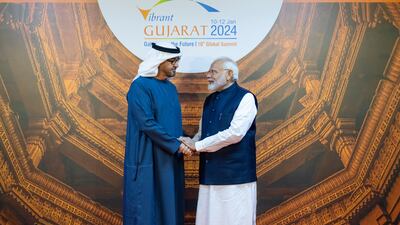
President Sheikh Mohamed with Prime Minister Narendra Modi of India at the Vibrant Gujarat Global Summit, in Gandhinagar, Gujarat. Photo: Hamad Al Kaabi / UAE Presidential Court -
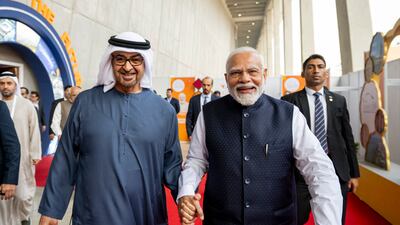
The three-day summit is being attended by heads of state, government officials, decision-makers, and business and finance professionals from around the world. Photo: Mohamed Al Hammadi / UAE Presidential Court -
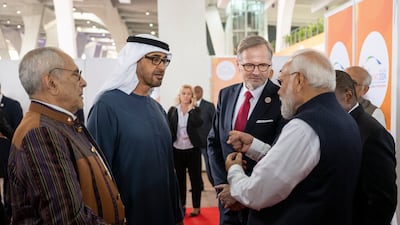
Sheikh Mohamed with Mr Modi and President Jose Ramos of East Timor, left, and Prime Minister Petr Fiala of the Czech Republic, third left. Photo: Hamad Al Kaabi / UAE Presidential Court -
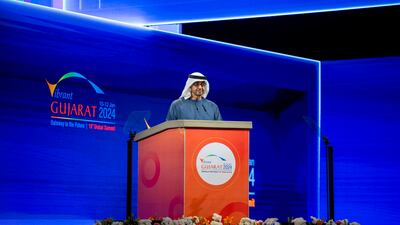
Sheikh Mohamed delivers a speech during the summit. Photo: Hamad Al Kaabi / UAE Presidential Court -
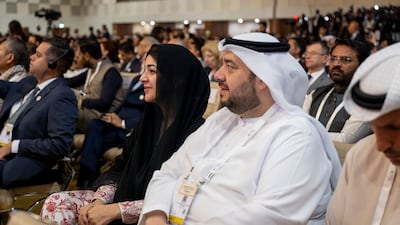
Mohamed Al Suwaidi, UAE Minister of Investment, and Reem Al Hashimy, Minister of State for International Co-operation, at the summit. Photo: Hamad Al Kaabi / UAE Presidential Court -
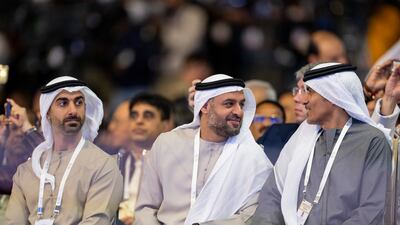
Sheikh Hamdan bin Mohamed, Sheikh Mohammed bin Hamad, Adviser for Special Affairs at the Presidential Court, and Ali Al Shamsi, Deputy Secretary General of the Supreme National Security Council, follow proceedings. Photo: Mohamed Al Hammadi / UAE Presidential Court -
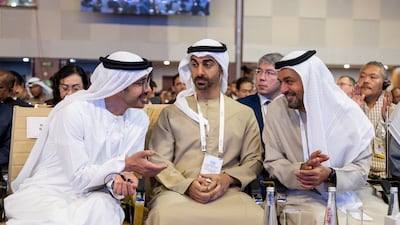
Sheikh Abdullah bin Zayed, Minister of Foreign Affairs, Sheikh Hamdan bin Mohamed, and Sheikh Mohammed bin Hamad during the conference. Photo: Mohamed Al Hammadi / UAE Presidential Court -
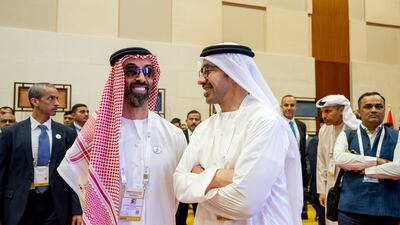
Sheikh Tahnoun bin Zayed, National Security Adviser and Deputy Ruler of Abu Dhabi, and Sheikh Abdullah bin Zayed on the sidelines of the summit. Photo: Mohamed Al Hammadi / UAE Presidential Court -
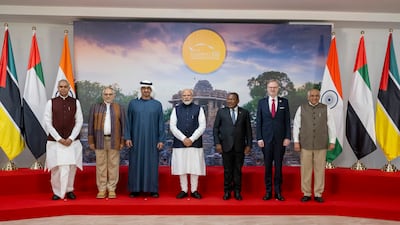
President Sheikh Mohamed with, from left, Acharya Devvrat, Governor of Gujarat, President Horta of East Timor, Prime Minister Modi, President Filipe Nyusi of Mozambique, Prime Minister Fiala of the Czech Republic, and Bhupendrabhai Patel, Chief Minister of Gujarat. Photo: Hamad Al Kaabi / UAE Presidential Court -
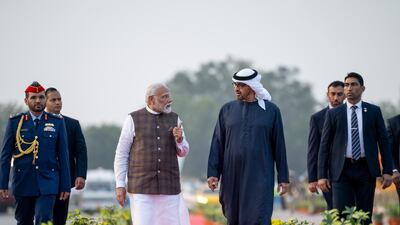
President Sheikh Mohamed is received by Narendra Modi, Prime Minister of India. All photos: UAE Presidential Court -
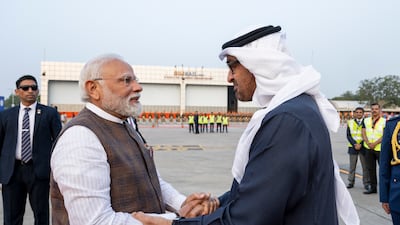
Sheikh Mohamed is greeted by Mr Modi ahead of the Vibrant Gujarat Global Summit -
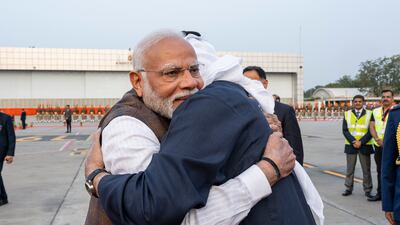
Sheikh Mohamed embraces Mr Modi -
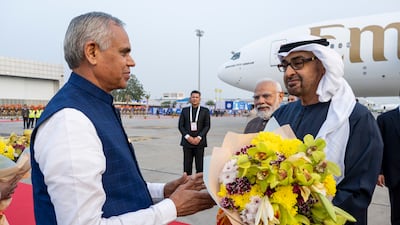
Sheikh Mohamed receives flowers upon arriving at the airport -
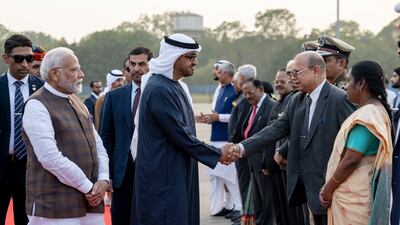
Sheikh Mohamed greets a dignitary. Hamad Al Kaabi / UAE Presidential Court -
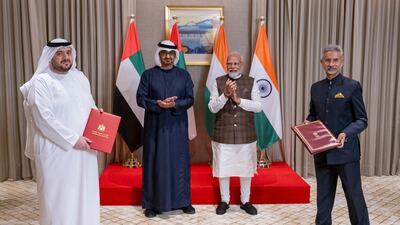
Sheikh Mohamed and Mr Modi witness a Memorandum of Understanding exchange ceremony at The Leela Gandhinagar hotel -
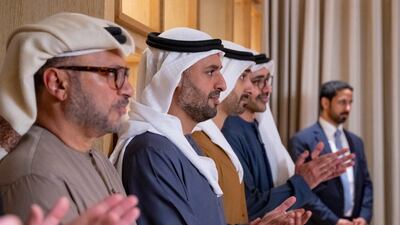
Dr Anwar Gargash, diplomatic adviser to the President, former minister of state for foreign affairs, Sheikh Mohamed bin Hamad, Private Affairs Adviser in the Presidential Court, Sheikh Hamdan bin Mohamed and Sheikh Abdullah bin Zayed, UAE Minister of Foreign Affairs, at the exchange ceremony. Mohamed Al Hammadi / UAE Presidential Court -
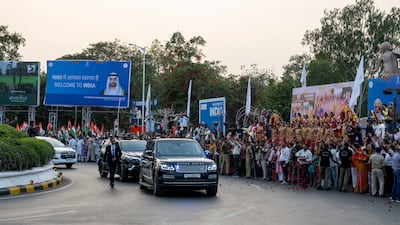
A motorcade carries Sheikh Mohamed and Mr Modi in Gujarat


This shift in the nature of BRI is certainly good news for the Indian government, which even more than the West lacked the resources to compete with the vast capacity of China’s state-owned enterprises and banks. But in a competition between the two countries’ private enterprises, and of state-directed technical assistance, institutional capacity building and training, the scales would be far more even.
India and China are vying for the position as chief spokesperson of the Global South, but they offer increasingly distinct value propositions. One significant difference is in aid philosophies. India has increasingly offered cash assistance to economically distressed neighbours, building on its traditionally generous and wide-ranging support during humanitarian disasters. China prefers indirect forms of assistance, such as debt restructuring.
The biggest and most consequential difference emerges from their profoundly different relationships with the West, and the US in particular. As America and China have gradually disengaged from each other, Beijing has increasingly moved towards building an alternative world order to accommodate states that have rejected the US-led financial and technological ecosystem.
India, on the other hand, has managed to simultaneously enter a strategic partnership with the US while still maintaining much of its old non-alignment posture. This has allowed New Delhi to position itself as a bridge-builder and an advocate that can offer marginalised states more access and possibly even a better deal from the US-led world order.
Unsurprisingly, most countries in the Global South prefer to participate in both systems rather than commit to an exclusive, zero-sum choice. Most of South Asia, including Pakistan, China’s oldest ally in the region, has been happy to do just that. Taken together, these dynamics create a natural ceiling for China’s strategic influence in South Asia.
The result is that India’s biggest challenge in the region is not China, but itself.
The vast asymmetry between India and its neighbours in terms of size, resources and media power means that the smaller countries have sometimes been disadvantaged in their dealings. This has naturally often made other South Asian governments highly sensitive to the power dynamics in their relations with New Delhi, while providing the perfect emotive totem for local nationalist politicians.
Ironically, competition with China provides India with the opportunity and the motivation to listen more carefully than ever before to its neighbours.

