


Electoral pressures are making it difficult for US President Joe Biden to endure further blows from the Houthis in the Red Sea and the Popular Mobilisation Forces in Iraq.
Yet his administration is keen to convey to Iran that military escalation against its proxies – the US and UK have conducted strikes on Houthi targets in Yemen – doesn’t imply a shift towards full-fledged war against Tehran. Washington is keen to prevent Israel’s ongoing operation inside Gaza from escalating into a regional war.
There have even been US-Iran back-channel talks in this regard. But before delving into America’s diplomatic efforts in the Middle East last week, which included engagement on Lebanon, it is important to analyse the developments in the Red Sea.
The US-UK strikes carry major economic and geopolitical implications. The Houthis, under the pretext of solidarity with Gaza, have since November intensified attacks on ships and tankers in the Red Sea, endangering the safety of maritime navigation.
A statement from the US Central Command after the strikes stated that they were aimed at undermining the Houthis’ capabilities to continue such attacks. Importantly, the statement said the strikes were unrelated to Operation Prosperity Guardian, which comprises more than 20 countries operating in the Red Sea, Bab Al Mandeb strait and the Gulf of Aden.
Most countries expressed understanding towards the strikes, with the exception of Russia, which called for a UN Security Council session. The global majority is, after all, concerned about the Houthi attacks’ impact on the global economy. Yet there is also apprehension about a potential US-UK confrontation with Iran, which is accused of providing the Houthis with missiles and drones.
A pivotal question to be asked is whether it is Iran, as a state, or entities Tehran backs that are fuelling Houthi aggression against international shipping. Alternatively, it could be that the Houthis, much like Hamas in Gaza, have chosen to deviate from Iranian oversight, acting independently.
-
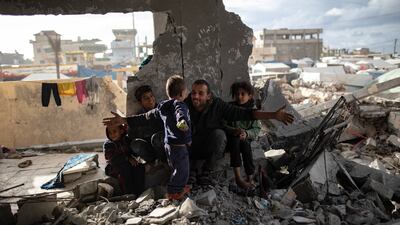
Palestinian Muhammad Al Durra with his children in the ruins of a house in Rafah where they sheltered on January 11, 2024. EPA -
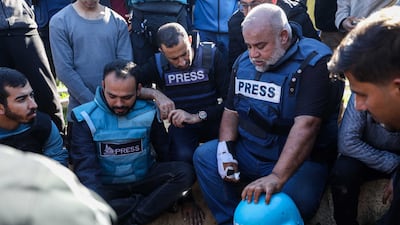
Family and friends at the funerals of journalists Hamza Al Dahdouh and Mustafa Thuraya on January 7, 2024 in Rafah, Gaza. Getty Images -
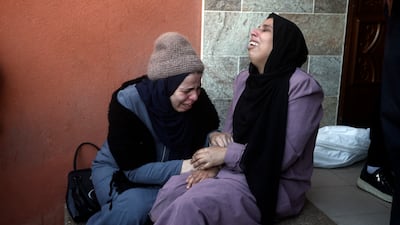
Palestinians mourn relatives killed by Israeli bombardment of the Gaza Strip outside a mortuary in Khan Younis January 4, 2024. AP Photo -
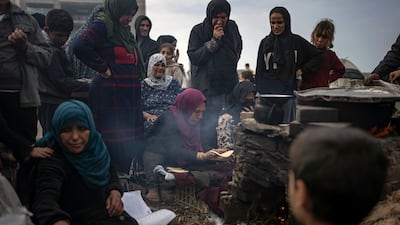
Displaced Palestinians queue to bake bread at a camp in the Muwasi area of Rafah, Gaza Strip, on December 23, 2023. AP Photo -
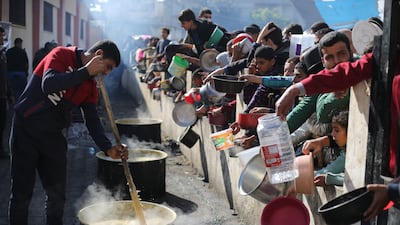
Palestinians queue for food in Rafah, the Gaza Strip, on December 20, 2023. AP Photo -

The ruins of Rafah on December 14, 2023. AFP -
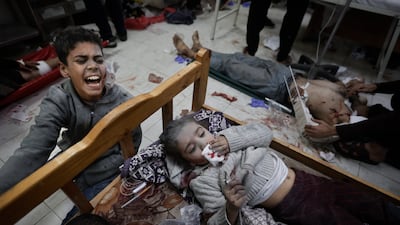
Palestinians wounded in the Israeli bombardment of the Gaza Strip arrive at a hospital in Khan Younis on December 8, 2023. AP Photo -
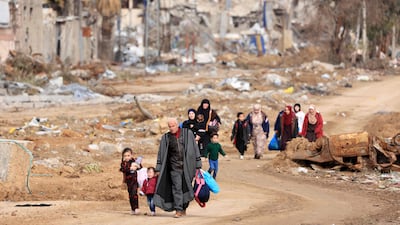
Palestinians flee Israeli bombing along the Salaheddine Road in the Zeitoun district of Gaza city on November 28, 2023. AFP -

A Red Cross vehicle takes Israeli hostages from the Gaza Strip into Egypt in Rafah on November 25, 2023. AP -
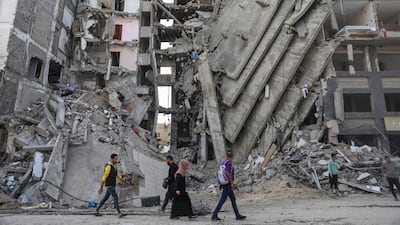
The ruins of buildings in Gaza city on November 24, 2023, as a temporary truce between Israel and Hamas took effect. AP Photo -

A woman and her cat return home to eastern Khan Younis in the southern Gaza Strip during the first hours of a four-day truce between Israel and Hamas forces on November 24, 2023. AFP -
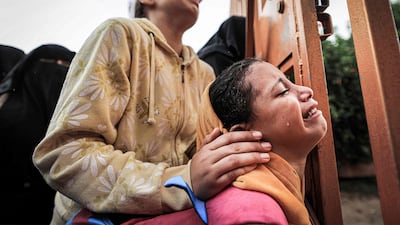
Mourning the dead of Israeli bombardment outside the mortuary at Nasser Hospital in Khan Younis on November 14, 2023. AFP -
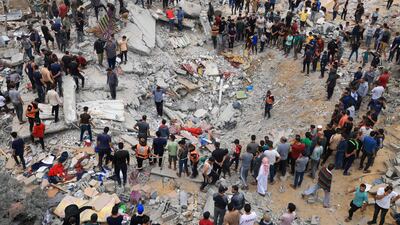
Civilians and rescuers look for survivors in the rubble of a building after Israeli bombing of Khan Younis in the southern Gaza Strip on November 12, 2023. AFP -

November 7, 2023, a month to the day after Hamas attacked Israel, a victim of an Israeli bombardment in Rafah is moved from the rubble. AFP -
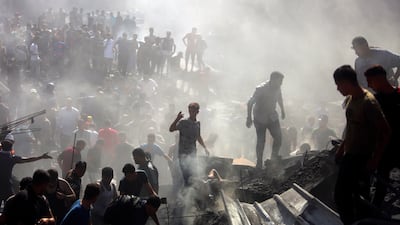
Searching the rubble after Israeli air strikes on the town of Khan Younis, southern Gaza Strip, on October 26, 2023. AP Photo -

Mourning the Kotz family at their funeral in Gan Yavne, Israel, on October 17, 2023. AP Photo -

An Israeli firefighter composes himself after he and his colleagues extinguished cars set on fire by a rocket fired from the Gaza Strip in Ashkelon, Israel, on October 9, 2023. AP Photo -
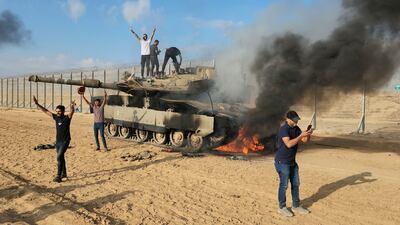
Palestinians with the wreckage of an Israeli tank at the Gaza Strip fence east of the city of Khan Younis on October 7, 2023, the day Hamas forces swept unopposed into Israel. AP Photo -
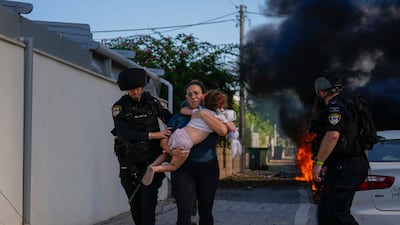
Israeli police officers evacuate a woman and a child from a site hit by a rocket fired from the Gaza Strip, in Ashkelon, southern Israel, on October 7, 2023. AP Photo


Despite the Iranian regime’s warning that these strikes could fuel instability in the region, it will stop short of plunging itself into a military confrontation in the Red Sea. However, dangers will persist in these waters and on the Lebanon-Israel border until Tehran decides to contain the Houthis in Yemen and Hezbollah in Lebanon.
Meanwhile, the current phase in the international efforts to contain the Netanyahu government’s operation inside Gaza involves western-Arab “dual guarantees” to Israel in exchange for a commitment on the two-state solution. Their objective extends beyond merely securing temporary ceasefires and seeking a long-term settlement on the Arab-Israeli conflict, particularly the Palestinian-Israeli conflict.
The essence of the proposal lies in the idea that, in exchange for the US and Europe guaranteeing Israel’s acceptance of a two-state solution and the establishment of a Palestinian state, Arab guarantees for Palestine as a peaceful state would be unequivocal.
One obstacle may lie in intra-Palestinian relations given the historical disputes among various factions and movements. Another major dilemma lies in the Israeli political establishment’s rejection of a Palestinian state alongside Israel.
This poses a challenge for the US. In its proposals, the Biden administration aims to emphasise that the reward for enduring peace for Israel is far more valuable than the costs of wars and the siege mentality. There is readiness among Arab and Islamic nations backed by unequivocal guarantees that sustainable peace will lead to prosperity in the Middle East.
But if Israel’s obstinacy against the two-state solution persists, and if Israel insists on involving the US in a war with Iran or other conflicts, the American people will not approve, irrespective of whether the administration is Democratic or Republican. This is the main message that Israel is getting from the Americans.
In other words, what Israel is hearing from the Biden administration is that expanded and exceptional security guarantees for Israel will ensure its security, while Arab guarantees will ensure its prosperity, but all this is contingent on its acceptance of the two-state solution.

Right now, from the devastation in Gaza due to Israeli actions, and the displacement of more than a million Palestinians, to the illusions and equations of Palestinian victory or defeat, and Houthi aggression, it is evident that the region is teetering on the brink.
In such a scenario, it’s worth mentioning that, even as Lebanon remains in the eye of the storm – as tensions between Israel and Hezbollah continue – it appears to be moving away from it.
For Beirut, the choice is between war with Israel and diplomacy, with efforts on the latter being led by US special envoy Amos Hochstein. The interpretation of Mr Hochstein’s latest visit to Lebanon, based on my conversations with informed sources, leads me to several conclusions.
First, he has stated that no one desires war. Second, the choice between war and diplomacy is not open-ended, but the Israeli government is willing to halt its aggression on the border if Resolution 1701, which aims to end the 2006 Lebanon War, is implemented and Hezbollah retreats to 10km beyond the so-called Blue Line.
Today, the proposal is to not completely freeze the diplomatic option until after a complete ceasefire in Gaza – as demanded by Hezbollah – but to continue reviving diplomatic prospects and implementing Resolution 1701 while the concerned parties work towards a humanitarian ceasefire in Gaza and negotiate the release of Israeli hostages under Hamas custody.
These negotiations are expected take a transitional period of three months, assuming, of course, that diplomacy prevails over war in the fateful race between these two options.

