


Last week, The New York Times carried a lengthy Tom Friedman article titled “What is happening to our world”. In it, he makes the claim that Hamas could have turned Gaza into Dubai if only they had made the right choices. There is little doubt that Hamas’s suicidal policies have brought terrible pain to Palestinians, but Friedman’s argument, which others have also made, is so fanciful and ahistorical that it must be rebutted.
The reasons for the Palestinian Territories’ lack of development go back 10 years before the fateful elections of 2005 that brought Hamas to power. I know because I was there and watched this disaster unfolding in real time. While Palestinians were not without fault, it is cruel to blame them for Israeli policies that deliberately strangled the Palestinian economy and the failure of the US to take effective measures to counter them.
From 1993 to 1996, I co-chaired a project, Builders for Peace, launched by then vice president Al Gore to promote US investment in the Occupied Territories. In that capacity, I chaired the session on the Palestinian economy at the 1994 Casablanca Economic Summit and travelled to the region with then secretary of commerce Ron Brown. And on several occasions, US business leaders visited the West Bank and Gaza to promote business partnerships that would spur economic development.
This project came about after a World Bank study observed that the Palestinian private sector in the territories could be the engine for growth if they could secure investment and had the opportunity to freely engage in trade with the outside world. There was an awareness, as Mr Gore noted, that expanding economic opportunities wouldn’t automatically bring peace, but that without these opportunities achieving peace would be impossible.

Our initial delegation visits gave us hope. Prominent US businesses were impressed with the Palestinian businessmen they met, and some deals were struck. But in the months that followed, it became clear that the Israelis were unwilling to allow Palestinians or their US partners to import raw materials or export finished products without Israeli control or an Israeli middleman. As a result, the deals that had been lined up collapsed.
The problem ran deeper. One day I received a call from an official at the US Department of Agriculture. There was a shipment of 50,000 flower bulbs the US had tried to get into Gaza. The bulbs sat awaiting Israeli clearance for so long that they rotted. Israel didn’t want competition for its own flower exports. The Agriculture Department had enough funds for another shipment of bulbs but didn’t want to risk the expenditure if the result would be the same.
In frustration, in 1995, I wrote a lengthy memo to then US president Bill Clinton. I also testified with a number of colleagues before the Senate Foreign Relations Committee detailing the Israeli impediments to investment and economic growth in Palestinian lands.
In my letter and testimony, I noted that the situation – less than two years after the Oslo Accords were signed – had become dire. Israel’s closure of Palestinian lands and imposition of internal checkpoints across the West Bank following Baruch Goldstein’s massacre of Muslims in the mosque in Hebron had taken a toll in Palestinian support for peace. Settlements were growing, as was Palestinian unemployment. In the West Bank unemployment was more than one third of the workforce, while in Gaza it had reached a staggering 62 per cent.
Specifically citing Gaza, I noted: “Despite promises from the international community, not a single job-creating infrastructure project has begun. Open sewage remains a serious health hazard. Instead of real progress, Palestinians got observers, studies, pledges, unfulfilled promises and blame.
-
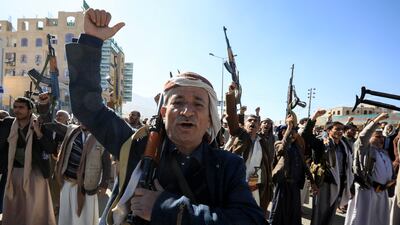
Houthi fighters shout gather in Sanaa. The rebels have launched attacks in the Red Sea in response to the Gaza war. EPA -

From left, Israeli Foreign Ministry adviser Tal Becker, lawyer Malcolm Shaw and Gilad Noam, deputy attorney general for international affairs, at the International Court of Justice in The Hague. AFP -

A Palestinian man injured in an Israeli strike receives treatment in Khan Younis, southern Gaza. AP -

Palestinian medics mourn after members of the Palestinian Red Crescent were killed in an Israeli strike in Deir Al Balah. Reuters -

Israeli soldiers take up positions during a ground operation in Khan Younis. AP -
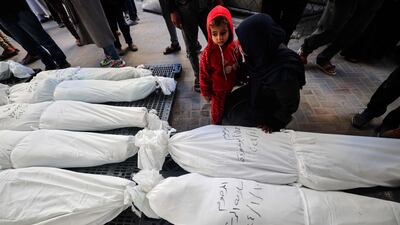
Mourners gather at Al Najar hospital in Rafah, after several relatives of a member of the Hamas general military council were killed in a strike. AFP -
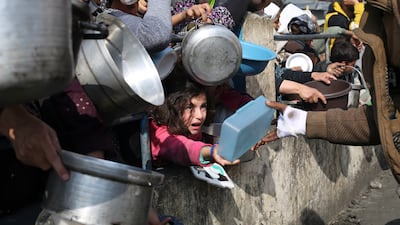
Palestinians wait to receive food aid in Rafah. AP -

A mass grave in Rafah. More than 23,000 people have been killed in Gaza since October 7. AFP -

Palestinians search the rubble of destroyed buildings after an Israeli attack on Rafah. AFP -
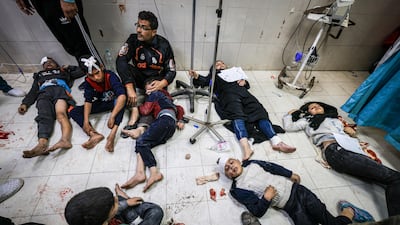
Injured Palestinians receive treatment at Nasser hospital in Khan Younis. AFP -
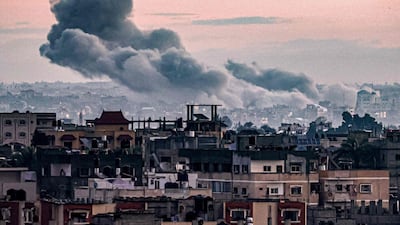
Smoke rises over Khan Younis in the southern Gaza Strip, as seen from Rafah, during sustained Israeli air strikes. AFP -
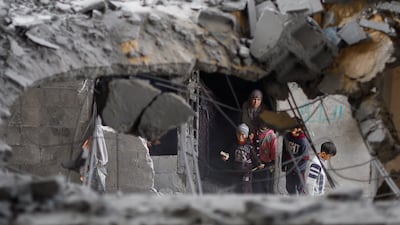
The destruction has spread throughout the Gaza Strip, from the north to Rafah in the south. Reuters -

Israeli soldiers stand on an armoured personnel carrier near the Israel-Gaza border, in southern Israel. Reuters -
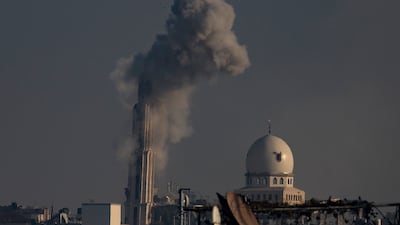
Smoke rises following Israeli air strikes in Khan Younis, the southern Gaza Strip. EPA -
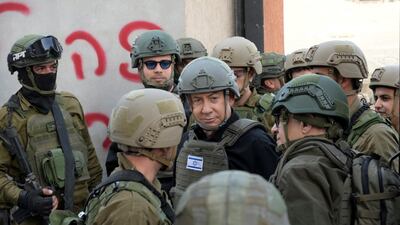
Israeli Prime Minister Benjamin Netanyahu receives a security briefing with commanders and soldiers in the northern Gaza Strip. AP -

Palestinians mourn their relatives killed in an Israeli strike on the Al Maghazi refugee camp. AFP -
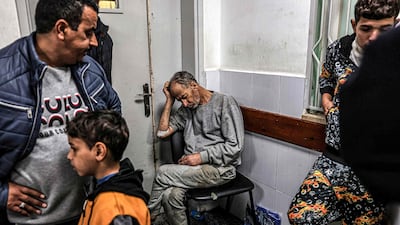
A Palestinian man detained by the Israeli military awaits treatment for his injuries in Rafah. AFP


“Young Palestinians want nothing more than to have a job, live a meaningful life, raise a family and see them prosper. Their anger is the product of despair – born of fear and frustration that they have no future. If peace is to survive, we must attack this crisis with all the resources and capabilities we have to show Palestinians that the promise of peace can be realised.”
Our asks were straightforward: that the Palestinian private sector be able to secure investments; that Israel be pressured to allow Palestinian businesses to import and export with the outside world; and that international donor funds be directed to job-creating projects. One colleague noted that the onus was on the US and Israel, not the Palestinians, to make these happen.
While Mr Clinton and the senators expressed support, our recommendation that Israel be pressured to let go of the reins and allow Palestinians to breathe and grow was rejected by the administration’s “peace team”. They argued that any pressure on Israel would impede their negotiating efforts.
All this happened in the 1990s, not 2005. In a real sense, Hamas didn’t create the mess; they inherited and preyed off the despair that was left to them by Israel’s suffocating control and US neglect and acquiescence.
Hamas handled it badly, to be sure, but the reason why Gaza didn’t become Singapore, which is what Yasser Arafat had set as his North Star, or Dubai, had less to do with Hamas’s choices and more to do with those who failed Palestinians and peace.

