


The people of Taiwan will go to the polls to elect a new president on January 13 – just two weeks after Chinese President Xi Jinping used his New Year’s address to declare that “the reunification of the motherland is a historical inevitability”.
“Compatriots on both sides of the Taiwan Strait should be bound by a common sense of purpose and share in the glory of the rejuvenation of the Chinese nation,” he said. Taiwanese Vice President Lai Ching-te, a leader in the Democratic Progressive Party (DPP) and the frontrunner in the presidential race, might politely agree with the second statement.
But he doesn’t agree with the first, having stated in the past that “we are already an independent sovereign nation called the Republic of China. We don't need a separate declaration of independence”. Such talk is why one politician from the opposition Kuomintang (KMT) says Mr Lai’s election could “open the doors to hell”.
China views Taiwan as a renegade province that must be reunited with the mainland. The only reason for the separation is that the losing side in China’s civil war, Chiang Kai-shek’s KMT, retreated to Taiwan in 1949. They called themselves the Republic of China (ROC), whereas the mainland became the People’s Republic of China (PRC). Both parties recognised the “oneness” of China, which was later codified in what became known as the 1992 Consensus. In 2008, then Taiwanese president Ma Ying-jeou – still an influential figure in the KMT – said this meant “one China with different interpretations”.
However, just as US President Joe Biden has blown up the longstanding American policy of “strategic ambiguity” – which left it officially unclear if the US would respond militarily if China took over the island by force – so Taiwanese President Tsai Ing-wen, of the DPP, made it clear that her party has never accepted the 1992 Consensus. This approach from Ms Tsai and even more so from Mr Lai, said a former presidential candidate, Foxconn’s Terry Gou, had brought Taiwan “close to the abyss of war with China”.

Claims of de jure independence are untenable legally. Generalissimo Chiang did not think he was retreating to another country. It has been only US financial and military support that has kept Taiwan apart for so long. That may possibly have been understandable during the Cold War, when the West perceived communism as an existential threat.
But today American hawks are in the preposterous position of risking a Third World War by making it clear that they would back the losing side in another country’s civil war if the winning side demanded they conclude matters by reintegrating the missing territory.
I say preposterous, because on what grounds would they have the right to intervene? Aren’t civil wars generally internal matters? And isn’t it the case that nearly every country – including the US, formally – adheres to some form of the “One China” principle? (Answer: yes.)
Whatever may be said, US backing for Taiwan is not because it is a democracy – it supported the island for decades when it was an authoritarian state. US politicians do have a genuine national interest in continued access to advanced semi-conductors, 90 per cent of which are produced in Taiwan. But the US is ramping up production at home, and it has been reported that Mr Xi told Mr Biden at the November Apec summit in San Francisco that the timing of reunification had not been decided and that he would prefer it to be done peacefully.
China has several maritime and territorial claims, some probably negotiable (as in the South China Sea), and some effectively parked, if potentially combustible (such as that over the Indian state of Arunachal Pradesh). But Taiwan is, and has always been, the reddest of red lines. The only difference with Mr Xi is that he is clarifying that resolution cannot be put off forever, and that “splitting Taiwan from China in any way”, as he put it last month, is not an option as far as he is concerned.
Rather than encouraging aspirations to independence, real friends of Taiwan ought to be proposing new solutions. Singapore’s former foreign minister, George Yeo, had just such candid words when he addressed the Asia-Pacific Forward Forum in Taiwan in September.

“I think many, if not most, Taiwanese are aware that the only reason the US supports Taiwan is to deny it as an unsinkable aircraft carrier to mainland China and not because it is a democracy,” he said. “The status quo may seem attractive, but it is unsustainable because the relative strength of the PRC versus the US is shifting in the PRC’s favour.”
Pointing out that Singapore’s founding leader, Lee Kuan Yew, urged Taiwanese leaders to negotiate with Beijing earlier rather than later, Mr Yeo suggested the idea of a “Chinese commonwealth”. This, according to him, would reaffirm the One China principle and could see “mainland China and Taiwan meeting regularly to make rules governing their interaction and resolving disputes without there being an overall executive body for an extended period of time”.
This is not a new application of “one country, two systems”, as in Hong Kong. No. Mr Yeo, who is highly regarded in China, said his belief was that: “If mainland China knows that the end point is unification after a period of time, then maintaining some kind of a status quo for many years will be acceptable to it.”
Ambiguity would allow a future with hope, he said, because the alternative to eventual peaceful reunification was “inevitable war” that would be “tragic for the entire world”. I can’t disagree with Mr Yeo at all and, given the high level of his contacts in China, he may have been speaking with at least the knowledge of some in Beijing.
Western leaders who parrot that they stand with Taiwan are doing its inhabitants no favours at all. They still, rather strangely, refuse to take Mr Xi at face value when it comes to reunification. Sooner or later, both they and the people of Taiwan will have to come to realise that he means exactly what he says – not least because no Chinese leader could possibly survive losing the island.
Once the inevitable is accepted, a solution such as Mr Yeo’s would be slow and incremental, with no outcome predetermined except unity. “By then,” he said, “it is entirely possible that there will neither be a PRC nor an ROC but, just simply, China.” Unless you are irrevocably prejudiced, what could possibly be wrong with that?
-
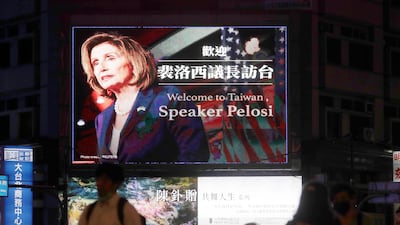
People walk past a billboard welcoming US House Speaker Nancy Pelosi in Taipei, Taiwan. AP -
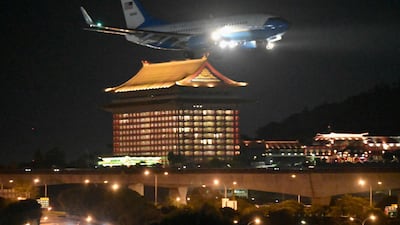
A US military aircraft carrying Ms Pelosi makes its descent at Songshan Airport in Taipei. AFP -
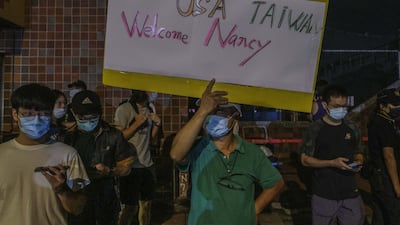
Supporters outside Songshan Airport welcome Ms Pelosi. Bloomberg -
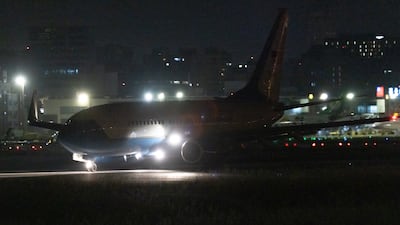
Ms Pelosi is visiting Taiwan as part of a tour of Asia aimed at reassuring allies in the region. Getty Images -
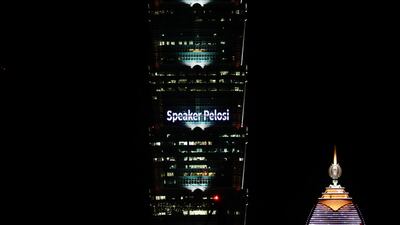
A Taipei 101 skyscraper message welcomes Ms Pelosi to Taiwan. EPA -
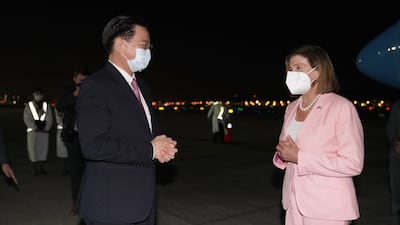
Ms Pelosi is greeted by Joseph Wu, Taiwan's foreign minister, at Songshan Airport. EPA / Taiwan Ministry of Foreign Affairs -

Ms Pelosi poses for a group photo with Mr Wu and other officials on the tarmac. EPA / Taiwan Ministry of Foreign Affairs -
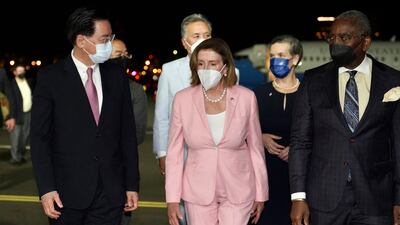
Ms Pelosi is the highest-ranking US official to visit the island in 25 years. Taiwan Ministry of Foreign Affairs / AP -
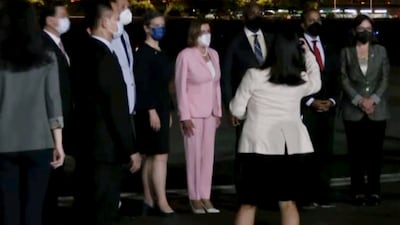
Ms Pelosi poses with members of her delegation and Taiwanese officials. AP -
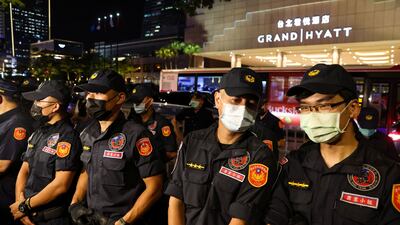
Police officers stand outside the Grand Hyatt Taipei. Bloomberg -

Police officers await a convoy carrying Ms Pelosi outside the Grand Hyatt Taipei. Bloomberg -
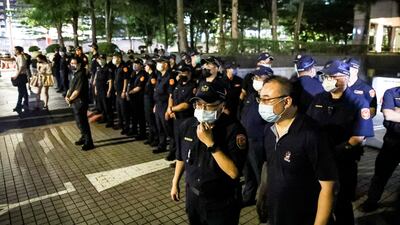
Police officers await a convoy carrying Ms Pelosi. Bloomberg -
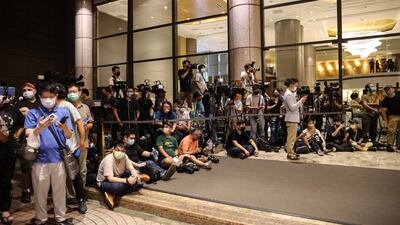
Throngs of media wait outside the Grand Hyatt Taipei. Bloomberg -
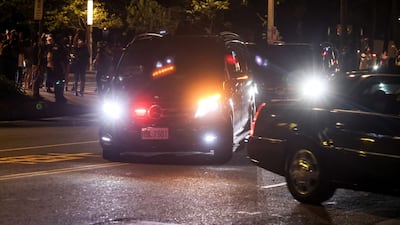
The convoy carrying Ms Pelosi arrives at the Grand Hyatt. Bloomberg -
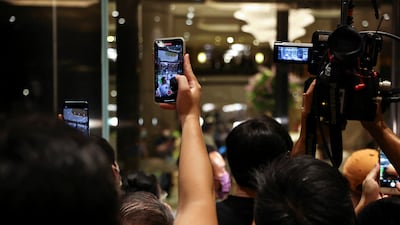
People hope to take a photo of Ms Pelosi's arrival outside the hotel. Reuters -
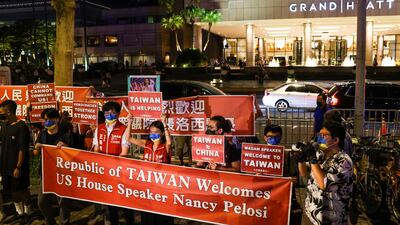
Supporters gathered outside the Grand Hyatt welcome Ms Pelosi. Bloomberg -
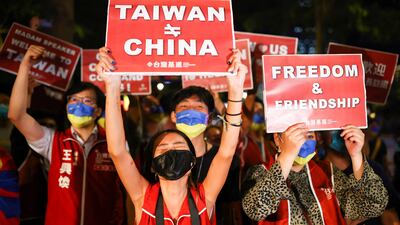
Demonstrators show their support for Ms Pelosi's visit. Reuters -

The Taipei 101 building lit up with a message reading 'TW hearts US'. Bloomberg -
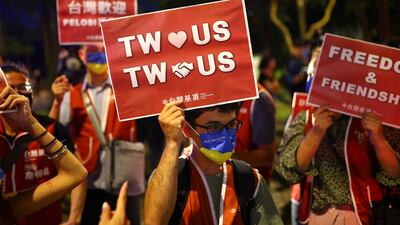
Demonstrators in Taipei show their support of the US as Ms Pelosi arrives. Reuters -
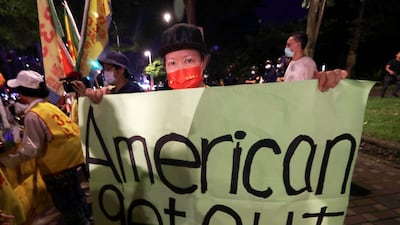
Not everyone in Taipei is thrilled by Ms Pelosi's visit. AP



