


What if Israel insists on its goal of crushing Hamas, regardless of the costs, brushing aside Hamas's warning that it will eliminate the hostages if Israel does not back down? Who is bluffing in their threats, and what room is there for manoeuvre and de-escalation?
Both sides consider this war existential, not just for Palestinians and Israelis, but for Hamas, Prime Minister of Israel Benjamin Netanyahu, and his government. But they have cornered themselves into seemingly impossible negotiations.
Israel wants Hamas to surrender, relinquish power and give up its leaders by leaving Gaza – or face the threat of assassination.
Hamas wants Israel to retract these conditions and accept its continued rule in Gaza, while subtly indicating its willingness to recognise Israel and embrace moderation over radicalism.
Hostages might serve as ammunition that could trigger a larger conflict, or as bargaining chips for a ceasefire agreement. This is the complex equation of today and it has far-reaching consequences.
-
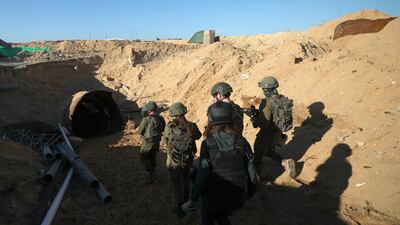
Israeli soldiers at the entrance of a tunnel 400 metres from the Erez crossing between Gaza and Israel, in the Palestinian town of Beit Hanun. EPA -

Israeli soldiers at an entrance to the tunnel in northern Gaza. EPA -
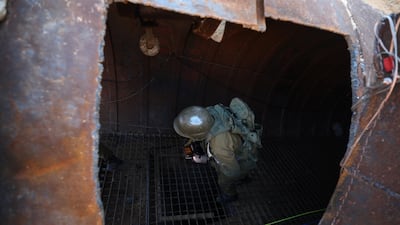
Israeli army spokesman Admiral Daniel Hagari in an entrance of the tunnel. EPA -

Israeli soldiers investigate the tunnel. Reuters -
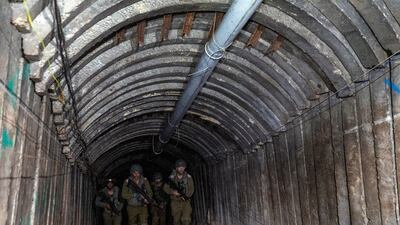
Israel's military says the the tunnel was dug by Hamas to get fighters across the border for surprise attacks. Reuters -

Israeli soldiers inside the tunnel. Israel says this is the biggest tunnel discovered in the Israel-Gaza war. EPA -

Admiral Hagari inspects the tunnel. Israel says Hamas militants used the tunnel to attack the Erez crossing. EPA -

Israeli soldiers investigate the tunnel. AP -
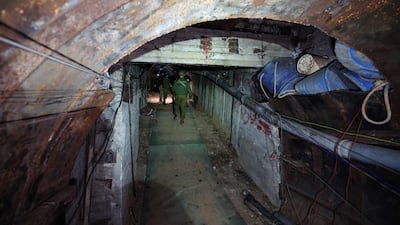
Israeli troops inside the iron-girdered tunnel AFP -

Israeli troops inside the tunnel 400 metres from the Erez crossing between Gaza and Israel. AP


Those who criticise and blame Palestinians, failing to discern between the Palestinian people and leaders who harbour animosity towards one another, need to understand the facts and not engage in odious posturing or incite discord.
Israel's assault on Gaza has gone beyond brutal, particularly in its targeting of civilians, especially children. It is crucial to recall that the condemnation of Hamas's actions on October 7 came not only from ordinary Arab citizens but from Arab leaders themselves, who rejected the targeting of young men and women, including at a music concert.
The difficulties for US President Joe Biden's administration in persuading Israel to exercise even a modicum of wisdom exposes a weakness at the core of the US-Israeli relationship, which harms American interests. This administration should not persist in politically and ethically exposing itself by opposing UN Security Council and General Assembly decisions calling for a ceasefire.
The draft resolution proposed by the UAE and Egypt in the Security Council aims to improve the humanitarian situation and urges both parties in Gaza to cease hostilities and enable the entry of aid into the besieged sector under an international monitoring mechanism supervised by the UN. There is no justification for the US's opposition to allow the Security Council to adopt such a resolution. It should not bow down to what Israel dictates.
If Mr Biden and his team believe that confronting Mr Netanyahu and his hawkish allies would cost them in the 2024 presidential elections, then yielding to Israel's dictates would cost them even more, and could lead the US into a war it does not want if Israel opens a front against Lebanon, drawing in Iran.
This is something the Biden team understands well and has contained so far. However, Israel's intransigence must be met with serious scepticism, firmness and clear opposition to Israeli plans and traps in Lebanon as well as in Gaza.

The Biden team is working intensively on arrangements for the Gaza Strip, which have compelled Mr Netanyahu to retreat from some of his dangerous stances. Today, reports suggest that Hamas will reject any ceasefire unless Israel and the US back down from the goal of destroying the leadership and infrastructure of Hamas. The card that Hamas is playing against Israel and the US is that of the hostages.
The Biden administration's stance that Hamas should release all the hostages first before discussing diplomatic solutions is illogical, especially since Israeli and American positions exclude Hamas from the "day after arrangements".
Therefore, the Biden administration must pressure Israel to abandon its policy of destroying Hamas, as it may lead to Hamas burning the hostage card if Israel insists on burning Gaza with its citizens and civilians, while implementing a strategy to crush Hamas.
Instead, the logical thing to do is apply pressure on Israel to accept a ceasefire and conduct a fresh assessment of the situation, then adopt a new approach towards Gaza and the entire Middle East.
Israel's rejection of the two-state solution is catastrophic, as it indicates its unwillingness to peacefully co-exist with the Palestinians and its refusal of the Arab-Islamic initiative for recognition and normalisation in exchange for agreeing to the two-state solution.
Hamas’s political and military leadership are not on the same page. There are signs that the political wing is willing to join the Palestine Liberation Organisation (PLO) to stay relevant and play a role in the future of Palestine in both Gaza and the West Bank.
In other words, the political wing of Hamas aims to confront Israel's war of annihilation by adjusting its ideology and policies, achieve a ceasefire, and halt the massacres that have claimed the lives of 20,000 Palestinians. But the military wing appears not to be interested in this same approach.

The PLO cannot monopolise power in the West Bank and Gaza, but nor can it wait until after the end of the war and Israeli occupation to present its reform programme. It must be open to Hamas and Islamic Jihad joining its ranks now as a necessary means to achieve unity between Gaza and the West Bank in the Palestinian project, without conditions and restrictions.
This is not the time for grandstanding; it is a time for Palestinian maturity and for refraining from squandering further opportunities to stop the conflicts and divisions. The Palestinian Authority (PA) is one thing, and the PLO is another. There is a lack of trust in both, but it is imperative that the Palestinian leadership in the Authority stops delaying the necessary renewal and reforms until the current situation in Gaza is over. Its duties are to take action, not to wait.
The Riyadh Summit granted it confidence, but it has not endorsed the PA's traditional patterns of behaviour, from its usual "no"s and boycotts, to its refusal to inject fresh blood into its ranks. It needs to realise that its reputation, both regionally and globally, requires reform and renewal in its institutions and leadership.
The internal strife within the PA, led by President Mahmoud Abbas, and the tension between its members who were once in or close to power, has reached a critical point that demands attention. Various proposals and perspectives need thorough consideration.
"The Gaza Peace Plan" was proposed by Salam Fayyad, who was Prime Minister of the PA from 2007 to 2013, and published in Foreign Affairs and it incorporates reforms allowing the PLO to govern the Gaza Strip. The plan drew the attention of American, European and Arab leaders.
Similarly, former head of Palestinian security, Mohammed Dahlan, presented his vision, including a two-year transitional period under technocratic administration in both Gaza and the West Bank, and said it would have Arab approval. While the PA may not fully endorse this plan, it should consider some of its ideas that could be beneficial.
Salam Fayyad and Mohammed Dahlan are not the only ones presenting ideas or emerging as potential candidates for future leadership. Some dub Marwan Al Barghouti, the leader of Fatah's organisation, as the "Palestinian Mandela," although this comparison is exaggerated.
What’s important here is that there is a generation of young individuals prepared with innovative ideas, plans and fresh perspectives. The older leadership should bring them in to recognise their capabilities and explore their potential for future leadership.
Ultimately, Palestine is the responsibility of Palestinians before being an Arab or international concern. Palestinians are the decision-makers who have the right to self-determination. Arab and international support for their legitimate rights is crucial, and resisting Israeli aggression against Palestinian civilians is a moral obligation.
However, engaging in verbal skirmishes and cross accusations of betrayal is a kind of folly steeped in ignorance and absurdity. Palestinians cannot afford such distractions that only add insult to their deep wounds.
Live updates: Follow the latest news on Israel-Gaza

