Chitrabhanu Kadalayil is deputy comment editor at The National
December 13, 2023
Cruel irony came knocking on the Indian Parliament’s door, not once but twice, on Wednesday.
Exactly 22 years to the day since a deadly attack on the old Parliament premises in New Delhi, two people jumped from the visitors’ gallery of the newly inaugurated building right next door into the well of the lower house, and pulled out canisters emitting yellow smoke. Moments after it was established that no one was harmed, and five people were arrested, Speaker Om Birla barred visitors for the foreseeable future.
As if it wasn’t bad enough that there was a security lapse inside the country’s highest legislature on the anniversary of the worst attack against it, this was swiftly followed by the decision made by its custodians to bar the “demos” from accessing the so-called temple of democracy. The ban, it is hoped, will be revoked as soon as possible.
Wednesday’s incident is in no way comparable to the attack that took place on December 13, 2001, which left 14 people dead – eight security personnel, one gardener and the five gunmen who entered the premises with fake passes. After years-long investigations, the Indian state named Pakistan-based terrorist outfits Jaish-e-Mohammed and Lashkar-e-Taiba responsible for the attack and in 2013 hanged an Indian man for his involvement in the operation.
Yet a full two decades after the assault, not enough lessons have been learnt.
The solution to protect government buildings isn’t to shut them off from the citizens
Just as it is the state’s responsibility to keep its citizens safe and secure, so it is to shield public servants and their offices from attacks. This is particularly true for a country like India, which has lost two of its prime ministers to assassinations, including one in harness, and whose state faces sometimes violent troubles from across the length and breadth of the subcontinent.
Throughout the world, from the 19th century onwards, there have been at least 70 assaults reported on national legislatures, the most documented among them being the January 6, 2021 US Capitol riot and the one on the Brazilian Congress on January 8 of this year.
What these incidents, including the one that occurred on Wednesday, remind us is of the need for authorities all over the world to maintain what is a difficult balance – between securing the premises of public servants and bureaucrats so that they can work without worrying about their safety and allowing ordinary people free access to government buildings. This is important, not just so that citizens can get work done where there is the opportunity for it, but also for them to be able to witness for themselves how the government of the day discharges its duties – in theory, the noblest of causes.
It is a fact that any attack on a parliament or any other government building is an attack on the system or the state that runs that country. And often any rioting that takes place inside or outside these hallowed premises stems from this notion that the state somehow isn’t working for the people – and that it needs to be taken over through an insurrection.
The Indian Express newspaper reported some MPs as saying that the intruders were chanting slogans such as: “Tana shahi nahi chalegi [dictatorship won’t be accepted].”
Donald Trump, the president at the time, speaks during a rally protesting the electoral college certification of Joe Biden as president in Washington on January 6, 2021. AP
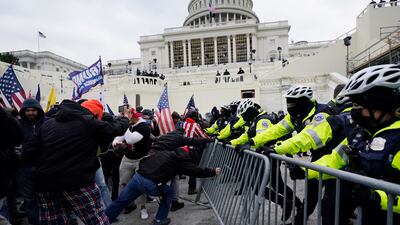
A mob loyal to Mr Trump tries to break through a police barrier at the Capitol. AP
The mob waves pro-Trump flags in front of the Capitol building. AP
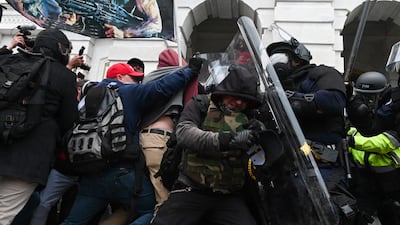
Riot police push back a crowd of rioters at the Capitol building. AFP
Trump supporters clash with police and security forces as people try to storm the US Capitol building. AFP
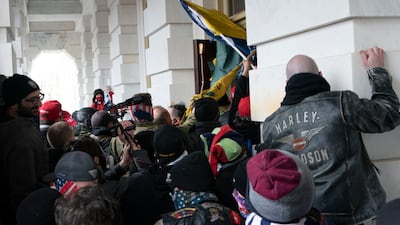
Insurrectionists loyal to Mr Trump try to open a door of the US Capitol building as they riot in Washington. AP
US Capitol Police push back rioters trying to enter the US Capitol. AP
Police and rioters confront each other in the Rotunda of the Capitol. US Capitol Police via AP
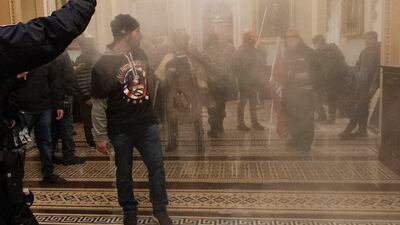
Smoke fills the hallway outside the Senate chamber of the Capitol. AP
Insurrectionists loyal to Mr Trump breach the Capitol in Washington. AP
Trump supporters, including Doug Jensen, centre, confront US Capitol Police in the hallway outside the Senate chamber at the Capitol. AP
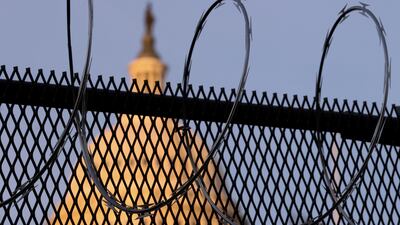
Newly installed razor wire tops the fence surrounding the US Capitol following the January 6 riot. Reuters
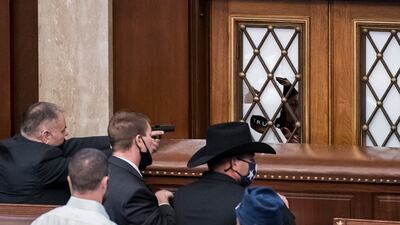
Security agents and members of Congress barricade the door to the House chamber as the violent mob breaches the Capitol. AP
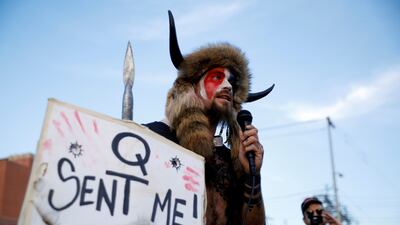
Rioter Jacob Chansley holds a sign referencing QAnon as supporters of Mr Trump gather to protest the early results of the 2020 presidential election. Reuters
But the solution to protect these buildings and the people inside them isn’t to shut them off from the citizens – for that would only serve to exacerbate whatever perceived distance there might be between the public and its servants.
It is possible for security to be tightened around all of India’s government buildings while at the same time allowing for its citizens – the very people who have voted this government and others to power – to enter their premises so that they can see governance, and indeed democracy, in action.
Wednesday’s incident is unfortunate, and it shouldn’t have been allowed to happen. What it calls for is a thorough investigation into the matter followed by the enforcement of a better system to keep the country’s parliamentarians safe and secure.
And once the dust settles, Mr Birla must be convinced to throw the Parliament’s door open once again for the well-meaning citizens of the country to witness the debates and discussions that, after all, shape their very own lives.

UAE currency: the story behind the money in your pockets
In Search of Mary Shelley: The Girl Who Wrote Frankenstein
By Fiona Sampson
Profile
Neil Thomson – THE BIO
Family: I am happily married to my wife Liz and we have two children together.
Favourite music: Rock music. I started at a young age due to my father’s influence. He played in an Indian rock band The Flintstones who were once asked by Apple Records to fly over to England to perform there.
Favourite book: I constantly find myself reading The Bible.
Favourite film: The Greatest Showman.
Favourite holiday destination: I love visiting Melbourne as I have family there and it’s a wonderful place. New York at Christmas is also magical.
Favourite food: I went to boarding school so I like any cuisine really.
UAE currency: the story behind the money in your pockets
Nearly a quarter of Americans say they never plan to retire, according to a poll that suggests a disconnection between individuals' retirement plans and the realities of ageing in the workforce.
Experts say illness, injury, layoffs and caregiving responsibilities often force older workers to leave their jobs sooner than they'd like.
According to the poll from The Associated Press-NORC Centre for Public Affairs Research, 23 per cent of workers, including nearly two in 10 of those over 50, don't expect to stop working. Roughly another quarter of Americans say they will continue working beyond their 65th birthday.
According to government data, about one in five people 65 and older was working or actively looking for a job in June. The study surveyed 1,423 adults in February this year.
For many, money has a lot to do with the decision to keep working.
"The average retirement age that we see in the data has gone up a little bit, but it hasn't gone up that much," says Anqi Chen, assistant director of savings research at the Centre for Retirement Research at Boston College. "So people have to live in retirement much longer, and they may not have enough assets to support themselves in retirement."
When asked how financially comfortable they feel about retirement, 14 per cent of Americans under the age of 50 and 29 per cent over 50 say they feel extremely or very prepared, according to the poll. About another four in 10 older adults say they do feel somewhat prepared, while just about one-third feel unprepared.
"One of the things about thinking about never retiring is that you didn't save a whole lot of money," says Ronni Bennett, 78, who was pushed out of her job as a New York City-based website editor at 63.
She searched for work in the immediate aftermath of her layoff, a process she describes as akin to "banging my head against a wall." Finding Manhattan too expensive without a steady stream of income, she eventually moved to Portland, Maine. A few years later, she moved again, to Lake Oswego, Oregon. "Sometimes I fantasise that if I win the lottery, I'd go back to New York," says Ms Bennett.
Starring: Brad Pitt, Damson Idris, Kerry Condon, Javier Bardem
Director: Joseph Kosinski
Rating: 4/5
SNAPSHOT
While Huawei did launch the first smartphone with a 50MP image sensor in its P40 series in 2020, Oppo in 2014 introduced the Find 7, which was capable of taking 50MP images: this was done using a combination of a 13MP sensor and software that resulted in shots seemingly taken from a 50MP camera.
A German university was a good fit for the family budget
Annual fees for the Technical University of Munich - £600
Shared rental accommodation per month depending on the location ranges between £200-600
The family had budgeted for food, books, travel, living expenses - £20,000 annually
Overall costs in Germany are lower than the family estimated
As proof that the student has the ability to take care of expenses, international students must open a blocked account with about £8,640
Funding: Raised $5.8m in a seed fund round in December 2018. Backers include Y Combinator, Beco Capital, Venturesouq, Paul Graham, Peter Thiel, Paul Buchheit, Justin Mateen, Matt Mickiewicz, SOMA, Dynamo and Global Founders Capital
Mercer, the investment consulting arm of US services company Marsh & McLennan, expects its wealth division to at least double its assets under management (AUM) in the Middle East as wealth in the region continues to grow despite economic headwinds, a company official said.
Mercer Wealth, which globally has $160 billion in AUM, plans to boost its AUM in the region to $2-$3bn in the next 2-3 years from the present $1bn, said Yasir AbuShaban, a Dubai-based principal with Mercer Wealth.
“Within the next two to three years, we are looking at reaching $2 to $3 billion as a conservative estimate and we do see an opportunity to do so,” said Mr AbuShaban.
Mercer does not directly make investments, but allocates clients’ money they have discretion to, to professional asset managers. They also provide advice to clients.
“We have buying power. We can negotiate on their (client’s) behalf with asset managers to provide them lower fees than they otherwise would have to get on their own,” he added.
Mercer Wealth’s clients include sovereign wealth funds, family offices, and insurance companies among others.
From its office in Dubai, Mercer also looks after Africa, India and Turkey, where they also see opportunity for growth.
Wealth creation in Middle East and Africa (MEA) grew 8.5 per cent to $8.1 trillion last year from $7.5tn in 2015, higher than last year’s global average of 6 per cent and the second-highest growth in a region after Asia-Pacific which grew 9.9 per cent, according to consultancy Boston Consulting Group (BCG). In the region, where wealth grew just 1.9 per cent in 2015 compared with 2014, a pickup in oil prices has helped in wealth generation.
BCG is forecasting MEA wealth will rise to $12tn by 2021, growing at an annual average of 8 per cent.
Drivers of wealth generation in the region will be split evenly between new wealth creation and growth of performance of existing assets, according to BCG.
Another general trend in the region is clients’ looking for a comprehensive approach to investing, according to Mr AbuShaban.
“Institutional investors or some of the families are seeing a slowdown in the available capital they have to invest and in that sense they are looking at optimizing the way they manage their portfolios and making sure they are not investing haphazardly and different parts of their investment are working together,” said Mr AbuShaban.
Some clients also have a higher appetite for risk, given the low interest-rate environment that does not provide enough yield for some institutional investors. These clients are keen to invest in illiquid assets, such as private equity and infrastructure.
“What we have seen is a desire for higher returns in what has been a low-return environment specifically in various fixed income or bonds,” he said.
“In this environment, we have seen a de facto increase in the risk that clients are taking in things like illiquid investments, private equity investments, infrastructure and private debt, those kind of investments were higher illiquidity results in incrementally higher returns.”
The Abu Dhabi Investment Authority, one of the largest sovereign wealth funds, said in its 2016 report that has gradually increased its exposure in direct private equity and private credit transactions, mainly in Asian markets and especially in China and India. The authority’s private equity department focused on structured equities owing to “their defensive characteristics.”
Key facilities
Olympic-size swimming pool with a split bulkhead for multi-use configurations, including water polo and 50m/25m training lanes
Premier League-standard football pitch
400m Olympic running track
NBA-spec basketball court with auditorium
600-seat auditorium
Spaces for historical and cultural exploration
An elevated football field that doubles as a helipad
Specialist robotics and science laboratories
AR and VR-enabled learning centres
Disruption Lab and Research Centre for developing entrepreneurial skills
About Seez
Company name/date started: Seez, set up in September 2015 and the app was released in August 2017
Founder/CEO name(s): Tarek Kabrit, co-founder and chief executive, and Andrew Kabrit, co-founder and chief operating officer
Based in: Dubai, with operations also in Kuwait, Saudi Arabia and Lebanon
Sector: Search engine for car buying, selling and leasing
Size: (employees/revenue): 11; undisclosed
Stage of funding: $1.8 million in seed funding; followed by another $1.5m bridge round - in the process of closing Series A
Investors: Wamda Capital, B&Y and Phoenician Funds
Profile
Company name: Marefa Digital
Based: Dubai Multi Commodities Centre
Number of employees: seven
Sector: e-learning
Funding stage: Pre-seed funding of Dh1.5m in 2017 and an initial seed round of Dh2m in 2019
Investors: Friends and family
Specs
Engine: 51.5kW electric motor
Range: 400km
Power: 134bhp
Torque: 175Nm
Price: From Dh98,800
Available: Now
MATCH INFO
Fulham 0
Aston Villa 3 (Grealish 4', Hourihane 15', Mings 48')
Friday, September 29
First practice: 7am - 8.30am
Second practice: 11am - 12.30pm
Saturday, September 30
Qualifying: 1pm - 2pm
Sunday, October 1
Race: 11am - 1pm
Sugary teas and iced coffees
The tax authority is yet to release a list of the taxed products, but it appears likely that sugary iced teas and cold coffees will be hit.
For instance, the non-fizzy drink AriZona Iced Tea contains 65 grams of sugar – about 16 teaspoons – per 680ml can. The average can costs about Dh6, which would rise to Dh9.
Cold coffee brands are likely to be hit too. Drinks such as Starbucks Bottled Mocha Frappuccino contain 31g of sugar in 270ml, while Nescafe Mocha in a can contains 15.6g of sugar in a 240ml can.
Scores
Oman 109-3 in 18.4 overs (Aqib Ilyas 45 not out, Aamir Kaleem 27) beat UAE 108-9 in 20 overs (Usman 27, Mustafa 24, Fayyaz 3-16, Bilal 3-23)
Results
6.30pm: Maiden Dh165,000 (Dirt) 1,400m. Winner: Rio Angie, Pat Dobbs (jockey), Doug Watson (trainer).
Alexandru Chitoran (ROM) v Hussein Fakhir Abed (SYR)
Catch 74kg
Tohir Zhuraev (TJK) v Omar Hussein (JOR)
Strawweight (Female)
Weronika Zygmunt (POL) v Seo Ye-dam (KOR)
Featherweight
Kaan Ofli (TUR) v Walid Laidi (ALG)
Lightweight
Leandro Martins (BRA) v Abdulla Al Bousheiri (KUW)
Welterweight
Ahmad Labban (LEB) v Sofiane Benchohra (ALG)
Bantamweight
Jaures Dea (CAM) v Nawras Abzakh (JOR)
Lightweight
Mohammed Yahya (UAE) v Glen Ranillo (PHI)
Lightweight
Alan Omer (GER) v Aidan Aguilera (AUS)
Welterweight
Mounir Lazzez (TUN) Sasha Palatnikov (HKG)
Featherweight title bout
Romando Dy (PHI) v Lee Do-gyeom (KOR)
Company Profile
Name: Thndr Started: 2019 Co-founders: Ahmad Hammouda and Seif Amr Sector: FinTech Headquarters: Egypt UAE base: Hub71, Abu Dhabi Current number of staff: More than 150 Funds raised: $22 million