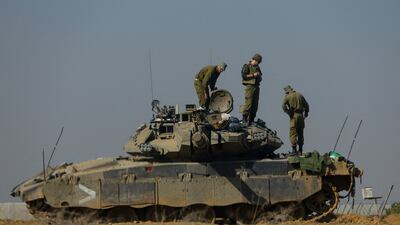
In recent weeks, the administration of US President Joe Biden has attempted to pivot from its initial unconditional support for Israeli actions in Gaza by combining caution with a vague plan for “the day after”.
In the immediate aftermath of Hamas’s October 7 attack and murder of 1,200 Israelis, Mr Biden offered the government of Israeli Prime Minister Benjamin Netanyahu exaggerated support, including of its “right to defend itself”, its goal of eliminating Hamas and his pledge that the US would always stand with Israel. This response to what had just occurred may have been understandable, but it soon became clear that Israel viewed Mr Biden’s words as a green light to exact a punishing toll on the Palestinian people as a whole.
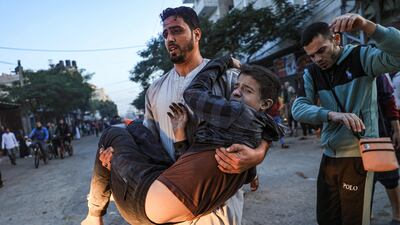
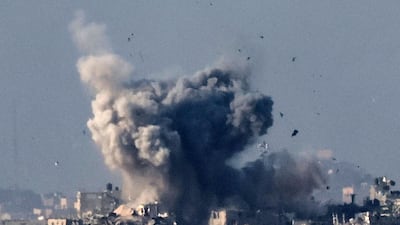
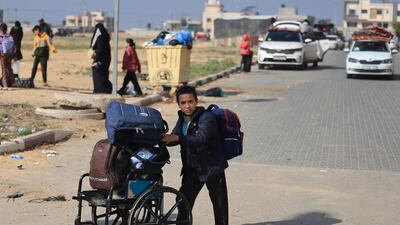
As the staggering numbers of dead grew, and Americans witnessed the horrific damage and scenes of more than one million Palestinians walking kilometres to seek safety, the White House attempted a slight pivot. It warned Israel to be “more strategic” in its bombing raids to avoid putting civilians at risk. With no “and if you continue, we’ll ...”, these warnings were viewed in Israel as toothless.
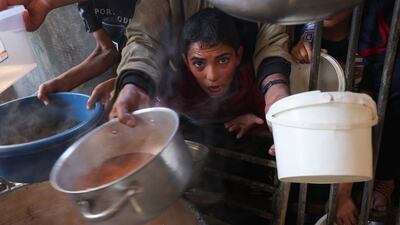
As US polls showed growing disapproval for Israeli actions and the Biden administration’s timid response, coupled with signs of increasing Arab world dissatisfaction with America’s refusal to rein in Israel, the administration attempted to create even more distance. Key White House talking points now included: urging Israel to adhere to the “rules of war” by limiting civilian casualties, warnings that the US wouldn’t accept the reoccupation of Gaza and insistence on increased humanitarian assistance to displaced Palestinians.
Instead of asking the Israelis to limit civilian casualties, settlement expansion or settler violence, the President should just say “No”
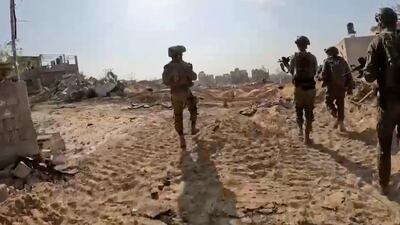
Despite this slight change in tune, there was no shift in policy. The administration refused to place conditions on future US military aid to Israel. Nor would it discourage Israel from resuming its war, while continuing to caution about “limiting” civilian casualties.
More recently, after the White House expressed concern with the lack of an Israeli “end game”, it offered a few of its own ideas – most of which are neither new nor especially serious. In addition to warning Israel against a reoccupation of Gaza, they called for a “reconstituted Palestinian Authority” to administer Gaza, leading to recognition of the West Bank and Gaza as one entity that would constitute the future Palestinian state. The US has also called on Israel to control settler violence in the West Bank.
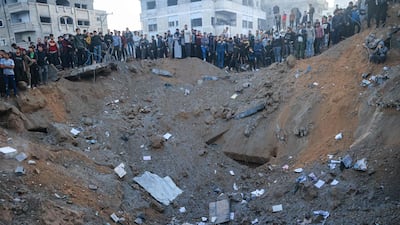
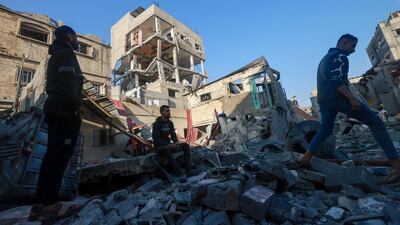
After nearly two months in which more than 16,000 Palestinians have been killed, 1.7 million forced to flee and half of Gaza’s structures demolished, several questions come to mind. How will renewed bombings not take more civilian lives? With many of Hamas’s leaders and operatives having gone to the south, to a now overly congested region of misery, how can Israel fulfil its goal of eliminating Hamas without creating more deaths? How can the Palestinian Authority be reconstituted while Palestinians continue to live under occupation?
While Hamas’s popularity was low before the war began, polls now show that Hamas is surging in support, with the PA losing even more legitimacy. How can an election be held under these conditions without producing a result that the Israelis and the US will never accept?
Although many ideas put forward by those close to the White House also envision an end of the Netanyahu government and its replacement by a new coalition, no possible reconfiguration of the existing Knesset nor a new election will produce a government able to pursue significantly different policies regarding Palestinians. It would not guarantee anything close to an independent Palestinian state, would be unable to rein in settlers and would be uninterested in limiting settlement expansion in the West Bank.
Just two words would reverse this downward spiral. The first is “No”. Instead of oblique reminders of the “rules of war”, or asking the Israelis to please limit civilian casualties, settlement expansion or settler violence, the President should just say “No”. No more offensive military equipment or US support in international forums without a permanent ceasefire, firm action to disarm violent settlers and an end to all settlement expansion.
If America were serious about a path forward to the conflict’s peaceful resolution, it would need to perform dramatic surgery to remove the cancer continuing to provoke violence and create radicalisation on all sides. It would have to say “No” to the continued occupation.
To enable this, the US would have to change its “No” at the UN to a “Yes” and support a Security Council resolution recognising Palestine as a state, declaring its continued occupation as a threat to regional peace and security, and ordering an empowered UN peacekeeping force to the occupied territories to provide peace and security for both Israelis and Palestinians.
Such moves from the US would undoubtedly cause a shock to both societies. Only under the security provided by such a UN mandate would the Palestinians be able to put their house in order. At the same time, the shock of a US “No” to Israel and “Yes” to a Security Council resolution that would change the status of territories to Palestinian land, Israelis would be left to ask hard questions about where decades of unchecked acquisitiveness and expansion have led them. They would be forced to re-examine whether they could continue to oppress Palestinians with impunity. In the aftershock, sane voices will be able to break through in the public square reigniting both Israeli peace forces and Palestinian moderates.
It won’t be easy, but leaving the cancer in place is nothing more than a prescription for certain death. A shock to the system is required and it all begins with a US “No” followed by “Yes”.

Who's who in Yemen conflict
Houthis: Iran-backed rebels who occupy Sanaa and run unrecognised government
Yemeni government: Exiled government in Aden led by eight-member Presidential Leadership Council
Southern Transitional Council: Faction in Yemeni government that seeks autonomy for the south
Habrish 'rebels': Tribal-backed forces feuding with STC over control of oil in government territory
More from Neighbourhood Watch:
The President's Cake
Director: Hasan Hadi
Starring: Baneen Ahmad Nayyef, Waheed Thabet Khreibat, Sajad Mohamad Qasem
Rating: 4/5
Arabian Gulf League fixtures:
Friday:
- Emirates v Hatta, 5.15pm
- Al Wahda v Al Dhafra, 5.25pm
- Al Ain v Shabab Al Ahli Dubai, 8.15pm
Saturday:
- Dibba v Ajman, 5.15pm
- Sharjah v Al Wasl, 5.20pm
- Al Jazira v Al Nasr, 8.15pm
Saudi Cup race day
Schedule in UAE time
5pm: Mohamed Yousuf Naghi Motors Cup (Turf), 5.35pm: 1351 Cup (T), 6.10pm: Longines Turf Handicap (T), 6.45pm: Obaiya Arabian Classic for Purebred Arabians (Dirt), 7.30pm: Jockey Club Handicap (D), 8.10pm: Samba Saudi Derby (D), 8.50pm: Saudia Sprint (D), 9.40pm: Saudi Cup (D)
Dengue%20fever%20symptoms
%3Cp%3EHigh%20fever%20(40%C2%B0C%2F104%C2%B0F)%3Cbr%3ESevere%20headache%3Cbr%3EPain%20behind%20the%20eyes%3Cbr%3EMuscle%20and%20joint%20pains%3Cbr%3ENausea%3Cbr%3EVomiting%3Cbr%3ESwollen%20glands%3Cbr%3ERash%26nbsp%3B%3C%2Fp%3E%0A
Mercer, the investment consulting arm of US services company Marsh & McLennan, expects its wealth division to at least double its assets under management (AUM) in the Middle East as wealth in the region continues to grow despite economic headwinds, a company official said.
Mercer Wealth, which globally has $160 billion in AUM, plans to boost its AUM in the region to $2-$3bn in the next 2-3 years from the present $1bn, said Yasir AbuShaban, a Dubai-based principal with Mercer Wealth.
“Within the next two to three years, we are looking at reaching $2 to $3 billion as a conservative estimate and we do see an opportunity to do so,” said Mr AbuShaban.
Mercer does not directly make investments, but allocates clients’ money they have discretion to, to professional asset managers. They also provide advice to clients.
“We have buying power. We can negotiate on their (client’s) behalf with asset managers to provide them lower fees than they otherwise would have to get on their own,” he added.
Mercer Wealth’s clients include sovereign wealth funds, family offices, and insurance companies among others.
From its office in Dubai, Mercer also looks after Africa, India and Turkey, where they also see opportunity for growth.
Wealth creation in Middle East and Africa (MEA) grew 8.5 per cent to $8.1 trillion last year from $7.5tn in 2015, higher than last year’s global average of 6 per cent and the second-highest growth in a region after Asia-Pacific which grew 9.9 per cent, according to consultancy Boston Consulting Group (BCG). In the region, where wealth grew just 1.9 per cent in 2015 compared with 2014, a pickup in oil prices has helped in wealth generation.
BCG is forecasting MEA wealth will rise to $12tn by 2021, growing at an annual average of 8 per cent.
Drivers of wealth generation in the region will be split evenly between new wealth creation and growth of performance of existing assets, according to BCG.
Another general trend in the region is clients’ looking for a comprehensive approach to investing, according to Mr AbuShaban.
“Institutional investors or some of the families are seeing a slowdown in the available capital they have to invest and in that sense they are looking at optimizing the way they manage their portfolios and making sure they are not investing haphazardly and different parts of their investment are working together,” said Mr AbuShaban.
Some clients also have a higher appetite for risk, given the low interest-rate environment that does not provide enough yield for some institutional investors. These clients are keen to invest in illiquid assets, such as private equity and infrastructure.
“What we have seen is a desire for higher returns in what has been a low-return environment specifically in various fixed income or bonds,” he said.
“In this environment, we have seen a de facto increase in the risk that clients are taking in things like illiquid investments, private equity investments, infrastructure and private debt, those kind of investments were higher illiquidity results in incrementally higher returns.”
The Abu Dhabi Investment Authority, one of the largest sovereign wealth funds, said in its 2016 report that has gradually increased its exposure in direct private equity and private credit transactions, mainly in Asian markets and especially in China and India. The authority’s private equity department focused on structured equities owing to “their defensive characteristics.”
JUDAS AND THE BLACK MESSIAH
Directed by: Shaka King
Starring: Daniel Kaluuya, Lakeith Stanfield, Jesse Plemons
Four stars
Day 3 stumps
New Zealand 153 & 249
Pakistan 227 & 37-0 (target 176)
Pakistan require another 139 runs with 10 wickets remaining
The specs: 2018 Nissan Patrol Nismo
Price: base / as tested: Dh382,000
Engine: 5.6-litre V8
Gearbox: Seven-speed automatic
Power: 428hp @ 5,800rpm
Torque: 560Nm @ 3,600rpm
Fuel economy, combined: 12.7L / 100km
The%20specs
%3Cp%3E%3Cstrong%3EEngine%3A%3C%2Fstrong%3E%202-litre%204-cylinder%3Cbr%3E%3Cstrong%3EPower%3A%20%3C%2Fstrong%3E153hp%20at%206%2C000rpm%3Cbr%3E%3Cstrong%3ETorque%3A%20%3C%2Fstrong%3E200Nm%20at%204%2C000rpm%3Cbr%3E%3Cstrong%3ETransmission%3A%20%3C%2Fstrong%3E6-speed%20auto%3Cbr%3E%3Cstrong%3EFuel%20consumption%3A%20%3C%2Fstrong%3E6.3L%2F100km%3Cbr%3E%3Cstrong%3EPrice%3A%20%3C%2Fstrong%3EDh106%2C900%3Cbr%3E%3Cstrong%3EOn%20sale%3A%20%3C%2Fstrong%3Enow%3C%2Fp%3E%0A
Did you know?
Brunch has been around, is some form or another, for more than a century. The word was first mentioned in print in an 1895 edition of Hunter’s Weekly, after making the rounds among university students in Britain. The article, entitled Brunch: A Plea, argued the case for a later, more sociable weekend meal. “By eliminating the need to get up early on Sunday, brunch would make life brighter for Saturday night carousers. It would promote human happiness in other ways as well,” the piece read. “It is talk-compelling. It puts you in a good temper, it makes you satisfied with yourself and your fellow beings, it sweeps away the worries and cobwebs of the week.” More than 100 years later, author Guy Beringer’s words still ring true, especially in the UAE, where brunches are often used to mark special, sociable occasions.
How%20I%20connect%20with%20my%20kids%20when%20working%20or%20travelling
%3Cp%3E%0D%3Cstrong%3ELittle%20notes%3A%20%3C%2Fstrong%3EMy%20girls%20often%20find%20a%20letter%20from%20me%2C%20with%20a%20joke%2C%20task%20or%20some%20instructions%20for%20the%20afternoon%2C%20and%20saying%20what%20I%E2%80%99m%20excited%20for%20when%20I%20get%20home.%0D%3Cbr%3E%3Cstrong%3EPhone%20call%20check-in%3A%20%3C%2Fstrong%3EMy%20kids%20know%20that%20at%203.30pm%20I%E2%80%99ll%20be%20free%20for%20a%20quick%20chat.%0D%3Cbr%3E%3Cstrong%3EHighs%20and%20lows%3A%20%3C%2Fstrong%3EInstead%20of%20a%20%E2%80%9Chow%20was%20your%20day%3F%E2%80%9D%2C%20at%20dinner%20or%20at%20bathtime%20we%20share%20three%20highlights%3B%20one%20thing%20that%20didn%E2%80%99t%20go%20so%20well%3B%20and%20something%20we%E2%80%99re%20looking%20forward%20to.%0D%3Cbr%3E%3Cstrong%3EI%20start%2C%20you%20next%3A%20%3C%2Fstrong%3EIn%20the%20morning%2C%20I%20often%20start%20a%20little%20Lego%20project%20or%20drawing%2C%20and%20ask%20them%20to%20work%20on%20it%20while%20I%E2%80%99m%20gone%2C%20then%20we%E2%80%99ll%20finish%20it%20together.%0D%3Cbr%3E%3Cstrong%3EBedtime%20connection%3A%20%3C%2Fstrong%3EWake%20up%20and%20sleep%20time%20are%20important%20moments.%20A%20snuggle%2C%20some%20proud%20words%2C%20listening%2C%20a%20story.%20I%20can%E2%80%99t%20be%20there%20every%20night%2C%20but%20I%20can%20start%20the%20day%20with%20them.%0D%3Cbr%3E%3Cstrong%3EUndivided%20attention%3A%20%3C%2Fstrong%3EPutting%20the%20phone%20away%20when%20I%20get%20home%20often%20means%20sitting%20in%20the%20car%20to%20send%20a%20last%20email%2C%20but%20leaving%20it%20out%20of%20sight%20between%20home%20time%20and%20bedtime%20means%20you%20can%20connect%20properly.%0D%3Cbr%3E%3Cstrong%3EDemystify%2C%20don%E2%80%99t%20demonise%20your%20job%3A%20%3C%2Fstrong%3EHelp%20them%20understand%20what%20you%20do%2C%20where%20and%20why.%20Show%20them%20your%20workplace%20if%20you%20can%2C%20then%20it%E2%80%99s%20not%20so%20abstract%20when%20you%E2%80%99re%20away%20-%20they%E2%80%99ll%20picture%20you%20there.%20Invite%20them%20into%20your%20%E2%80%9Cother%E2%80%9D%20world%20so%20they%20know%20more%20about%20the%20different%20roles%20you%20have.%3C%2Fp%3E%0A
The team
Videographer: Jear Velasquez
Photography: Romeo Perez
Fashion director: Sarah Maisey
Make-up: Gulum Erzincan at Art Factory
Models: Meti and Clinton at MMG
Video assistant: Zanong Maget
Social media: Fatima Al Mahmoud
Key findings of Jenkins report
- Founder of the Muslim Brotherhood, Hassan al Banna, "accepted the political utility of violence"
- Views of key Muslim Brotherhood ideologue, Sayyid Qutb, have “consistently been understood” as permitting “the use of extreme violence in the pursuit of the perfect Islamic society” and “never been institutionally disowned” by the movement.
- Muslim Brotherhood at all levels has repeatedly defended Hamas attacks against Israel, including the use of suicide bombers and the killing of civilians.
- Laying out the report in the House of Commons, David Cameron told MPs: "The main findings of the review support the conclusion that membership of, association with, or influence by the Muslim Brotherhood should be considered as a possible indicator of extremism."
The%20specs
%3Cp%3E%3Cstrong%3EPowertrain%3A%20%3C%2Fstrong%3ESingle%20electric%20motor%0D%3Cbr%3E%3Cstrong%3EPower%3A%20%3C%2Fstrong%3E201hp%0D%3Cbr%3E%3Cstrong%3ETorque%3A%20%3C%2Fstrong%3E310Nm%0D%3Cbr%3E%3Cstrong%3ETransmission%3A%20%3C%2Fstrong%3ESingle-speed%20auto%0D%3Cbr%3E%3Cstrong%3EBattery%3A%20%3C%2Fstrong%3E53kWh%20lithium-ion%20battery%20pack%20(GS%20base%20model)%3B%2070kWh%20battery%20pack%20(GF)%0D%3Cbr%3E%3Cstrong%3ETouring%20range%3A%20%3C%2Fstrong%3E350km%20(GS)%3B%20480km%20(GF)%0D%3Cbr%3E%3Cstrong%3EPrice%3A%20%3C%2Fstrong%3EFrom%20Dh129%2C900%20(GS)%3B%20Dh149%2C000%20(GF)%0D%3Cbr%3E%3Cstrong%3EOn%20sale%3A%3C%2Fstrong%3E%20Now%3C%2Fp%3E%0A
The specs: 2018 Chevrolet Trailblazer
Price, base / as tested Dh99,000 / Dh132,000
Engine 3.6L V6
Transmission: Six-speed automatic
Power 275hp @ 6,000rpm
Torque 350Nm @ 3,700rpm
Fuel economy combined 12.2L / 100km
HIJRA
Starring: Lamar Faden, Khairiah Nathmy, Nawaf Al-Dhufairy
Director: Shahad Ameen
Rating: 3/5
If you go
Flying
Despite the extreme distance, flying to Fairbanks is relatively simple, requiring just one transfer in Seattle, which can be reached directly from Dubai with Emirates for Dh6,800 return.
Touring
Gondwana Ecotours’ seven-day Polar Bear Adventure starts in Fairbanks in central Alaska before visiting Kaktovik and Utqiarvik on the North Slope. Polar bear viewing is highly likely in Kaktovik, with up to five two-hour boat tours included. Prices start from Dh11,500 per person, with all local flights, meals and accommodation included; gondwanaecotours.com
UAE currency: the story behind the money in your pockets