


The UAE has always been a land of vision and innovation. Whether it’s erecting the world’s tallest building or pioneering renewable energy projects, the country has been a trailblazer. Now, as the world turns its eyes towards sustainable finance, the UAE has an opportunity to lead yet again – not just through governmental or corporate actions but by harnessing the untapped potential of its vibrant community.
Engaging the community in sustainable finance can add a robust layer to the country’s already ambitious green agenda. Sustainable finance is not just the prerogative of large corporations or investment firms; it’s a model that every individual, local business and community organisation can adopt to incite change. When local communities become active participants, sustainable finance evolves from being an abstract concept discussed in corporate boardrooms to a living, breathing reality.
To mainstream sustainable finance, however, a number of stakeholders need to be engaged.
In this case, awareness is the first step. Governments could establish localised sustainability indices, specifically designed to reflect the ecological and social conditions unique to the UAE. Investors could refer to these indices to assess the impact of their investments, making informed decisions aligned with both profitability and community good.
Entrepreneurs often steer clear of sustainability-oriented projects due to higher upfront costs. Offering government grants or tax incentives for such initiatives can ease this burden, making it more appealing for local businesses to invest in sustainable ventures.
Tailored financial literacy programmes could be introduced in schools, universities and community centres. These could focus on the basic tenets of sustainable finance, ethical investment, and how individual choices can lead to broader societal benefits.
The way forward is to roll out awareness campaigns, both online and offline. Using social media, community forums and schools as platforms to highlight the importance of sustainable finance helps create a positive societal impact. A well-informed public is the first step to meaningful change.
Introducing community-based funds specifically aimed at supporting sustainable local projects is another option. Financial backing is critical whether it’s a neighbourhood aiming to install solar panels or a local farmer wanting to shift to organic farming. By establishing such funds, the government not only supports sustainable projects but also enables community ownership of these ventures.
Organising community gatherings encourages families to update themselves on sustainable finance opportunities, discuss challenges and share success stories. The government could use these forums to collect valuable community input, making people feel included and heard in policymaking processes.
Once successful models are identified, it’s time to use them to expand similar initiatives to other parts of the country. Recognising and rewarding communities that contribute significantly to sustainable finance will help set an example for others to follow.
By involving the community in sustainable finance, multiple objectives can be achieved.
The UAE could foster financial inclusivity, allowing more people to partake in the country’s growth story. Entrepreneurship and innovation would be encouraged, particularly in areas that align with the country’s long-term sustainability goals. Most importantly, a sense of collective ownership among the people would be nurtured, empowering them to act for the good of both their communities and the planet at large.
Integrating community participation into the sustainable finance landscape is undeniably promising, but it’s crucial to recognise the challenges accompanying such government initiatives.
One primary hurdle is the disparity in financial literacy levels across different segments of the community. Localised sustainability indices and community-based funds are excellent tools, but they require a certain level of understanding that not everyone may possess. Creating educational programmes to bridge this gap, therefore, becomes a task of its own, demanding resources, and time.
-

A rehearsal of 'Alya in Terraland,' a musical on climate change that will be open to all visitors of the Cop28 green zone at Expo City Dubai. The performance urges the audience to leave a positive impact on the environment. All photos: Khushnum Bhandari / The National -

Hend Al Mheiri, director of special projects at Expo City Dubai, Marjan Faraidooni, chief of education and culture, Nadia Verjee, executive director of Expo Dubai Group, Matt Brown, chief of sustainability at Expo City Dubai, and Yousuf Caires, executive director of the Expo Live Innovation Programme announce Expo City Dubai's public programming for Cop28. -

Hend Al Mheiri, director of special projects Expo City Dubai, said hosting Cop28 shows the UAE's commitment to working towards environmental sustainability and helping to address the global challenges of climate change. -

A rehearsal at the Terra Pavilion, of the musical Alya in Terraland, at Expo City. -

Cast members during the rehearsal of Alya in Terraland. -
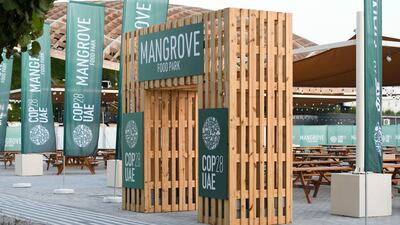
Reused material from palm trees has been used in Cop28 signs across Expo City Dubai. -

Matt Brown, sustainability chief, Expo City Dubai (left) and Yousuf Caires, executive director, Expo Live Innovation Programme, share details of an organic farm and workshops on climate action open to all in the Cop28 green zone. -

Ms Faraidooni says youth engagement is a key component of Cop28. -

A 45-minute musical Alya in Terraland aims to inspire people to participate in climate discussions. -

Sustainable material has been used in the Cop28 signs across Expo City Dubai.


Another challenge lies in the execution of these initiatives, particularly in ensuring transparency and accountability. The availability of grants and incentives for sustainable projects is a step forward but also opens up avenues for misuse. Safeguards must be put in place to prevent “greenwashing”, where projects claim to be sustainable merely to avail of governmental benefits. This would require a robust regulatory mechanism.
Finally, the cultural challenges.
Sustainable finance often calls for a shift in long-standing practices and beliefs. Whether it’s a farmer used to traditional agricultural practices or a business owner sceptical of the return on investment from sustainability measures, changing mindsets is always a slow and arduous process.
Despite these challenges, the fact that these initiatives are being discussed and implemented is a significant positive step. Each challenge provides an opportunity to refine the system, to learn, and to grow. The journey towards sustainable finance is not a sprint but a marathon that requires the collective stamina of government bodies, businesses and communities.
Sustainable finance should not be an esoteric field confined to experts. It’s a practical, accessible strategy for anyone committed to a more equitable and sustainable world. The UAE has the opportunity to be a global leader, not just in words but in action, and this action must start at the grassroots level.
The UAE has the vision, the resources, and most importantly, the people to make this happen. The time has come to seize this moment and collectively set a global example of how community-driven sustainable finance can be the bedrock of a prosperous, equitable and sustainable future.
Sameera Fernandes is director of corporate affairs and sustainability at Century Financial, a Dubai-based financial services provider

