Alexandria Ocasio-Cortez speaks at a news conference in Washington on Monday calling for a ceasefire in Gaza. AFP


Will the Israel-Gaza war break Biden's Democratic Party?


  • English
  • Arabic

November 15, 2023

The Israel-Gaza war has had an explosive and surprising impact on the cohesion of the Democratic Party coalition in the US.

For decades now, the American body politic has been fractured mainly over critical social and cultural issues ranging from race and gender to guns and immigration – more often than not with Republicans on one side and Democrats on the other. Only in rare instances have foreign policy concerns entered the equation, and never in the way that the Palestine-Israel conflict has in recent weeks.

The few occasions when the Middle East has become a deeply partisan issue in the past involved Republicans calling upon Israeli Prime Minister Benjamin Netanyahu to score points against a Democratic president.

The first was when Newt Gingrich, then-speaker of the House of Representatives, invited Mr Netanyahu to address a joint session of Congress to crown the GOP’s efforts to sabotage Bill Clinton’s work in supporting the Oslo peace process. The other was when speaker John Boehner invited Mr Netanyahu to try to defeat Barack Obama’s Iran nuclear deal. Over the long haul, both efforts ultimately bore fruit, putting obstacles in the way of peace and paving the way for Donald Trump’s scuttling the nuclear deal.

As contentious as these issues were, they were largely confined to Washington and never filtered down to the grassroots of politics in the way that the Palestine-Israel issue has in today’s fraught political environment. Both support for the peace process and the Iran deal remained partisan issues and neither had broad appeal, nor mass demonstrations in favour of or opposed to either concern.

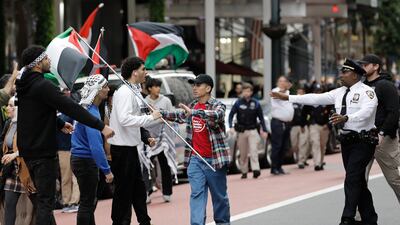
  • A pro-Israel supporter argues with people marching in support of Palestine in New York City. Getty Images
    A pro-Israel supporter argues with people marching in support of Palestine in New York City. Getty Images
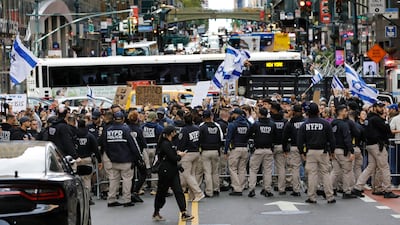
  • New York City Police hold back Israeli supporters during a protest between Palestinian and Israeli demonstrators. EPA
    New York City Police hold back Israeli supporters during a protest between Palestinian and Israeli demonstrators. EPA
  • New York police detain an Israeli supporter during the demonstration. EPA
    New York police detain an Israeli supporter during the demonstration. EPA
  • Israeli and Palestinian supporters on opposite sides of 42nd Street in New York. EPA
    Israeli and Palestinian supporters on opposite sides of 42nd Street in New York. EPA
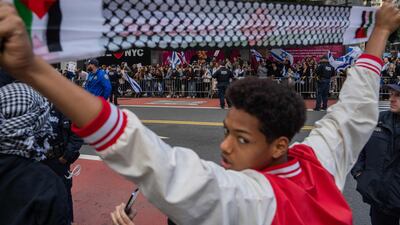
  • Palestinian supporters during a demonstration in New York. EPA
    Palestinian supporters during a demonstration in New York. EPA
  • A New York police chief heads to intervene as Palestinian supporters move closer to Israeli supporters during a protest. EPA
    A New York police chief heads to intervene as Palestinian supporters move closer to Israeli supporters during a protest. EPA
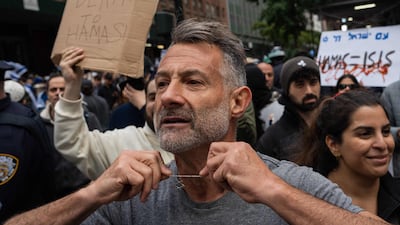
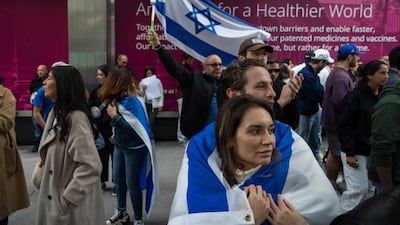
  • A pro-Israel supporter holds up a Star of David necklace during protests near the Israeli Consulate in New York. Getty Images
    A pro-Israel supporter holds up a Star of David necklace during protests near the Israeli Consulate in New York. Getty Images
  • Opposing groups protest in support of Palestine and Israel near the Israeli Consulate in New York. Getty Images
    Opposing groups protest in support of Palestine and Israel near the Israeli Consulate in New York. Getty Images
  • A man prays on the Palestinian flag near the Israeli Consulate in New York. Getty Images
    A man prays on the Palestinian flag near the Israeli Consulate in New York. Getty Images
  • Pro-Israel supporters embrace during protests near the Israeli Consulate in New York. Getty Images
    Pro-Israel supporters embrace during protests near the Israeli Consulate in New York. Getty Images
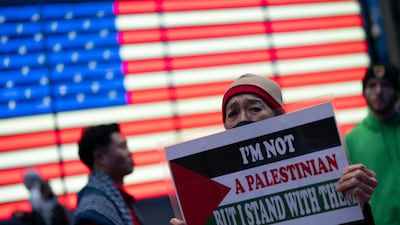
  • A person holds a sign in support of the Palestinian people in Times Square in New York. Getty Images
    A person holds a sign in support of the Palestinian people in Times Square in New York. Getty Images
  • People protest in support of Israel near the Israeli Consulate in New York. Getty Images
    People protest in support of Israel near the Israeli Consulate in New York. Getty Images
What is unfolding in Gaza and in the US has resonated with the very component groups that Democrats have long seen as essential to their electoral victories

Hamas’s October 7 deadly attack in Israel and the now month-long Israeli brutal assault on Gaza have been quite different.

In the first place, these events viscerally affected both of the impacted communities – American Jews and Arab/Palestinian Americans. Seeing the scenes and hearing the reports of the wanton killings, the Jewish community was horrified. It evoked the painful trauma of the Holocaust and pogroms of their past and feelings of their vulnerability.

Palestinians and Arabs recoiled in shock and anger when it became clear from Israel’s devastating bombings of Gaza and the allegedly racist and genocidal language used by Israeli leaders that this wouldn’t be like previous attacks on Gaza.

With thousands dead, one-half of the dwellings in Gaza City and its environs destroyed, and witnessing the scenes of hundreds of thousands of Palestinians fleeing for their lives to an uncertain future in the southern part of the impoverished Strip, Palestinian and Arab Americans saw the Nakba playing out in real time. Here too there was vulnerability and trauma.

To some extent, this drama had a partisan dimension with Republicans, fuelled by their hardline right-wing Christian base, siding with Israel. But while a number of Democratic elected officials also demonstrated their support for Israel, there has been a fracturing of the party’s base.

Pro-Palestinian demonstrations have erupted nationwide, culminating last week in a huge gathering in Washington. Never before has there been such large outpouring of support for Palestinians. And, most significantly, those involved in the mobilisations demanding a ceasefire and Palestinian rights have been extraordinarily diverse, including large contingents of young American Jews, Arab, black, Latino and Asian Americans.

What is unfolding in Gaza and in the US has resonated with the very component groups that Democrats have long seen as essential to their electoral victories. This has never happened before.

When Jesse Jackson raised the issue of Palestinian rights during his two presidential runs in the 1980s, and when Bernie Sanders did the same in the last decade, they were able to mobilise support, to be sure. But this is different in that it is similar to the mass eruption of support that we witnessed in the Women’s March, the anti-Trump Muslim ban, and the Black Lives Matter movement.

But, once again, there is a difference.

Those demonstrations were mobilisations of Democrats and faced no real opposition from the party leadership. The pro-Palestinian demonstrations, on the other hand, have become an intra-party fight, as some pro-Israel groups have mobilised to threaten, demean and punish those who are speaking out against the Israeli assault on Gaza. Campus groups have been disbanded, some Latino and black groups have lost their funding, and outspoken individuals are publicly scorned as anti-Semitic.

The party was already divided on Palestinian rights before October 7, with Democrats having more favourable attitudes toward Palestinians than Israelis. While one may have thought that Hamas’s massacre of civilians would have altered that, as the horrors of the Israeli response became clear, polls are showing that a majority of Democrats are opposed to what Israel is doing and want a ceasefire. And key groups like young people and people of colour remain supportive of Palestinians.

With some pro-Israel groups taking repressive measures against students and others, and announcing that they will spend millions to defeat members of Congress who speak out against Israeli actions or in support of Palestinian rights, a real rupturing of the Democratic coalition is possible.

As all of the congressional representatives who are being threatened are young people of colour, the optics of a pro-Israel group threatening to spend money (raised from a handful of billionaire donors – some of whom are Republicans) will not sit well with other Democrats.

If the party’s leadership wants to succeed in 2024 and beyond, they will need to intervene to tamp down this behaviour.

Debate and reasoned discourse should be encouraged. But threats should be stopped before the division is too deep and it’s too late to turn back.

Live updates: Follow the latest news on Israel-Gaza

Cinco in numbers

Dh3.7 million

The estimated cost of Victoria Swarovski’s gem-encrusted Michael Cinco wedding gown

46

The number, in kilograms, that Swarovski’s wedding gown weighed.

1,000

The hours it took to create Cinco’s vermillion petal gown, as seen in his atelier [note, is the one he’s playing with in the corner of a room]

50

How many looks Cinco has created in a new collection to celebrate Ballet Philippines’ 50th birthday

3,000

The hours needed to create the butterfly gown worn by Aishwarya Rai to the 2018 Cannes Film Festival.

1.1 million

The number of followers that Michael Cinco’s Instagram account has garnered.

Tonight's Chat on The National

Tonight's Chat is a series of online conversations on The National. The series features a diverse range of celebrities, politicians and business leaders from around the Arab world.

Tonight’s Chat host Ricardo Karam is a renowned author and broadcaster who has previously interviewed Bill Gates, Carlos Ghosn, Andre Agassi and the late Zaha Hadid, among others.

Intellectually curious and thought-provoking, Tonight’s Chat moves the conversation forward.

Facebook | Our website | Instagram

UAE currency: the story behind the money in your pockets
'The Lost Daughter'

Director: Maggie Gyllenhaal

Starring: Olivia Colman, Jessie Buckley, Dakota Johnson

Rating: 4/5

Previous men's records
  • 2:01:39: Eliud Kipchoge (KEN) on 16/9/19 in Berlin
  • 2:02:57: Dennis Kimetto (KEN) on 28/09/2014 in Berlin
  • 2:03:23: Wilson Kipsang (KEN) on 29/09/2013 in Berlin
  • 2:03:38: Patrick Makau (KEN) on 25/09/2011 in Berlin
  • 2:03:59: Haile Gebreselassie (ETH) on 28/09/2008 in Berlin
  • 2:04:26: Haile Gebreselassie (ETH) on 30/09/2007 in Berlin
  • 2:04:55: Paul Tergat (KEN) on 28/09/2003 in Berlin
  • 2:05:38: Khalid Khannouchi (USA) 14/04/2002 in London
  • 2:05:42: Khalid Khannouchi (USA) 24/10/1999 in Chicago
  • 2:06:05: Ronaldo da Costa (BRA) 20/09/1998 in Berlin
Ten tax points to be aware of in 2026

1. Domestic VAT refund amendments: request your refund within five years

If a business does not apply for the refund on time, they lose their credit.

2. E-invoicing in the UAE

Businesses should continue preparing for the implementation of e-invoicing in the UAE, with 2026 a preparation and transition period ahead of phased mandatory adoption. 

3. More tax audits

Tax authorities are increasingly using data already available across multiple filings to identify audit risks. 

4. More beneficial VAT and excise tax penalty regime

Tax disputes are expected to become more frequent and more structured, with clearer administrative objection and appeal processes. The UAE has adopted a new penalty regime for VAT and excise disputes, which now mirrors the penalty regime for corporate tax.

5. Greater emphasis on statutory audit

There is a greater need for the accuracy of financial statements. The International Financial Reporting Standards standards need to be strictly adhered to and, as a result, the quality of the audits will need to increase.

6. Further transfer pricing enforcement

Transfer pricing enforcement, which refers to the practice of establishing prices for internal transactions between related entities, is expected to broaden in scope. The UAE will shortly open the possibility to negotiate advance pricing agreements, or essentially rulings for transfer pricing purposes. 

7. Limited time periods for audits

Recent amendments also introduce a default five-year limitation period for tax audits and assessments, subject to specific statutory exceptions. While the standard audit and assessment period is five years, this may be extended to up to 15 years in cases involving fraud or tax evasion. 

8. Pillar 2 implementation 

Many multinational groups will begin to feel the practical effect of the Domestic Minimum Top-Up Tax (DMTT), the UAE's implementation of the OECD’s global minimum tax under Pillar 2. While the rules apply for financial years starting on or after January 1, 2025, it is 2026 that marks the transition to an operational phase.

9. Reduced compliance obligations for imported goods and services

Businesses that apply the reverse-charge mechanism for VAT purposes in the UAE may benefit from reduced compliance obligations. 

10. Substance and CbC reporting focus

Tax authorities are expected to continue strengthening the enforcement of economic substance and Country-by-Country (CbC) reporting frameworks. In the UAE, these regimes are increasingly being used as risk-assessment tools, providing tax authorities with a comprehensive view of multinational groups’ global footprints and enabling them to assess whether profits are aligned with real economic activity. 

Contributed by Thomas Vanhee and Hend Rashwan, Aurifer

Mercer, the investment consulting arm of US services company Marsh & McLennan, expects its wealth division to at least double its assets under management (AUM) in the Middle East as wealth in the region continues to grow despite economic headwinds, a company official said.

Mercer Wealth, which globally has $160 billion in AUM, plans to boost its AUM in the region to $2-$3bn in the next 2-3 years from the present $1bn, said Yasir AbuShaban, a Dubai-based principal with Mercer Wealth.

Within the next two to three years, we are looking at reaching $2 to $3 billion as a conservative estimate and we do see an opportunity to do so,” said Mr AbuShaban.

Mercer does not directly make investments, but allocates clients’ money they have discretion to, to professional asset managers. They also provide advice to clients.

“We have buying power. We can negotiate on their (client’s) behalf with asset managers to provide them lower fees than they otherwise would have to get on their own,” he added.

Mercer Wealth’s clients include sovereign wealth funds, family offices, and insurance companies among others.

From its office in Dubai, Mercer also looks after Africa, India and Turkey, where they also see opportunity for growth.

Wealth creation in Middle East and Africa (MEA) grew 8.5 per cent to $8.1 trillion last year from $7.5tn in 2015, higher than last year’s global average of 6 per cent and the second-highest growth in a region after Asia-Pacific which grew 9.9 per cent, according to consultancy Boston Consulting Group (BCG). In the region, where wealth grew just 1.9 per cent in 2015 compared with 2014, a pickup in oil prices has helped in wealth generation.

BCG is forecasting MEA wealth will rise to $12tn by 2021, growing at an annual average of 8 per cent.

Drivers of wealth generation in the region will be split evenly between new wealth creation and growth of performance of existing assets, according to BCG.

Another general trend in the region is clients’ looking for a comprehensive approach to investing, according to Mr AbuShaban.

“Institutional investors or some of the families are seeing a slowdown in the available capital they have to invest and in that sense they are looking at optimizing the way they manage their portfolios and making sure they are not investing haphazardly and different parts of their investment are working together,” said Mr AbuShaban.

Some clients also have a higher appetite for risk, given the low interest-rate environment that does not provide enough yield for some institutional investors. These clients are keen to invest in illiquid assets, such as private equity and infrastructure.

“What we have seen is a desire for higher returns in what has been a low-return environment specifically in various fixed income or bonds,” he said.

“In this environment, we have seen a de facto increase in the risk that clients are taking in things like illiquid investments, private equity investments, infrastructure and private debt, those kind of investments were higher illiquidity results in incrementally higher returns.”

The Abu Dhabi Investment Authority, one of the largest sovereign wealth funds, said in its 2016 report that has gradually increased its exposure in direct private equity and private credit transactions, mainly in Asian markets and especially in China and India. The authority’s private equity department focused on structured equities owing to “their defensive characteristics.”

Email sent to Uber team from chief executive Dara Khosrowshahi

From: Dara

To: Team@

Date: March 25, 2019 at 11:45pm PT

Subj: Accelerating in the Middle East

Five years ago, Uber launched in the Middle East. It was the start of an incredible journey, with millions of riders and drivers finding new ways to move and work in a dynamic region that’s become so important to Uber. Now Pakistan is one of our fastest-growing markets in the world, women are driving with Uber across Saudi Arabia, and we chose Cairo to launch our first Uber Bus product late last year.

Today we are taking the next step in this journey—well, it’s more like a leap, and a big one: in a few minutes, we’ll announce that we’ve agreed to acquire Careem. Importantly, we intend to operate Careem independently, under the leadership of co-founder and current CEO Mudassir Sheikha. I’ve gotten to know both co-founders, Mudassir and Magnus Olsson, and what they have built is truly extraordinary. They are first-class entrepreneurs who share our platform vision and, like us, have launched a wide range of products—from digital payments to food delivery—to serve consumers.

I expect many of you will ask how we arrived at this structure, meaning allowing Careem to maintain an independent brand and operate separately. After careful consideration, we decided that this framework has the advantage of letting us build new products and try new ideas across not one, but two, strong brands, with strong operators within each. Over time, by integrating parts of our networks, we can operate more efficiently, achieve even lower wait times, expand new products like high-capacity vehicles and payments, and quicken the already remarkable pace of innovation in the region.

This acquisition is subject to regulatory approval in various countries, which we don’t expect before Q1 2020. Until then, nothing changes. And since both companies will continue to largely operate separately after the acquisition, very little will change in either teams’ day-to-day operations post-close. Today’s news is a testament to the incredible business our team has worked so hard to build.

It’s a great day for the Middle East, for the region’s thriving tech sector, for Careem, and for Uber.

Uber on,

Dara

Avatar: Fire and Ash

Director: James Cameron

Starring: Sam Worthington, Sigourney Weaver, Zoe Saldana

Rating: 4.5/5

SPEC%20SHEET%3A%20APPLE%20M3%20MACBOOK%20AIR%20(13%22)
%3Cp%3E%3Cstrong%3EProcessor%3A%3C%2Fstrong%3E%20Apple%20M3%2C%208-core%20CPU%2C%20up%20to%2010-core%20CPU%2C%2016-core%20Neural%20Engine%3C%2Fp%3E%0A%3Cp%3E%3Cstrong%3EDisplay%3A%3C%2Fstrong%3E%2013.6-inch%20Liquid%20Retina%2C%202560%20x%201664%2C%20224ppi%2C%20500%20nits%2C%20True%20Tone%2C%20wide%20colour%3C%2Fp%3E%0A%3Cp%3E%3Cstrong%3EMemory%3A%3C%2Fstrong%3E%208%2F16%2F24GB%3C%2Fp%3E%0A%3Cp%3E%3Cstrong%3EStorage%3A%3C%2Fstrong%3E%20256%2F512GB%20%2F%201%2F2TB%3C%2Fp%3E%0A%3Cp%3E%3Cstrong%3EI%2FO%3A%3C%2Fstrong%3E%20Thunderbolt%203%2FUSB-4%20(2)%2C%203.5mm%20audio%2C%20Touch%20ID%3C%2Fp%3E%0A%3Cp%3E%3Cstrong%3EConnectivity%3A%3C%2Fstrong%3E%20Wi-Fi%206E%2C%20Bluetooth%205.3%3C%2Fp%3E%0A%3Cp%3E%3Cstrong%3EBattery%3A%3C%2Fstrong%3E%2052.6Wh%20lithium-polymer%2C%20up%20to%2018%20hours%2C%20MagSafe%20charging%3C%2Fp%3E%0A%3Cp%3E%3Cstrong%3ECamera%3A%3C%2Fstrong%3E%201080p%20FaceTime%20HD%3C%2Fp%3E%0A%3Cp%3E%3Cstrong%3EVideo%3A%3C%2Fstrong%3E%20Support%20for%20Apple%20ProRes%2C%20HDR%20with%20Dolby%20Vision%2C%20HDR10%3C%2Fp%3E%0A%3Cp%3E%3Cstrong%3EAudio%3A%3C%2Fstrong%3E%204-speaker%20system%2C%20wide%20stereo%2C%20support%20for%20Dolby%20Atmos%2C%20Spatial%20Audio%20and%20dynamic%20head%20tracking%20(with%20AirPods)%3C%2Fp%3E%0A%3Cp%3E%3Cstrong%3EColours%3A%3C%2Fstrong%3E%20Midnight%2C%20silver%2C%20space%20grey%2C%20starlight%3C%2Fp%3E%0A%3Cp%3E%3Cstrong%3EIn%20the%20box%3A%3C%2Fstrong%3E%20MacBook%20Air%2C%2030W%2F35W%20dual-port%2F70w%20power%20adapter%2C%20USB-C-to-MagSafe%20cable%2C%202%20Apple%20stickers%3C%2Fp%3E%0A%3Cp%3E%3Cstrong%3EPrice%3A%3C%2Fstrong%3E%20From%20Dh4%2C599%3C%2Fp%3E%0A

Also on December 7 to 9, the third edition of the Gulf Car Festival (www.gulfcarfestival.com) will take over Dubai Festival City Mall, a new venue for the event. Last year's festival brought together about 900 cars worth more than Dh300 million from across the Emirates and wider Gulf region – and that first figure is set to swell by several hundred this time around, with between 1,000 and 1,200 cars expected. The first day is themed around American muscle; the second centres on supercars, exotics, European cars and classics; and the final day will major in JDM (Japanese domestic market) cars, tuned vehicles and trucks. Individuals and car clubs can register their vehicles, although the festival isn’t all static displays, with stunt drifting, a rev battle, car pulls and a burnout competition.

Updated: November 15, 2023, 8:37 AM