


It is with heavy hearts and infinite sadness that we follow the news from Gaza.
The region has had its share of violence but never on this calamitous scale. The tremendous loss of innocent civilian lives and the extensive destruction of nuclear proportions in the occupied territory has shocked the world.
The protests around the world have been hitherto unseen, and they are an expression of global conscience and solidarity with the people of Gaza who have been dragged into this war without having a say.
Different and opposing narratives have been promoted but none justify the cruel onslaught, least of all that of the right of Israel for self-defence. Current events cannot be taken out of context of decades of occupation, siege, misery and injustice. For too long, the plight of the Palestinians has been ignored, as well as the relevant UN Security Council Resolutions and international laws.
A just and lasting peace is more urgent than ever.
The 2002 Arab Peace Initiative needs to be revisited as the basis of a comprehensive plan that acknowledges the right of the Palestinians to have their independent state with East Jerusalem as its capital. We have learnt that no peace and stability in this region is possible if we fail to address the central issue of Palestinian rights.
-
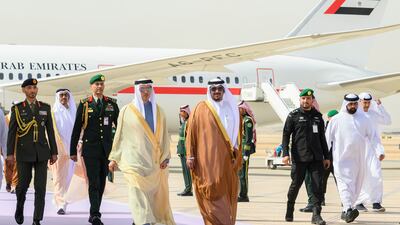
Sheikh Mansour bin Zayed, UAE Vice President, is received by Prince Mohammed bin Abdulrahman, Acting Governor of the Riyadh Region, at King Khalid International Airport. UAE Presidential Court -
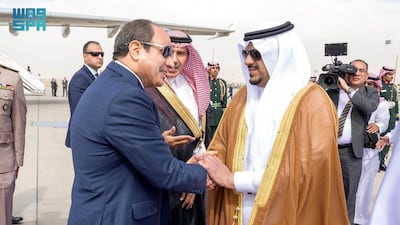
Egypt President Abdel Fattah El-Sisi arrives in Riyadh. SPA -
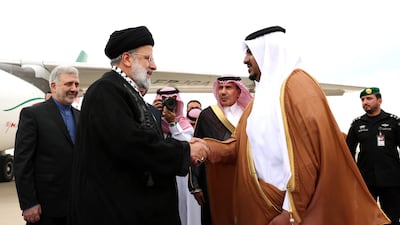
Iranian President Ebrahim Raisi, left, is received at the airport in Riyadh. Mr Raisi is in Saudi Arabia to attend the Organisation of Islamic Countries leaders' summit on Palestine and will likely meet high-ranking Saudi officials for the first time since the restoration of bilateral ties between Tehran and Riyadh. EPA -
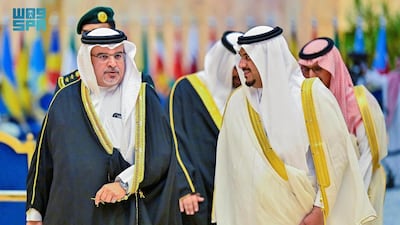
Bahrain's Crown Prince and Prime Minister, Sheikh Salman bin Hamad Al Khalifa, arrives for the OIC summit. SPA -
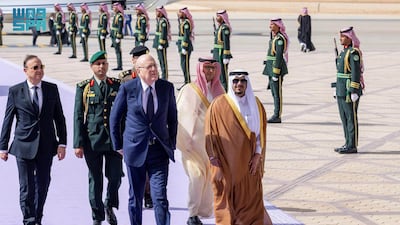
Lebanese Prime Minister Najib Mikati arrives in Riyadh. SPA -
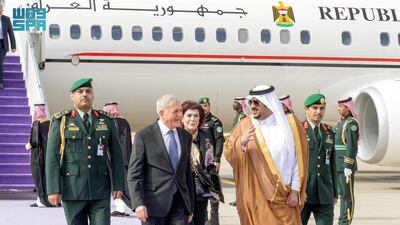
Iraqi President Abdul Latif Rashid arrives. SPA -
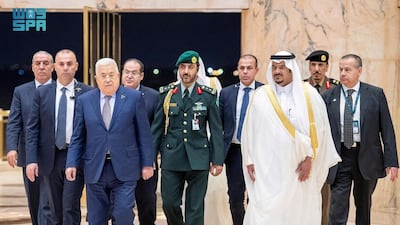
Palestinian President Mahmoud Abbas, third left, is welcomed at the airport. SPA -

Uzbekistan's Prime Minister, Abdulla Aripov, second left, arrives in Riyadh. SPA -
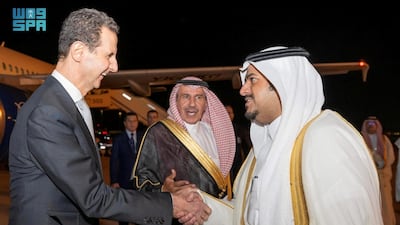
Syria's President Bashar Al Assad arrives for the OIC summit in Riyadh. SPA -
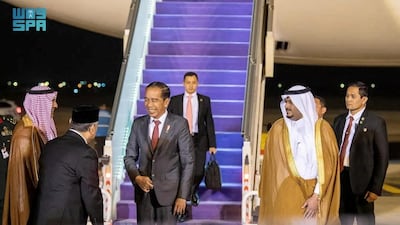
Indonesian President Joko Widodo arrives in Riyadh to attend the OIC summit. SPA -
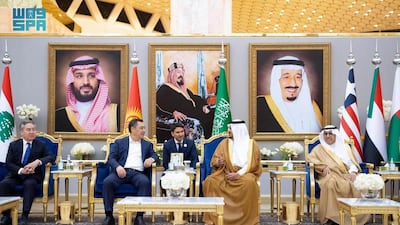
The President of the Kyrgyz Republic, Sadyr Japarov, in Riyadh. SPA


In a desperate attempt to woo western audiences and justify the level of violence, a reframing of the conflict is presented to undermine the Palestinian dimension. The conflict is said to be part of the war on terror, similar in many ways to the war on ISIS, thereby justifying collateral damage.
An even more sinister attempt is being made to label the conflict as a civilisational war – the West against the rest – as if we are still in the times of the Crusades. This confuses cause with consequence: such tensions are the outcome of the violence against Gaza and not the reason for it.
It is true that the Israel-Gaza war has created a major rift between East and West, perhaps more so than after 9/11. We have seen that the cultural and interfaith ramifications of the ongoing conflict are enormous. They should be reasons for us to stop the bombing of Gaza at any cost, to avoid consequences that can escalate the conflict and give it a global dimension. Presenting the war as an inevitable clash of civilisations is a false rationale to validate its continuation.
The alarming rise in anti-Semitism and Islamophobia is a symptom of growing interfaith tensions that could reverse years of progress in that field. The recent split in the UN General Assembly vote on the Arab proposition attests to the alarming East-West rift resulting from the war.
We must not fall into the trap of extremists, who are opposed to a just settlement and are responsible for its failure. This attempt at dividing the world along cultural and religious lines is going to fail. There are more values, principles and interests that bring us together.
The first, and most urgent, step is to secure a ceasefire, in order to stop further deteriorations. Then a political process is to be immediately initiated. It should involve the Arab League, the Organisation of Islamic Co-operation, and it requires collaboration with Europe, the US, as well as the UN Security Council.

This is a time when wisdom should trump emotion. History will hold us all accountable if we fail – and we cannot, and should not, fail.
The implementation of international resolutions and the establishment of an independent and viable Palestinian state should be our top priority. It should meet the aspirations of the Palestinian people and ensure security for all, foremost of all the warring parties.
It has been more than 30 years since the Madrid Middle East Peace Conference and the launch of the Oslo Peace Process, following which the Security Council failed to take the necessary measures to implement its relevant resolutions, thus succumbing to the agendas of the extremists.
Over the years, numerous studies have been undertaken, reports prepared, and meetings and consultations held, in which every aspect of the conflict has been dissected. If we do not have all the just answers now, we never will.
Resolutions drafted at the joint Arab-Islamic nations summit over the weekend in Riyadh – comprised of 57 countries – unanimously called for an immediate ceasefire. This set of resolutions should be considered a strong and serious message to the whole world that it is high time to move now, in lock step, towards a comprehensive, just and permanent peace.
Like many others in the Arab world, I applaud the moral and unwavering stance of UN Secretary General Antonio Guterres on the Palestinian issue as well as on the larger Arab-Israeli conflict. A bold and noble effort is needed to stop this bloodshed.
This is not a civilisational war, nor is this a war on terror, and we must not let emotions lead us to further destruction.
Live updates: Follow the latest news on Israel-Gaza

