


Global pressure on Israel has started to take the form of a soft ultimatum amid growing co-operation between American and European countries, as well as between Arab and other Muslim countries.
Meanwhile, the Gulf countries are providing humanitarian support to Gaza and closely co-operating with Egypt, Jordan and the Palestinian Authority to establish a pragmatic de-escalation strategy, outlining the path towards “lasting peace”.
Currently, these efforts are clashing with Israel’s rejection of ceasefire calls until its stated mission of destroying Hamas is accomplished – no matter the humanitarian cost to the people of Gaza and the political cost to world leaders, and no matter how long it would take. However, prolonging the war will not serve Israel’s official objective, nor will it succeed in indefinitely displacing Palestinians to southern Gaza or beyond the occupied territory – as some extremist elements in the government have called for.
US President Joe Biden cannot issue a blank cheque to Israeli Prime Minister Benjamin Netanyahu and his military to proceed with the alleged ethnic cleansing of Gaza under the pretext of purging Hamas. Similarly, European governments are not willing to endorse the fantasies of extremist elements within the Israel government under the pretext of self-defence. Regional security is crucial to Europe, as it is to the US and other G7 member states. The consequences of endorsing such actions could cost the leadership in all these countries.
During a meeting in Tokyo earlier in the week, G7 foreign ministers affirmed their support for “ceasefires and humanitarian corridors” and discussed ways to revive peace efforts on the “day after” once the conflict subsides. They emphasised the two-state solution principle as the only way to settle the conflict. They also condemned Hamas’s attack and called on Iranian authorities to refrain from supporting the group as well as its Lebanese proxy Hezbollah.
-
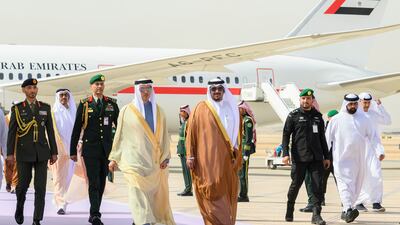
Sheikh Mansour bin Zayed, UAE Vice President, is received by Prince Mohammed bin Abdulrahman, Acting Governor of the Riyadh Region, at King Khalid International Airport. UAE Presidential Court -
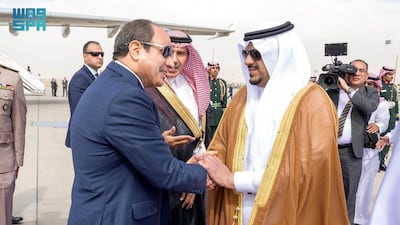
Egypt President Abdel Fattah El-Sisi arrives in Riyadh. SPA -
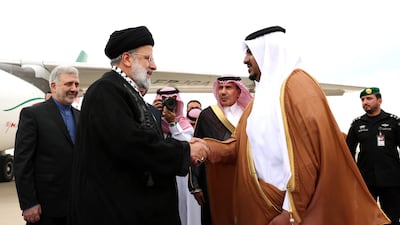
Iranian President Ebrahim Raisi, left, is received at the airport in Riyadh. Mr Raisi is in Saudi Arabia to attend the Organisation of Islamic Countries leaders' summit on Palestine and will likely meet high-ranking Saudi officials for the first time since the restoration of bilateral ties between Tehran and Riyadh. EPA -
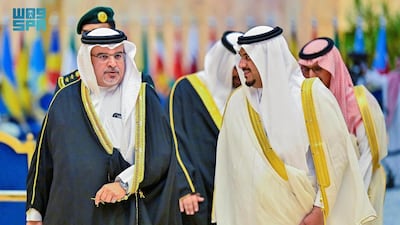
Bahrain's Crown Prince and Prime Minister, Sheikh Salman bin Hamad Al Khalifa, arrives for the OIC summit. SPA -
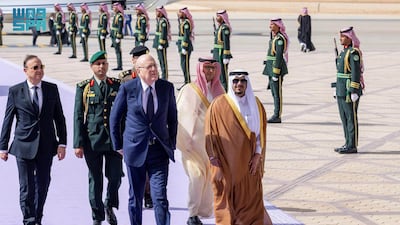
Lebanese Prime Minister Najib Mikati arrives in Riyadh. SPA -
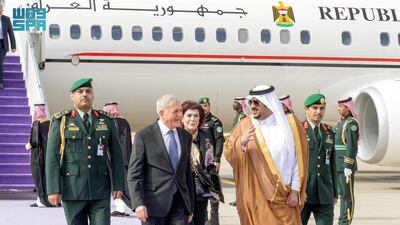
Iraqi President Abdul Latif Rashid arrives. SPA -
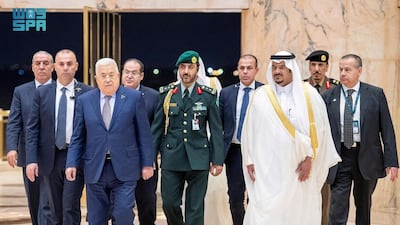
Palestinian President Mahmoud Abbas, third left, is welcomed at the airport. SPA -

Uzbekistan's Prime Minister, Abdulla Aripov, second left, arrives in Riyadh. SPA -
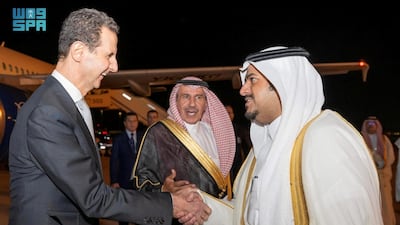
Syria's President Bashar Al Assad arrives for the OIC summit in Riyadh. SPA -
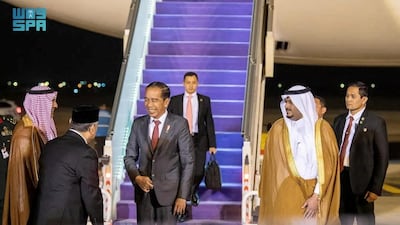
Indonesian President Joko Widodo arrives in Riyadh to attend the OIC summit. SPA -
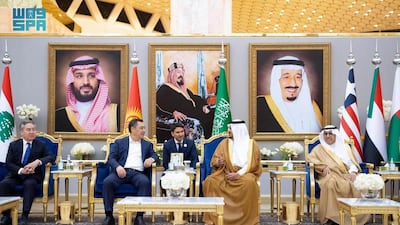
The President of the Kyrgyz Republic, Sadyr Japarov, in Riyadh. SPA


The final statement underscored that G7 members, alongside their regional partners, are working to prevent the expansion of the conflict in the Middle East and are collaborating, including on sanctions and other measures, to prevent Hamas from receiving financing.
Interestingly, some of the rhetoric around the issue of sanctions was heard in the context of Israel’s war effort.
Belgian Deputy Prime Minister Petra De Sutter recently said that it was time to impose sanctions on Israel for its “inhumane” bombing campaign in Gaza, adding that it was clear that Israel does not care about international calls for a ceasefire. She said that the EU should immediately suspend its economic and political co-operation partnership agreement with Israel, calling for banning Israeli politicians and soldiers responsible for “war crimes” from entering the continent.
The Belgian leader’s position is, however, an exception. It is also confined to a minority in Europe and unlikely to be echoed across the Atlantic. Indeed, in the US, it is inconceivable that either Republicans or Democrats would impose sanctions on Israel. Which also explains why Israel persists with its actions.
Still, the problem for Mr Biden is that American public opinion is shifting away from unconditional and unlimited support for Israel. The Democratic Party is divided to the extent that opposition to Israeli actions from its left flank, and from Arab-American voters, could jeopardise Mr Biden’s electoral prospects.
While Mr Netanyahu might view calling a ceasefire as tantamount to bringing about his own political undoing, Mr Biden could face political upheaval if he submits to Israel’s rejection of a ceasefire.
Interestingly, large sections of European and American societies believe that the solution to the Palestinian-Israeli conflict lies in Egypt welcoming millions of Palestinians into the Sinai Peninsula with substantial international assistance, primarily from Arab countries. This is in addition to the demand for other Arab countries to rehabilitate thousands of Palestinians within their boundaries.
The response in Arab and international circles, not to be disregarded in its size and magnitude, is that it is unacceptable to uproot an entire people from their homes in a process of ethnic cleansing that ends with Israel seizing Gaza, with its idyllic coastline, offshore gas resources, and its strategically advantageous location for the Ben Gurion Canal project.
Many people around the world, particularly youth, oppose Israel’s actions in Gaza while at the same time condemning Hamas for holding hostages and allegedly hiding under hospitals. And even though Israel sees an opportunity to destroy the military and command infrastructure of Hamas, it knows that it cannot erase the group politically.

And so, it wants the US, Europe and others to demand that Arab countries, Turkey and Iran provide guarantees to ensure that Hamas or similar organisations cannot repeat the events of October 7.
For their part, Arab and Islamic nations are putting up a united front in response to the current conflict.
After concluding three days of talks on their collective response and action regarding the developments in Gaza over the weekend, the joint Arab League and Organisation of Islamic Co-operation summit called for an arms embargo against Israel. The leaders also called on the International Criminal Court to complete its investigation into alleged war crimes committed by Israel against the Palestinian people in all the occupied territories, including East Jerusalem.
Amid all this, it is important to take a long view.
The UAE, for instance, continues to emphasise the need for a de-escalation of all conflicts across the Middle East, including the one involving Israel and the differences other countries have with Iran.
Three years ago, Dr Anwar Gargash, diplomatic adviser to the UAE President, first mentioned the policy of “de-escalation” in the virtual political circles of the fourth Beirut Institute Summit in Abu Dhabi. Last week, while speaking at the World Policy Conference on Saadiyat Island, he pointed out that the October 7 attack proved that the policy of “containment” had failed.
“Containment has limitations, and we need to find solutions today,” Dr Gargash said, while highlighting the opportunity that the US has to play the role of “problem solver” in the region, and stating that the UAE is among the “most constructive”, albeit not the loudest countries, in working quietly to find solutions.
To echo this sentiment, the Israel-Gaza war indeed demands bold leadership from all the stakeholders.
The Palestinian Authority has a chance to renew itself after years of failing to use the Arab and international readiness to assist it. The Biden administration should dare to compel Israel to cease its actions. For its part, Iran should dare to restrain its proxies from further pyrrhic victories.
Everyone is watching and waiting, especially now.
Live updates: Follow the latest news on Israel-Gaza

